 Retro Replay Retro Gaming History, Reviews & Emulation



Retro Replay Review
Gameplay
The first hour has a satisfying, no-nonsense rhythm. You pick a ruler, assess the provinces around you, and immediately have to balance long-term conquest against the unglamorous work of keeping an army supplied and funded. Sangokushi does not bury you under an enormous simulation; compared with the broader Romance of the Three Kingdoms formula, it pares the political and military game down to a more approachable core.
Diplomacy matters because it is one of the few ways to shape the board before marching. Sending offerings or missions to another ruler can make a neighboring power less urgent, letting you focus resources elsewhere. You also manage commanders, finances, and provisions, so expansion is never just a matter of picking a target and hoping your armies can carry the day. If you enjoy making a modest plan, seeing its weak point, then revising it before the next turn, this has the right kind of tension.
Invasions move onto a tactical hex grid, which is where the game becomes more immediate. Positioning troops and navigating them across the map is clear turn-based strategy, while combat itself triggers automatically when opposing units stand adjacent. That trade-off will divide you. You retain the responsibility for arranging the encounter, but not control over every exchange once it begins. It can be frustrating when a carefully prepared advance turns on a battle you cannot directly steer, yet it also keeps wars moving and puts the emphasis squarely on maneuver.
The lack of scenario selection makes the campaign feel more fixed than a strategy sandbox. You are working from a single broad wartime situation rather than browsing alternate starts, so replay value comes chiefly from taking command of a different warlord and pursuing dominance from another position. That limitation is easier to accept if you want a concentrated campaign rather than endless historical what-ifs.

Graphics
The battles use a top-down tactical view built around a hexagonal grid. That is the important visual choice here: it gives troop placement and adjacent engagements an easy-to-follow shape when armies begin closing in on each other.

Story
This is a Three Kingdoms conquest story first and foremost, set during the struggle in which Liu Bei and Cao Cao stand as the main opposing forces. The goal is not to shepherd a tightly scripted tale from scene to scene; it is to seize the historical struggle for yourself through diplomacy, administration, and war.
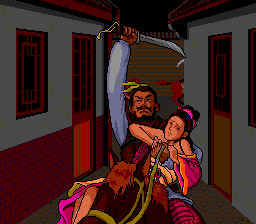
Liu Bei serves as the default ruler and receives an extended introduction, along with personal motivations that draw from Luo Guanzhong’s famous novelized version of the era. That gives a newcomer a more clearly framed entrance than the other available rulers and makes Liu Bei the sensible first choice if you want a little context before the map takes over.
Choosing another one of the six renowned warlords shifts the perspective, but the central dramatic question remains the same: can your chosen leader build relationships, gather the means to fight, and outlast every rival? The story works best when you bring some enthusiasm for the period. Without that, the political names and territorial push may feel functional rather than stirring.
Overall Experience
Sangokushi: Eiketsu Tenka ni Nozomu is a compact historical strategy game that understands where its strongest moments are. The pre-war decisions create pressure, and the hex-grid invasions give that pressure a concrete payoff. It lacks the breadth and scenario variety that can make this genre endlessly replayable, but its simpler structure also makes it easier to get your bearings.
The automatic battles are the major point of friction. If your favorite part of strategy games is selecting every attack and controlling every confrontation, they may feel like an unwelcome loss of agency. If you care more about the choices that put armies into favorable positions, the system has a clean logic: command the campaign, arrange the clash, and live with the consequences.
Give it a chance if you want a brisk, old-school take on Three Kingdoms statecraft that does not demand mastery of an enormous rulebook. Start with Liu Bei for the fuller introduction, learn how provisions and diplomacy protect an emerging power, and treat every invasion as a positioning puzzle rather than a chance to win through battlefield micromanagement. The payoff is a disciplined conquest game whose best decisions happen just before the fighting starts.



Reviews
There are no reviews yet.