 Retro Replay Retro Replay gaming reviews, news, emulation, geek stuff and more!



Retro Replay Review
Gameplay
Battle Valley delivers a classic side-view shoot ’em up experience that emphasizes both strategic vehicle management and fast-paced action. From the moment you start, the dual-objective of retrieving two stolen nuclear warheads sets a tense pace—each weapon sits at opposite ends of the map, and you’re free to choose your path. This non-linear structure adds depth, allowing you to assess enemy layouts and decide whether to tackle the northern stronghold first or to push southward before the clock winds down.
(HEY YOU!! We hope you enjoy! We try not to run ads. So basically, this is a very expensive hobby running this site. Please consider joining us for updates, forums, and more. Network w/ us to make some cash or friends while retro gaming, and you can win some free retro games for posting. Okay, carry on 👍)
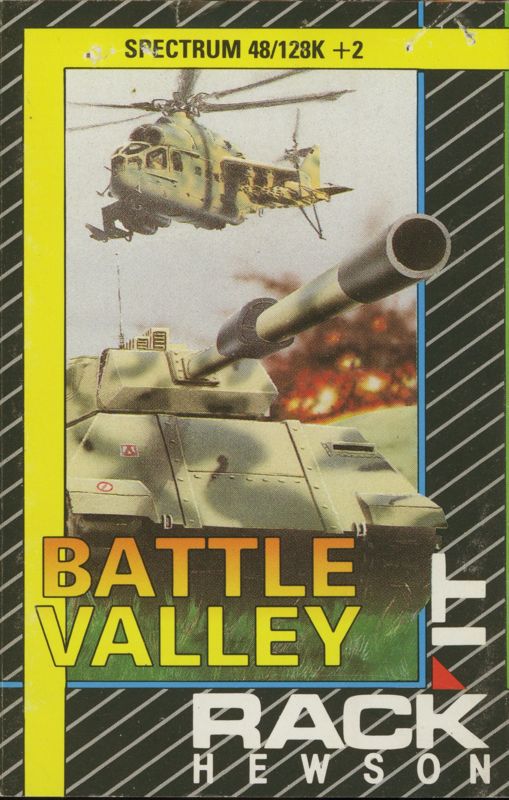
The game’s signature mechanic is alternating between a helicopter and a tank, each offering distinct advantages. In helicopter mode, you can hover over hazards, snipe at airborne enemies, and repair damaged bridges with well-aimed missiles. The agility of the chopper comes at the cost of vulnerability; one direct hit can send you crashing. Conversely, the tank is a slow but heavily armored workhorse, perfect for breezing through fortified ground positions once the bridges are restored. Mastering the ebb and flow between these two vehicles is both challenging and rewarding.
Time plays a critical role: you start with 4000 seconds on the clock, and every lost life deducts 500 seconds. This ticking timer injects urgency into every decision, forcing you to weigh the risks of repairing a far-off bridge versus pushing onward to the next enemy bunker. Risk-and-reward scenarios compound as waves of terrorists—infantry, attack helicopters, anti-aircraft guns, and mobile artillery—try to thwart your progress. Success hinges on balancing swift movement, precise shooting, and smart use of vehicle-switch points at the base.
Graphics
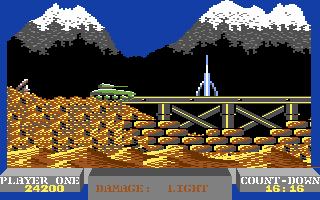
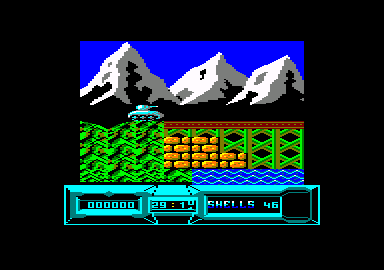
Visually, Battle Valley embraces the 8-bit era’s charm with crisp, colorful sprites and detailed side-scrolling backgrounds. The terrain shifts subtly as you advance—from desert outposts and ruined bridges to dense forest canopies—providing variety that keeps the eye engaged. Enemy designs are distinct: you can easily recognize ground troops, missile batteries, and the ominous black helicopters that require focused firepower to take down.
Animation is where the game truly shines for its time. Explosions ripple across the screen, vehicles recoil realistically when hit, and missiles arc with convincing physics as they repair or demolish structures. The transition animations between helicopter and tank modes are smooth, ensuring that the switch feels responsive rather than clumsy. Even under heavy enemy fire, the frame rate remains steady, preserving gameplay fluidity.
While limited by the technology of its era, the game uses a bold, contrasting color palette to differentiate friend from foe, and to highlight interactive elements like repairable bridges. Subtle parallax scrolling adds depth to the background layers, giving a sense of forward momentum as you press into enemy territory. Overall, the graphical presentation supports the game’s tense atmosphere and complements the core mechanics without overstaying its welcome.
Story
Battle Valley’s narrative is straightforward but effective: two nuclear warheads have been stolen by a terrorist organization and hidden at opposite ends of a hostile region. Your mission, as the lone operative, is to infiltrate these strongholds, neutralize enemy forces, and secure the weapons before they can be deployed. The urgency of this high-stakes rescue mission underpins every bullet fired and every bridge you rebuild.
There’s minimal in-game dialogue or cutscenes, but the context is conveyed through mission briefings and environmental storytelling. Crumbling fortresses, scorched earth, and downed helicopters allude to past battles and raise the narrative tension. Each segment of the map feels like a chapter, with its own set of obstacles—whether it’s a minefield you need to navigate under tank armor or a wave of jet fighters you must repel from the air.
While some players may long for a deeper plot or character development, Battle Valley’s streamlined story keeps the focus firmly on action and strategy. The simplicity is part of its appeal: there’s no time-wasting subplots, just a relentless push toward the enemy’s lair. For fans of arcade-style shooters who appreciate a classic “save the world” premise, the narrative scaffold is just robust enough to motivate and immerse you.
Overall Experience
Battle Valley stands out as a cleverly designed hybrid shooter that demands both quick reflexes and thoughtful planning. The innovative use of two distinct vehicles, each with its own strengths and weaknesses, brings a refreshing layer of strategy uncommon in many side-scrollers of its time. The tension of managing a finite time resource amplifies every skirmish, ensuring that each playthrough feels urgent and meaningful.
For newcomers, the learning curve can be steep: knowing when to switch vehicles, how to allocate limited ammunition, and how best to repair crucial infrastructure under fire takes practice. But once you grasp the rhythm—air strike, bridge repair, tank advance—the game becomes a thrilling push-pull of offense and defense. Replay value is high as you refine your routes, shave precious seconds off your run, and experiment with different approaches to enemy strongholds.
Despite its dated presentation by modern standards, Battle Valley offers an engaging retro experience that still holds up for enthusiasts of classic shooters. Its blend of strategic vehicle swapping, time management, and relentless action provides a satisfying challenge. If you’re looking for a concise, action-packed arcade adventure that rewards both skill and tactical thinking, Battle Valley is well worth your time.


Reviews
There are no reviews yet.