 Retro Replay Retro Replay gaming reviews, news, emulation, geek stuff and more!

Retro Replay Review
Gameplay
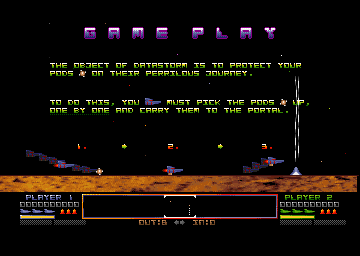
Datastorm’s core gameplay loop takes direct inspiration from the classic Defender formula, tasking you with navigating a horizontally‐scrolling landscape that loops seamlessly from end to end. Your objective is simple yet addictive: locate each of the eight rescue pods scattered across the level, pick one up, and ferry it through a portal to safety. Once a pod is delivered, you head straight back into the fray for the next, with the level only clearing once every hostile craft is destroyed.
(HEY YOU!! We hope you enjoy! We try not to run ads. So basically, this is a very expensive hobby running this site. Please consider joining us for updates, forums, and more. Network w/ us to make some cash or friends while retro gaming, and you can win some free retro games for posting. Okay, carry on 👍)
A suite of power‐ups adds strategic depth to the frantic action. You can snag an auto‐fire module—one of the earliest software implementations of its kind—to reduce finger fatigue, combine multiple simultaneous lasers for increased firepower, or unleash homing missiles that automatically seek out the deadly Lander ships. Level‐skip tokens allow seasoned pilots to breeze past particularly punishing stages, while the Super Shield can absorb several hits, turning the tide in moments of dire peril.
Enemies in Datastorm follow the familiar Defender-style behavior, with Lander vessels attempting to make off with your pods. Shoot down a Lander before it escapes or risk facing an enraged super‐enemy that arrives once it reaches the top of the playfield. Unlike many contemporaries, you don’t have to wait for a Lander to snatch up a pod—this freedom lets you swoop in for pickups even while enemy craft circle overhead, making risk‐reward decisions more dynamic than in the original.
The progression system strikes a careful balance between reward and challenge. After each level, you receive a points bonus based on how many pods remain intact. Every fourth stage replenishes all pods, but losing them early in that cycle can hamper your bonus potential for the next three rounds. Fail to rescue at least one pod per level, and enemies grow both tougher and more relentless, while your shield restorations become scarce. This escalating tension keeps every run engaging and competitive.
Graphics
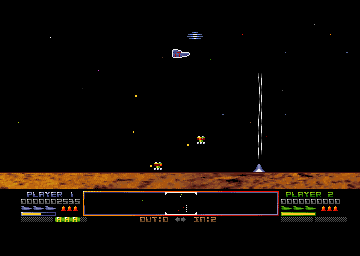
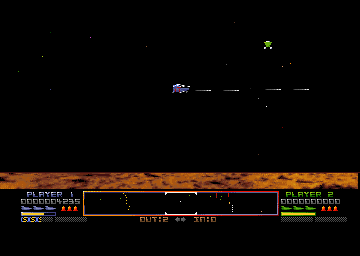
Visually, Datastorm captures the essence of mid‐’80s shoot ’em ups with crisp, brightly colored sprites set against a starry expanse that scrolls smoothly across the screen. While the hardware limitations of the era restrict palette size, the designer makes excellent use of contrast, ensuring each enemy type and rescue pod stands out clearly amid the frenetic action.
Background elements, such as distant stars and occasional planetary silhouettes, loop continuously without noticeable seams, reinforcing the illusion of an infinite battlefield. Explosions are rendered with punchy pixel clusters, delivering satisfying feedback every time you blast an enemy apart or rescue a pod. The smoothness of the horizontal scroll is especially impressive, minimizing flicker even when multiple sprites converge in tight clusters.
Power‐up icons are distinct and easily recognizable, with the auto‐fire symbol, missile icon, and shield emblem each sporting a clean, minimal design. This clarity is vital when you’re dodging incoming fire at high speed. Ship animations, though simple, have enough frames to convey responsive turning and banking maneuvers, making piloting feel intuitive and rewarding.
On compatible systems, slight palette‐shifting effects during level transitions and power‐up pickups add a touch of visual flair without pushing the hardware too far. Overall, Datastorm’s graphics may not rival later 16-bit titles, but they remain charming and highly functional, ensuring you never mistake a critical object for background noise.
Story
Datastorm doesn’t feature a sprawling narrative in the traditional sense; instead, it relies on a tight premise that provides context for the action. As an elite starfighter pilot, you’re tasked with recovering vital research pods from a besieged space colony before hostile invaders can seize their contents. Each successful rescue fuels the larger war effort against an encroaching enemy armada.
Brief mission briefings between levels hint at mounting stakes: the pods contain not only advanced technology but also critical data on the alien threat’s weaknesses. Though there are no in‐game cutscenes, the manual and onscreen text snippets paint a picture of a galaxy on the brink, urging you to persist through the toughest encounters. This minimal storytelling approach places the emphasis squarely on gameplay while still giving your actions weight.
Atmospheric details—like the distant hum of your engines and the flashing warning lights on your HUD—immerse you in a lone‐wolf struggle against overwhelming odds. Each portaling of a rescue pod feels like a small victory in a larger campaign, especially as subsequent levels introduce tougher adversaries and more intricate enemy patterns.
While hardcore narrative enthusiasts may find the story skeletal, fans of classic arcade shooters will appreciate that the sparse lore leaves room for personal interpretation. Whether you envision a grim interstellar war or a lone hero’s desperate stand, Datastorm’s lean premise ensures that every firefight feels purposeful.
Overall Experience
Datastorm delivers a polished, relentlessly challenging shoot ’em up experience that will appeal to fans of Defender and other arcade classics. Its tight controls, varied power‐ups, and cleverly designed progression system ensure that each play session feels fresh, even after dozens of levels. The risk‐reward dynamic of juggling pod pickups while fending off swarms of enemies keeps tension high throughout.
Its standout strengths lie in its addictive gameplay loop and clear visual presentation. Respawning mechanics and the four‐level pod replenishment cycle encourage players to improve their skills, hunt for high scores, and refine strategies for using limited power‐ups. Although occasional repetition is inherent to the genre, the escalating difficulty and occasional room for curve jumps make for a deeply satisfying playthrough.
Casual gamers may find the difficulty curve steep at first, particularly when facing relentless Lander waves without sufficient shield reserves. However, mastering each new enemy pattern and learning optimal rescue routes quickly becomes its own reward. The game’s straightforward premise—combined with surprisingly deep mechanics—ensures repeat plays remain engaging rather than rote.
Ultimately, Datastorm stands as a shining example of mid‐’80s shoot ’em up design. Its clean graphics, tight scrolling action, and intelligent power‐up system combine to create an arcade‐style thrill ride that remains compelling decades after its release. If you’re seeking a challenging yet fair throwback to the golden age of horizontal shooters, Datastorm is a must-try experience.


Reviews
There are no reviews yet.