 Retro Replay Retro Replay gaming reviews, news, emulation, geek stuff and more!



Retro Replay Review
Gameplay
Deflektor’s core gameplay revolves around reflection in both a literal and metaphorical sense. You guide a continuous beam of energy by positioning and rotating mirrors, forcing you to think several moves ahead. With 60 unique screens to conquer, each level unfolds like a mini chessboard where precision and foresight are your greatest assets.
(HEY YOU!! We hope you enjoy! We try not to run ads. So basically, this is a very expensive hobby running this site. Please consider joining us for updates, forums, and more. Network w/ us to make some cash or friends while retro gaming, and you can win some free retro games for posting. Okay, carry on 👍)
Each mirror can be adjusted to one of 16 distinct angles, dramatically altering the beam’s trajectory. Experimentation is key: a single misaligned reflection can send the beam careening into a hazard or off the playfield entirely. This fine control creates a satisfying loop of trial and error, as you learn to harness every angle to your advantage.
Levels are packed with additional devices that keep puzzles fresh. You’ll encounter teleports that instantly relocate the beam across the map, random angle-changers that throw your carefully planned path into chaos, and mines that must be “defused” by passing the beam overhead. Clearing all mines is a prerequisite to unlocking the exit, adding a layer of completionism to each challenge.
To escalate the difficulty, mobile droids patrol certain screens, shifting mirror orientations and forcing you to adapt on the fly. Hazards scattered throughout—overheating nodes or energy-draining zones—raise the stakes, turning what might seem like a serene puzzle into a tense test of timing and dexterity. The result is a deceptively simple premise that unravels into a deeply strategic puzzler.
Graphics
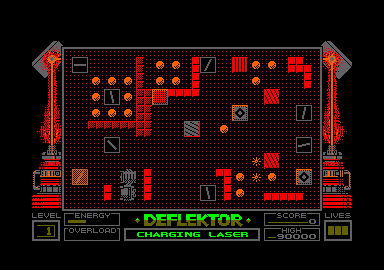
Graphically, Deflektor embraces a minimalist, schematic style reminiscent of early computer-era design. The playfield is presented in clean, wireframe top-down views, where every beam and mirror is sharply defined. This stripped-back aesthetic ensures that nothing distracts from the puzzle-solving at hand.
Color coding plays a crucial role in both function and form. Beams glow in vibrant hues to indicate their current state, while interactive elements such as mines, teleports, and hazards each sport a unique palette. This immediate visual feedback helps you track multiple variables at once—an essential feature when juggling several reflections.
Animations are smooth and purposeful. As you rotate a mirror, the beam’s redirection feels weighty and precise, reinforcing the mechanical nature of the gameplay. Teleports flash in a brief burst of light, and droids shuffle around the grid with a subtle sense of urgency. These small touches breathe life into the otherwise static grid.
While modern gamers accustomed to photorealism might find the visuals sparse, Deflektor’s design is purpose-built for clarity. Every graphical decision is geared toward readability and puzzle clarity, ensuring that even the most complex reflection patterns remain comprehensible at a glance.
Story
Deflektor doesn’t lean on a sprawling narrative; instead, it offers a lightweight sci-fi framework to justify its puzzles. You step into the role of an operator tasked with recalibrating a high-tech deflection system on a remote research station. The stakes are simple: neutralize unstable energy nodes before they overload.
Each level can be viewed as a test chamber, designed to push your understanding of optics and spatial geometry. While the game doesn’t deliver cutscenes or deep character arcs, its sparse lore—delivered through brief text prompts—provides just enough context. You’re not just shifting mirrors; you’re saving a facility from meltdown.
The minimal storytelling serves the gameplay by keeping you focused and unencumbered by superfluous plot threads. Instead of lengthy dialogue, you’re treated to succinct mission briefs that set the objective and move you swiftly into the next puzzle. For many players, this lean approach enhances immersion by letting the gameplay speak for itself.
Ultimately, the narrative of Deflektor is a canvas upon which players paint their own tales of triumph. Whether you’re celebrating a flawless “no-error” level clear or lamenting a last-second mirror misplacement, the game’s streamlined lore ensures your personal mastery takes center stage.
Overall Experience
Deflektor is a masterclass in focused puzzle design. Its combination of precise mirror manipulation, diverse level hazards, and incremental difficulty spikes keeps the experience engaging from start to finish. Each of the 60 screens feels like a rewarding brain teaser rather than filler content.
The learning curve is gentle but unrelenting: early levels introduce new mechanics one at a time, while later stages force you to juggle teleports, angle-changers, and roaming droids all at once. This pacing strikes an ideal balance between accessibility for newcomers and lasting depth for puzzle veterans.
The retro graphical style and minimalist story may not appeal to everyone, but they underscore the game’s unwavering focus on its central mechanic: reflection. If you prize clarity of design and enjoy methodical, thought-provoking challenges, Deflektor delivers in spades.
In the end, Deflektor stands out as a distinctive puzzle classic that rewards patience, experimentation, and spatial reasoning. It may not boast fancy visuals or an epic narrative, but its ingenious mirror-based puzzles will hold your attention long after you’ve turned off the lights—and for many, that’s the mark of a truly memorable game.


Reviews
There are no reviews yet.