 Retro Replay Retro Replay gaming reviews, news, emulation, geek stuff and more!
Retro Replay Review
Gameplay
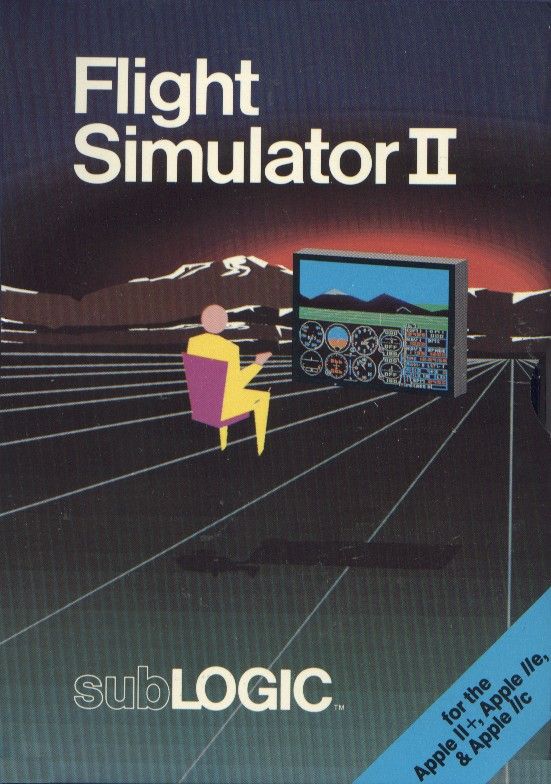
Flight Simulator II delivers an impressively detailed flight experience by simulating real-world aircraft dynamics. On the PC, you’ll pilot the Piper PA-28-181 Archer II, while Atari ST and Amiga owners hop into a Cessna 182RG or even a Gates Learjet 25G. Each airframe feels distinct: the Archer’s gentle handling contrasts with the Learjet’s brisk acceleration and need for precise throttle management. If you’re aiming for realism, you’ll appreciate the way each control input translates directly into changes in RPM, altitude, and airspeed.
(HEY YOU!! We hope you enjoy! We try not to run ads. So basically, this is a very expensive hobby running this site. Please consider joining us for updates, forums, and more. Network w/ us to make some cash or friends while retro gaming, and you can win some free retro games for posting. Okay, carry on 👍)
This sequel advances beyond first-generation flight sims by demanding attention to every variable of flight. From fuel mixture and propeller pitch to the nuances of basic avionics, Flight Simulator II encourages players to treat every takeoff and landing as a true training exercise. Novice pilots can start in Easy Mode, where many of these details are automated, and then graduate to Reality Mode for the full, hands-on experience. Manuals and aeronautical charts become essential study materials for those serious about learning procedures and navigation.
Added to the core simulation is a bonus WWI dogfighting module called WWI Ace, where you assume control of early biplanes armed with machine guns and bombs. While a built-in radar screen may feel anachronistic for a 1917 setting, it helps bridge the gap between raw historical accuracy and enjoyable gameplay. Whether you’re practicing circuits at a local airstrip or engaging enemy fighters over the Western Front, Flight Simulator II offers diverse challenges that keep every session engaging.
Graphics
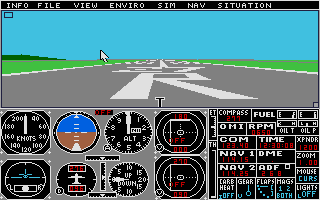
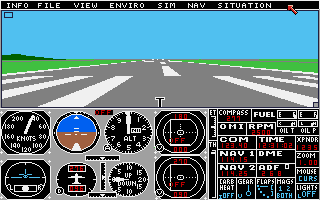
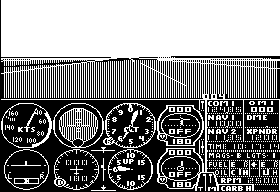
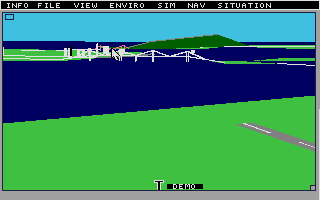
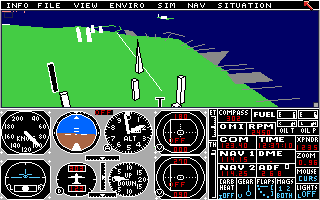
For its time, Flight Simulator II sets a high bar for graphical fidelity. Cockpit panels are rendered with crisp lines, clear gauges, and responsive indicators that change in real time as you adjust flaps, throttle, or make radio calls. The horizon smoothly transitions through sunrise and sunset hues, and runway markings stand out sharply against the surrounding terrain. You’ll immediately notice the difference between the flat shading of earlier simulators and the more nuanced, layered look here.
On the Amiga and Atari ST versions, the landscapes pop with more color depth and texture variety. Rolling fields, clustered towns, and winding rivers are laid out in a straightforward grid, but small details such as runway windsocks and airport beacons enhance the sense of place. In WWI Ace, the dogfighting theatres shift to open skies over muddy trenches, where distant trenches and camouflaged enemy balloons are rendered simply yet effectively for the era.
While polygon counts are modest by today’s standards, the clear, functional aesthetic ensures that pilots never struggle to read their instruments or identify landmarks. In every mode, visibility settings let you toggle through weather, fog, and haze, so you can simulate everything from crystal-clear VFR flights to overcast IFR conditions. Though there’s no dynamic lighting or texture filtering, the purposeful design of each screen element guarantees clarity in critical flight scenarios.
Story
Unlike narrative-driven adventure titles, Flight Simulator II’s “story” unfolds through the pilot’s journey from novice to seasoned aviator. Your progression is marked not by cutscenes or dialogues, but by your growing proficiency in takeoffs, navigation, and emergency procedures. Each successful solo flight, each perfect instrument approach, becomes part of your personal aviation tale.
WWI Ace introduces a more conventional storyline: you’re a rookie pilot entering the frantic skies of World War I, tasked with escort missions, bomber interceptions, and dogfights against ace adversaries. Briefings before each sortie set the stage—reconnaissance objectives, squadron wingmen, and looming weather threats—giving you a sense of purpose beyond pure flight mechanics. Though minimalistic, these mission outlines inject a dose of historical drama into the package.
Whether flying modern general aviation trainers or vintage fighters, the game fosters a narrative of growth and mastery. You’ll feel the thrill of your first solo cross-country, the tension of navigating through a sudden storm, and the adrenaline of barrels rolls and machine-gun tracers in WWI Ace. That gradual build—pilot’s license one moment, battle-hardened flyer the next—forms the core story arc that keeps you invested.
Overall Experience
Flight Simulator II is a landmark title for aspiring aviators and simulation enthusiasts alike. Its careful balance of authentic procedures and optional ease-of-use modes makes it accessible without diluting the challenge for serious pilots. The inclusion of multiple aircraft types across platforms extends replay value, letting you compare training in a Cessna against the high-speed demands of a twin-jet Learjet.
The synergy between the main simulation and the WWI Ace dogfight module offers a diverse package that appeals to both methodical learners and action-seeking gamers. While the core sim teaches instrument crosschecks and navigation, WWI Ace tests your reflexes and combat tactics. This dual approach ensures the title remains fresh long after the manuals have been memorized.
Even decades later, Flight Simulator II stands as a testament to SubLOGIC’s commitment to authenticity. It rewards curiosity—whether you’re charting courses on aeronautical charts or calculating fuel burn manually—and delivers an immersive sense of flight that few contemporaries matched. For anyone serious about understanding the mechanics of real-world aviation or simply craving a thorough simulator experience, Flight Simulator II remains a compelling choice.


Reviews
There are no reviews yet.