 Retro Replay Retro Replay gaming reviews, news, emulation, geek stuff and more!
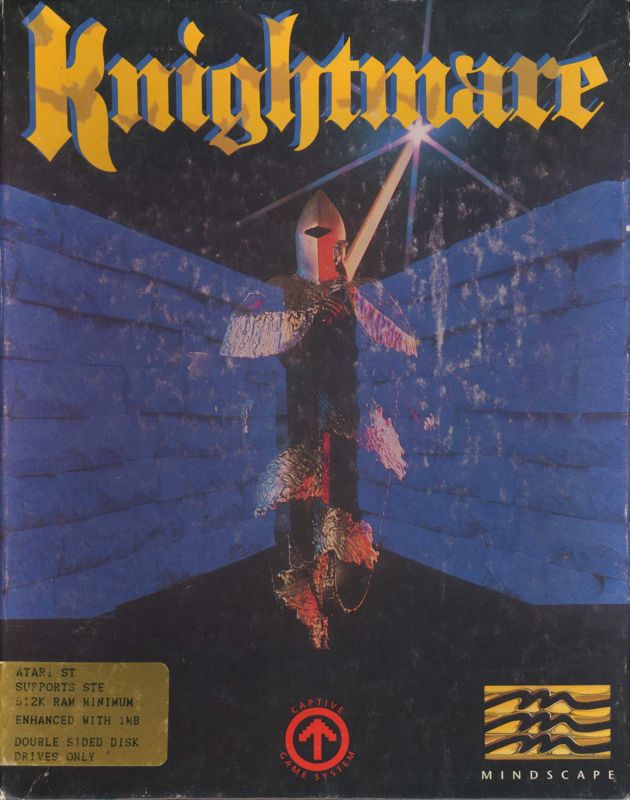

Retro Replay Review
Gameplay
Knightmare offers a classic dungeon-crawling experience that will feel instantly familiar to fans of the Captive series and Dungeon Master alike. You control a party of adventurers through a first-person, tile-based environment, using a combination of mouse clicks and keyboard shortcuts to navigate winding corridors, secret passages, and trap-filled rooms. The left mouse button allows you to interact with doors, levers, and treasure chests, while the right button invokes context-sensitive actions for your characters, whether that’s swinging a sword, casting a spell, or using a healing potion.
(HEY YOU!! We hope you enjoy! We try not to run ads. So basically, this is a very expensive hobby running this site. Please consider joining us for updates, forums, and more. Network w/ us to make some cash or friends while retro gaming, and you can win some free retro games for posting. Okay, carry on 👍)
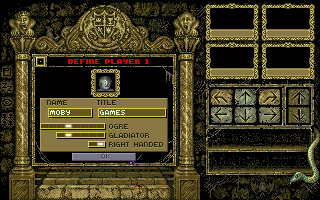
Equipping weapons and items is intuitive: click on a knife or sword in your inventory to bring up a menu of actions—“stab,” “swing,” and “hack” for blades, or “punch” and “kick” if your hands are bare. The wand, meanwhile, presents a list of available spells, each consuming precious magic points that regenerate slowly or via potions. Movement can be handled entirely with the mouse by clicking directional arrows on the screen, or you can opt for keyboard control if you prefer faster, more precise navigation. This hybrid interface offers flexibility but occasionally requires a moment of adjustment when switching between input methods.
One feature that sets Knightmare apart is its save system: you may save at any moment during your expedition, yet loading a saved game demands restarting the title or intentionally wiping out your party to return to the main menu. This quirk injects a subtle tension into exploration—you’re free to record your progress, but reloading isn’t seamless, encouraging careful planning and punishing reckless decisions. Overall, the gameplay loop of exploration, puzzle-solving, and tactical combat remains engaging throughout, rewarding players who pay attention to environmental clues and inventory management.
Graphics
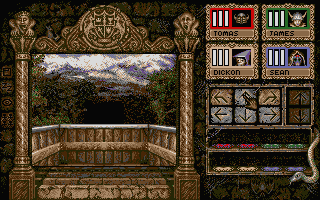
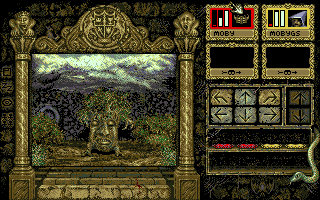
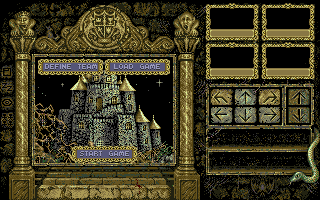
Visually, Knightmare leans into the aesthetic conventions of early 1990s RPGs, featuring a 256-color palette and simple sprite-based character portraits. The dungeon walls are textured with repeating stone patterns that can feel repetitive after long stretches, yet the occasional torch-lit alcove or mossy archway provides welcome variety. From a modern standpoint, the graphics may appear dated, but they possess a certain retro charm that captures the gritty atmosphere of Dunshelm’s labyrinthine depths.
Monsters and NPCs are rendered as flat sprites that swivel to face the player, echoing the style of Dungeon Master. While animations are minimal—most creatures twitch or slide into view—the game compensates with moody color schemes and strategic use of shadow to suggest unseen threats lurking around every corner. Inventory icons are small but recognizable, and the interface borders are decorated with ornate frames that reinforce the medieval fantasy theme.
Lighting effects, though basic, play an important role in heightening tension. Torches cast a flickering glow that barely reaches into blackened hallways, creating pockets of darkness where traps and monsters can hide. While there’s no dynamic light source system in play, the static shading and color gradients are implemented skillfully enough to keep you on edge during late-night forays. Overall, Knightmare’s graphics may not compete with modern blockbusters, but they remain functional, evocative, and true to the game’s legacy roots.
Story
The narrative thrust of Knightmare revolves around a party of courageous adventurers on a quest to locate four legendary artifacts in the dungeons beneath Dunshelm Castle: the Shield of Justice, the Sword of Freedom, the Cup of Life, and the Crown of Glory. Each item is imbued with its own mythic significance and grants unique benefits—whether defensive wards, offensive power boosts, healing capabilities, or morale lifts. Gathering these treasures is the only way to stand a chance against the malevolent Lord Fear, whose dark magic blankets the realm in terror.
Guiding you through this perilous journey is Treguard, the enigmatic Dungeon Master, who appears as an oracle in magical mirrors and shadowy recesses. His cryptic advice and hints provide crucial context for dungeon puzzles and combat encounters, though deciphering his riddles often feels as challenging as battling a horde of skeletons. The interplay between Treguard’s commentary and the party’s actions gives the game a distinct personality, reminiscent of the British TV series that inspired it.
While the overarching plot is straightforward—collect artifacts, vanquish Lord Fear—the game excels at environmental storytelling. Murals on the walls hint at ancient conflicts, runic inscriptions foreshadow deadly traps, and hastily scrawled journals or scrolls offer glimpses into the fate of previous explorers. Though dialogue is sparse and text boxes are kept to a minimum, the setting feels alive with history and mystery, driving players to delve deeper into every uncharted corridor.
Overall Experience
Knightmare is a rewarding adventure for anyone who appreciates old-school dungeon crawlers and tactical RPGs. Its interface borrows heavily from genre pioneers, yet it introduces its own quirks—particularly in saving mechanics and party management—that keep the experience fresh. Combat is methodical rather than frantic, demanding careful inventory choices and strategic positioning to survive the more lethal chambers of Dunshelm.
The game’s challenge curve is steep but fair, balancing resource scarcity with enough potions and scrolls hidden throughout the labyrinth to encourage exploration. Occasional frustrations arise from pixel-perfect traps or hard-to-find switches, yet overcoming these hurdles brings a real sense of accomplishment. The reward of finally wielding the four magic objects and confronting Lord Fear offers a satisfying climax that vindicates hours of careful mapping and puzzle solving.
In the end, Knightmare stands as a testament to its lineage: a title that may show its age in graphics and convenience features, but still captivates with immersive dungeons, strategic depth, and a touch of British eccentricity courtesy of Treguard. For players seeking a challenging, atmospheric RPG with a classic feel, this second videogame adaptation of the beloved TV series provides a memorable quest worth undertaking.


Reviews
There are no reviews yet.