 Retro Replay Retro Replay gaming reviews, news, emulation, geek stuff and more!
Retro Replay Review
Gameplay
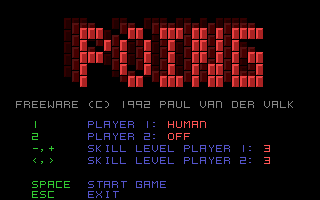
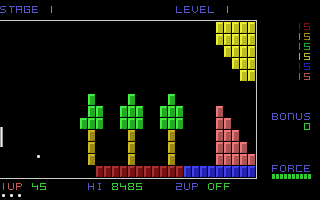
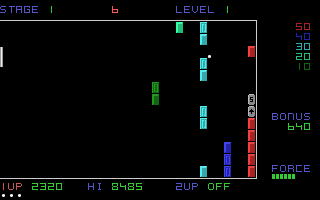
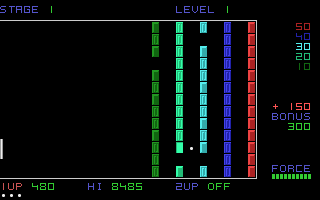
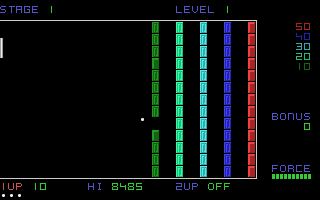
Poing takes the familiar Breakout formula and flips it on its side—literally. Instead of guiding a paddle at the bottom of the screen, you control a bat on the left-hand edge and must send a ball barreling horizontally through a grid of blocks toward the back wall. This left-to-right orientation immediately gives the game a fresh twist, forcing you to rethink angles, rebounds, and timing. The core loop remains simple yet satisfying: hit blocks, clear a path, and strike the back wall ten times to move on.
(HEY YOU!! We hope you enjoy! We try not to run ads. So basically, this is a very expensive hobby running this site. Please consider joining us for updates, forums, and more. Network w/ us to make some cash or friends while retro gaming, and you can win some free retro games for posting. Okay, carry on 👍)
What elevates Poing is its clever level structure. Levels are grouped into sets of eight screens, and if you lose the ball, you aren’t simply given a new life on the same board. Instead, you’re hurled in reverse through all previous screens at high speed, reminiscent of the MSX title Break In. Catching the ball on one of these return screens lets you resume from that point, giving you a second chance to claw your way back. This mechanic injects both tension and opportunity—you dread missing the ball, but you also relish the adrenaline rush of a high-velocity rebound sequence.
The variety of blocks and bonus bricks keeps each level feeling fresh. Blocks come in multiple colors, each linked to a different point value or function. Some yield immediate points, others add to a cumulative bonus meter, and a few require multiple hits before they vanish. Most grids will regenerate once cleared, allowing high-score chasers to farm extra points and pad their bonuses. Bonus bricks lie hidden beneath layers—uncovering and immediately re-hitting them can grant multipliers, extra balls, physics-altering effects (like sticky or speeding balls), and even extra lives. With five skill levels to choose from and a two‐player alternate mode, Poing offers both a solo challenge and a competitive couch experience.
Graphics
On a technical level, Poing embraces an unapologetically retro aesthetic. Its blocky, pixel-based visuals evoke the heyday of 8-bit and 16-bit arcade machines. Yet, within those constraints, the game leverages bright, contrasting colors to distinguish block types, bonuses, and backgrounds. Each screen set boasts its own palette, preventing visual monotony as you progress through dozens of levels.
Animations are simple but purposeful. The ball’s spin is clearly conveyed, blocks flash dynamically when hit, and the regenerative process of cleared grids adds a satisfying visual flourish. Even the high-speed reverse sequences—when you lose the ball—are rendered with a streaking effect that heightens the sensation of velocity. On modern hardware, Poing runs smoothly at a stable frame rate, ensuring that every ricochet feels precise and responsive.
While there are no elaborate cutscenes or detailed character sprites, the minimalism works in Poing’s favor. Distractions are kept to a minimum, allowing you to focus on the core action. Subtle background animations—drifting particles, changing gradient hues—lend a sense of atmosphere without detracting from gameplay. In short, Poing’s graphics serve the experience rather than overshadowing it.
Story
Poing doesn’t weave an intricate narrative or feature voiced characters; instead, its “story” is one of pure arcade progression. Each set of eight screens represents a new sector or chamber that you must break through to advance. The absence of dialogue or cutscenes allows you to project your own sense of purpose onto the action—whether you’re an interstellar miner tunneling through rock or a futuristic sports athlete smashing walls.
The game’s implicit journey from screen to screen provides its own reward. Every time you clear the required blocks and land those ten decisive hits on the back wall, you experience a palpable sense of accomplishment. The quick transition to the next chamber feels like unlocking a new door or discovering an unexplored region, even without explicit storytelling.
For players who crave more narrative context, Poing’s simplicity might feel like a drawback. However, the minimalist approach aligns perfectly with the design goal: fast-paced, pick-up-and-play action that never interrupts you with exposition. If you judge the story by how well it motivates and complements the gameplay, Poing’s skeletal framework delivers exactly what’s needed—a consistent drive to break through to the next challenge.
Overall Experience
Poing shines as a distilled arcade puzzle-action game. Its unconventional left-to-right orientation breathes new life into a genre that’s seen countless clones, and the reverse-travel mechanic keeps you on the edge of your seat. It strikes an excellent balance between accessibility and depth, offering immediate fun on lower skill levels while presenting a true test of precision and reflexes at higher difficulties.
The combination of regenerating blocks, point-based specials, and hidden bonuses ensures high replay value—each session feels like a fresh opportunity to discover a new tactic or chase a personal best. Multiplayer mode, although turn-based, adds a friendly competitive edge: you can trade rounds with a friend and see who can carve through the chambers most efficiently.
Ultimately, Poing is a testament to how thoughtful design can rejuvenate a classic formula. It offers enough variety, challenge, and strategic nuance to satisfy seasoned arcade veterans, while remaining approachable for newcomers seeking quick yet gratifying gameplay sessions. If you’re looking for a retro-inspired title with modern twists, Poing deserves a spot on your lineup.


Reviews
There are no reviews yet.