 Retro Replay Retro Replay gaming reviews, news, emulation, geek stuff and more!



Retro Replay Review
Gameplay
The Golden Path offers a fresh take on the classic point-and-click adventure formula by replacing standard verb menus with direct interaction through a mouse-driven cursor shaped like a Chinese character. Left-clicking on the ground guides Y’n Hsi smoothly to the destination, while clicking above or below him triggers context-sensitive actions such as using or dropping items. This streamlined approach keeps the player immersed in the world without wrestling through cumbersome command lists.
(HEY YOU!! We hope you enjoy! We try not to run ads. So basically, this is a very expensive hobby running this site. Please consider joining us for updates, forums, and more. Network w/ us to make some cash or friends while retro gaming, and you can win some free retro games for posting. Okay, carry on 👍)
Combat is seamlessly woven into exploration via a right-click that makes Y’n Hsi punch or kick enemies. Whenever he takes damage, the inventory briefly flashes, providing an immediate visual cue of his plight. This subtle integration of action elements adds tension to seemingly mundane scavenging tasks, as players must decide whether to engage adversaries head-on or employ clever item use to bypass them.
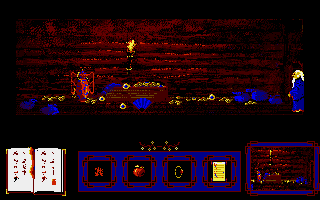
Inventory management in The Golden Path remains intuitive yet strategic. Four slots at the bottom of the screen hold collected objects; left-clicking on an item equips it to Y’n Hsi’s hands, ready for use. For those moments when you’re stuck, a mystical book at the screen’s corner serves as a built-in hint system, offering contextual insights into characters, objects, and ongoing events. Combined with an energy bar represented by a slowly withering vine—refreshed through puzzle completion—this design keeps players engaged without resorting to heavy-handed tutorials.
The map interface deserves special mention. A miniature version of the main play area at the bottom-right corner reveals the branching “Golden Path” in real time. This visual guide highlights bifurcations, allowing adventurers to plan routes, backtrack to missed items, or tackle optional areas for additional lore. With these tools at hand, The Golden Path strikes an ideal balance between challenge and guidance.
Save and load features are conveniently mapped to the S and L keys, making quick checkpoints and experimental puzzle attempts effortless. This system encourages risk-taking: feel free to test the limits of your combat skills or experiment with combining unexpected items. The result is a gameplay loop that feels both forgiving and rewarding.
Graphics
Visually, The Golden Path captures the serenity of ancient East Asian art with a palette of muted earth tones contrasted by vibrant splashes of gold along the protagonist’s route. Backgrounds evoke traditional ink-wash landscapes—misty mountains, bamboo groves, and weathered palaces—immaculately rendered to create a meditative atmosphere that reinforces the game’s spiritual themes.
Character sprites are fluidly animated, lending Y’n Hsi a graceful presence as he transitions from slow walks to nimble combat stances. Enemies—from wandering bandits to mythical creatures—move with satisfying weight and personality. Even the smallest details, such as the sway of Y’n Hsi’s robe or the flicker of his energy vine, demonstrate a commitment to polish rarely seen in indie adventure titles.
The user interface integrates seamlessly with the hand-painted world. The cursor’s Chinese-letter shape not only looks authentic but also ties into the lore of transcending material obstacles. Inventory slots, the hint book icon, and the energy vine are unobtrusive yet informative, ensuring that players stay focused on the unfolding story rather than a cluttered HUD.
Transitions between screens are smooth, with subtle fade effects that enhance immersion rather than distract. Loading times are minimal, and the small minimap in the corner updates in real time without noticeable lag. In sum, The Golden Path’s graphics consistently support its narrative and gameplay, crafting an aesthetically cohesive experience.
Story
At its core, The Golden Path is a journey of vengeance and spiritual awakening. You assume the role of Y’n Hsi, a Buddhist monk whose father was slain by the ruthless warlord Ch’un Kuei. Driven by justice and a longing to restore his family’s honor and palace, Y’n Hsi must “tread the golden path,” both as a literal route marked across the game’s levels and as a metaphorical road to transcendence.
The narrative unfolds organically through environmental storytelling and interactions with NPCs who offer cryptic wisdom or ominous warnings. There’s no heavy-handed dialogue tree—conversations are concise yet evocative, inviting players to read between the lines and piece together the moral complexities of revenge versus enlightenment.
Moments of quiet reflection are expertly balanced with tense skirmishes against Ch’un Kuei’s minions. As you collect symbolic items—incense bowls, lotus petals, ancient scrolls—the lore deepens, revealing a world where philosophy and martial skill intertwine. The game doesn’t shy away from exploring themes of suffering, redemption, and the true cost of absolute power.
By the climax, players feel intimately connected to Y’n Hsi’s internal struggle. The final confrontation with Ch’un Kuei transcends a mere boss fight; it becomes a rite of passage, challenging you to decide whether to wield the golden path as a sword of vengeance or a beacon of compassion.
Overall Experience
The Golden Path delivers a remarkably cohesive adventure that marries thoughtful design with an emotionally resonant narrative. Its innovative click-to-act interface minimizes friction, allowing newcomers to dive right in while still offering depth for veteran point-and-click fans. Combat, puzzles, and exploration are woven together so naturally that each victory—whether defeating an enemy or solving a tricky riddle—feels earned.
Sound design and music further enrich the experience. A meditative score punctuated by traditional instruments underscores moments of calm, while percussive drums and string flourishes heighten tension during combat. Ambient effects, like rustling bamboo and distant temple bells, add layers of authenticity and keep players grounded in Y’n Hsi’s world.
Some players might wish for more branching paths or side quests, but the game’s deliberate pacing encourages a reflective mindset rather than endless busywork. The hint book system ensures that no one remains stuck for long, though taking time to explore every corner and follow each golden path branch is rewarded with hidden lore and satisfying context.
Ultimately, The Golden Path stands out as a spiritual adventure that respects its audience’s intelligence. Easy-to-use save/load functions (S and L keys) combined with gentle guidance mean that frustration is minimal, while the game’s philosophical underpinnings invite players to ponder larger questions long after the credits roll. For those seeking a unique blend of contemplative storytelling and engaging puzzle-action gameplay, this journey is well worth embarking upon.


Reviews
There are no reviews yet.