 Retro Replay Retro Replay gaming reviews, news, emulation, geek stuff and more!

Retro Replay Review
Gameplay
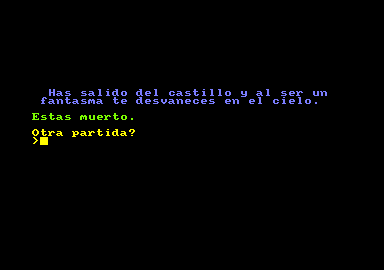
Abracadabra unfolds as a classic two-part text adventure where players first navigate the haunted halls of Castle Burgenfels as the spectral knight Clus d’Eledorf. In this phase, your goal is to break Saligia’s curse while confined to ghostly form. You can freely explore secret passages and hidden rooms but must take care not to stray beyond the castle walls, or your spectral form will dissipate entirely. The castle’s labyrinthine layout encourages careful mapping and persistent experimentation with items you collect.
(HEY YOU!! We hope you enjoy! We try not to run ads. So basically, this is a very expensive hobby running this site. Please consider joining us for updates, forums, and more. Network w/ us to make some cash or friends while retro gaming, and you can win some free retro games for posting. Okay, carry on 👍)
Once you complete the first section, the game prompts you to load the second scenario, in which Clus is reincarnated in human form and ventures into the enigmatic Greenwald forest. Here, the focus shifts from puzzle-solving within stone corridors to survival and exploration amid ancient trees and shifting pathways. The forest environment introduces new obstacles—tricky terrain descriptions, wandering creatures, and cryptic riddles—all of which demand keen observation and logical deduction to reunite Clus with Princess Violeta.
The parser, built on the Professional Adventure Writer system, offers a surprisingly robust command set for a ZX Spectrum release. It handles chain commands (“take sword and attack witch”), pronouns, adverbs, prepositions, and adjectives, allowing you to craft detailed instructions. While its vocabulary may not reach the lofty heights of Infocom’s best, it generally understands natural-language inputs, reducing frustrating misunderstandings. Savvy players will find the combination of exploration, dialogue with castle inhabitants, and inventory-based puzzles both nostalgic and challenging.
Graphics
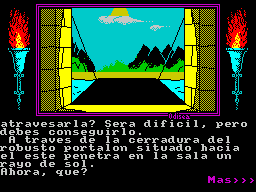
As a text-adventure title on the ZX Spectrum, Abracadabra contains no graphical scenes or illustrations during gameplay. Instead, it relies entirely on evocative text descriptions to paint its environments and characters in your mind. This minimalist approach places full emphasis on narrative detail—each creaking door, rustling forest glade, and spectral apparition emerges through carefully crafted prose rather than pixels on screen.
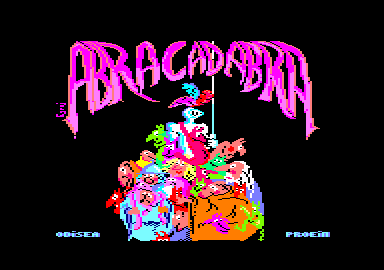
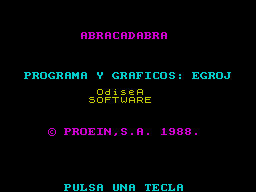
That said, the game’s presentation feels solid for its era. Menu prompts and on-screen text appear clearly in the standard Spectrum font, and loading screens feature simple yet atmospheric title art that hints at the game’s romantic and magical themes. The cover illustration—though external to gameplay—sets the tone with a brooding castle backdrop and an ethereal knight, giving players an immediate sense of the curse-driven romance at the heart of Abracadabra.
While modern gamers accustomed to high-definition visuals might find the lack of graphical feedback austere, fans of classic interactive fiction will appreciate how the absence of images compels deeper engagement with the story. If you relish painting pictures with your imagination, the text-only interface transforms each room description into a vivid mental tableau, proving that great adventures can thrive without fancy visuals.
Story
The narrative of Abracadabra centers on the doomed love triangle between Clus d’Eledorf, Princess Violeta, and the jealous witch Saligia. Clus and Violeta’s tender romance sparks Saligia’s ire, prompting her to cast a dual curse: Clus becomes a ghost trapped within Burgenfels, and Violeta vanishes into the sprawling Greenwald forest. This blend of chivalric love and dark enchantment drives every puzzle, dialogue, and exploration throughout the game.
Structuring the adventure in two distinct acts reinforces the story’s emotional arc. In the castle portion, you feel Clus’s frustration and longing as you harness ghostly abilities to interact with former allies, uncover secrets, and piece together clues about the curse’s origin. When the second act begins, the tone shifts to a hopeful quest of redemption and reunion, as the knight—now alive—braves natural perils in search of his lost love. The contrast between claustrophobic stone corridors and the open, mysterious forest amplifies the stakes and keeps the narrative fresh.
The writing showcases imaginative world‐building and a touch of medieval romance tempered by gothic dread. Descriptive passages evoke the chill of haunted chambers and the whisper of wind through ancient trees. NPC dialogues range from cryptic witches’ warnings to sympathetic castle servants, each contributing to a sense of a living world. Although the original Spanish text occasionally leads to literal translations in English, the overall storytelling remains immersive and emotionally resonant.
Overall Experience
Abracadabra offers a rewarding blend of classic text‐adventure mechanics and an engaging medieval-fantasy tale. Its dual-phase structure keeps challenges varied, while the PAW-powered parser delivers enough flexibility to avoid excessive frustration. Mapping Burgenfels’s hidden doors and deciphering forest riddles will appeal to puzzle veterans seeking a robust challenge without modern hand-holding.
The absence of graphics may feel stark by today’s standards, but it’s precisely this textual purity that has endeared Abracadabra to fans of interactive fiction. The evocative descriptions and atmospheric loading art set the mood, letting players’ imaginations fill in the gaps. Sound effects are limited to the ZX Spectrum’s basic beeps, further spotlighting the written narrative as the game’s central element.
Overall, Abracadabra stands as a notable entry in the Spanish text‐adventure scene of the 1980s. It is most suited for enthusiasts of retro gaming and interactive storytelling, as well as anyone curious about the Spectrum’s vibrant homebrew community. Whether you’re drawn by the tragic romance, the intricate puzzles, or the challenge of exploring a spectral castle and haunted forest, Abracadabra delivers an immersive journey well worth revisiting.


Reviews
There are no reviews yet.