 Retro Replay Retro Replay gaming reviews, news, emulation, geek stuff and more!




Retro Replay Review
Gameplay
Endurance builds on the familiar foundation established by CRL’s Formula One, shifting the focus from four wheels to two and emphasizing stamina and strategy over short bursts of speed. Before each of the six marathon events, you’re tasked with fine-tuning your bike’s setup: you must balance engine speed against fuel consumption and safety, while the chassis setup requires you to juggle speed, tyre wear, and rider protection. Choosing among three tire compounds adds another layer of decision-making, forcing you to predict track conditions and rider performance over sessions that can stretch to a full 24 hours.
(HEY YOU!! We hope you enjoy! We try not to run ads. So basically, this is a very expensive hobby running this site. Please consider joining us for updates, forums, and more. Network w/ us to make some cash or friends while retro gaming, and you can win some free retro games for posting. Okay, carry on 👍)
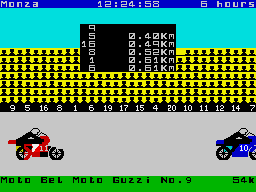
Once the race begins, the action unfolds in a minimalist side-view perspective. You watch your bikes scroll past the pit straight, while an on-screen display continually updates you on the race leader, lap times, and any mechanical issues that arise. Rather than full-motion 3D graphics or real-time camera angles, Endurance relies on concise data streams and clear visual icons, ensuring you never lose sight of the strategic demands at hand.
Pit stops are where Endurance truly shines as a management simulation. You decide when to call each bike in for fuel, tire changes, and rider swaps, then assume real-time control of the pit crew. Dragging your mechanic to the right position to perform each task adds a tactile challenge that underscores how every second counts. A slow tire change or a delayed refuel can mean the difference between victory and being lapped, so you learn to master both macro strategy and micro execution.
Endurance also lets you issue instructions directly to your riders. You can command them to push aggressively for overtakes or to hold back and preserve fuel and tires for later in the race. The interplay between these directives and the mechanical reliability of your machines creates a dynamic tension that rewards careful planning and quick reactions. For fans of management sims, this combination of pre-race setup, in-race tactics, and pit-lane dexterity makes Endurance a deeply engaging experience.
Graphics
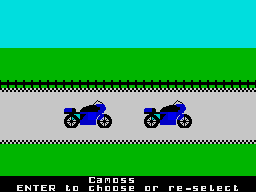
Visually, Endurance adopts a stripped-down, functional aesthetic well suited to its simulation roots. The side-on view of the racetrack isn’t aiming for photorealism; instead, it provides clear silhouettes of the bikes and riders as they speed past, supplemented by a concise HUD that reports position changes, lap counts, and mechanical alerts in real time. The color palette is restrained but effective, with team liveries and track markings standing out crisply against asphalt-colored backgrounds.
Though you won’t find elaborate replays or dynamic camera angles, the game’s simplicity keeps your attention squarely on the race data and split-second decisions. Tire wear indicators, fuel gauges, and rider stamina bars are all prominently displayed, so you can quickly assess a bike’s status. Animations are basic but fluid enough to convey speed and momentum, while the pit-lane sequences rack up tension through minimal yet satisfying motion cues.
The UI’s menu-based setup screens are equally utilitarian, relying mostly on clicking words rather than icons or sliders. While this approach may feel dated to some, it remains intuitive after a brief learning curve, making it easy to tweak settings without diving through nested screens. Hover-over tooltips and context-sensitive help further smooth the process, ensuring you can focus on race-day decisions rather than hunting for the right button.
Overall, Endurance’s graphics may not push hardware limits, but they succeed in delivering a clear, distraction-free interface. By stripping away non-essential visual flourishes, the game ensures that both rookie managers and seasoned veterans can concentrate on the core challenge: keeping two bikes and their riders in peak condition for hours on end.
Story
Endurance does not feature a traditional narrative with scripted events or character arcs. Instead, the “story” unfolds through your management decisions and on-track drama. Each race is a self-contained chapter in your team’s journey, and the outcome depends entirely on your ability to adapt to mechanical failures, weather shifts (as inferred from tire wear), and rival strategies. This emergent storytelling fosters a sense of personal investment: every comeback from last place or heartbreaking mechanical DNF becomes part of your unique racing legend.
As you progress through the six long-distance events, you’ll naturally generate rivalries and narratives—perhaps one rider consistently outperforms the other, or a particular tire compound proves decisive on a demanding circuit. Although there are no cutscenes or voiced dialogues, the interplay of statistics and split-second calls in the pits offers its own brand of drama. The absence of a fixed storyline allows players to craft their own tales of triumph and disaster, making each playthrough distinct.
The game’s focus on endurance over sprint racing further enhances this improvised narrative quality. You learn to anticipate rider fatigue, manage mechanical stress, and respond to unpredictable incidents such as engine overheating or sudden tire degradation. In doing so, you become the central character in a high-stakes saga that tests planning and reflexes equally, weaving a compelling tapestry of challenges rather than following a predetermined plotline.
Ultimately, Endurance’s story emerges from player agency. There are no predefined heroes or villains—only the unfolding outcomes of your strategies, the fortunes of your two motorcycles, and the legacies of your riders. For those who appreciate simulations as storytelling devices, this open-ended format can be far more engaging than any scripted narrative.
Overall Experience
Endurance stands out as a niche but rewarding simulation for fans of strategy and resource management. Its blend of pre-race setup decisions, in-race tactical choices, and real-time pit stop control offers a multi-layered gameplay loop that remains fresh across its six endurance events. While its minimalist visuals and text-heavy menus may not appeal to every racer, they reinforce the game’s emphasis on thoughtful planning over flashy presentation.
Patience and attention to detail are key virtues here. Early races may feel punishing as you learn to balance speed, fuel, and tire life, but each mistake offers valuable data for your next setup. As you master the menu system and pit-lane procedures, the satisfaction of executing a flawless two-bike strategy—juggling rider swaps and compound choices to perfection—becomes a memorable high point.
Despite lacking a conventional storyline, Endurance delivers a strong sense of progression through its escalating challenges and the natural rivalry that develops between your two teams. The game caters primarily to enthusiasts of motorsport management sims, who will appreciate the depth and precision rather than seeking arcade-style thrills. If you’ve ever wanted to experience the intricacies of 24-hour motorcycle racing from behind the pit-wall, Endurance offers an engrossing simulation that rewards perseverance.
In summary, Endurance may not be for players seeking rapid-fire action or cinematic flair, but for those eager to delve into the strategic heart of endurance racing, it delivers an authentic and engrossing ride. Its combination of setup menus, side-view racing, and real-time pit control forms a cohesive package that will keep strategy-minded players engaged for hours on end.


Reviews
There are no reviews yet.