 Retro Replay Retro Replay gaming reviews, news, emulation, geek stuff and more!
Retro Replay Review
Gameplay
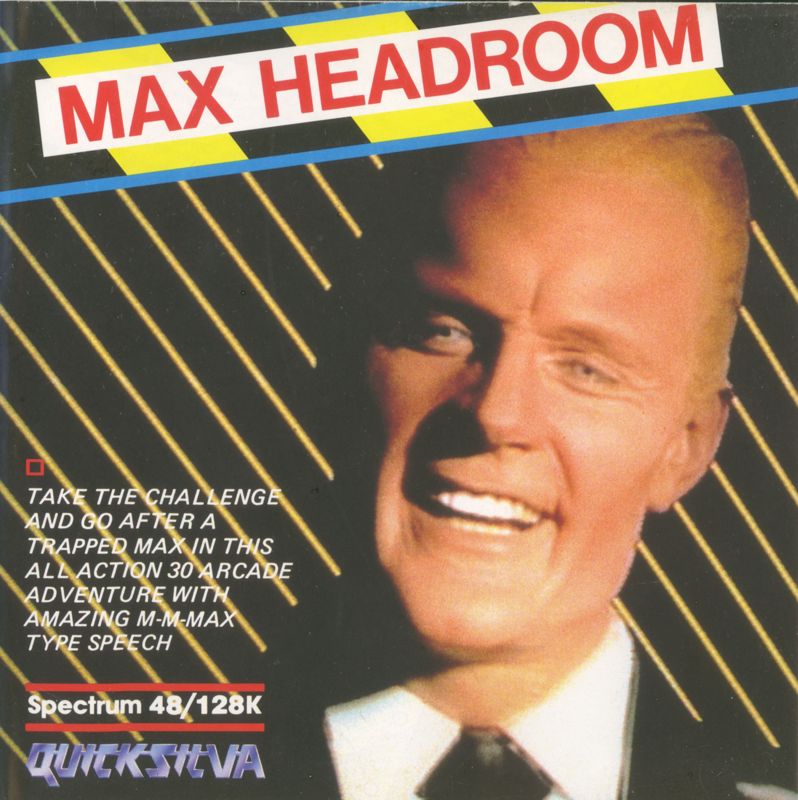
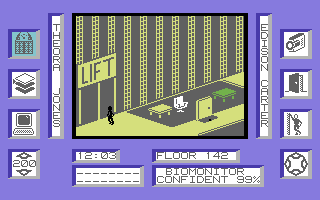
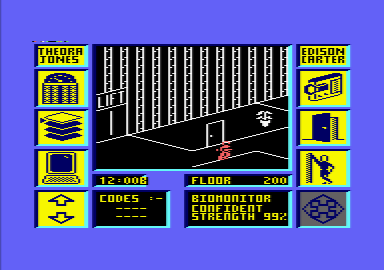
The gameplay of Max Headroom revolves around navigating a towering high-rise and retrieving the abducted digital persona of Max Headroom. Players assume the role of investigative reporter Edison Carter, descending from the 200th floor down through 11 top floors of Network 23’s building. Each floor is rendered in an isometric view, presenting a grid of rooms, walls, and office furniture to explore. Gaining access to new floors requires correctly entering security codes at elevators, blending exploration with puzzle-solving under time pressure.
(HEY YOU!! We hope you enjoy! We try not to run ads. So basically, this is a very expensive hobby running this site. Please consider joining us for updates, forums, and more. Network w/ us to make some cash or friends while retro gaming, and you can win some free retro games for posting. Okay, carry on 👍)
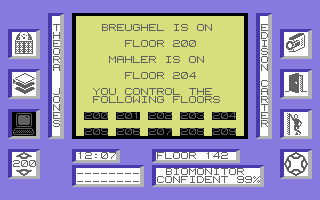
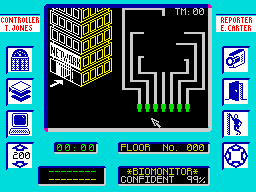
Robotic sentries patrol the floors relentlessly, firing on sight and chipping away at Carter’s health meter displayed prominently on the biomonitor at the bottom of the screen. Players must juggle weapons, movement, and strategic use of the four action icons available to Carter: opening doors, calling elevators, activating remote camera views, and sprinting across the floor. Meanwhile, Controller Theora “T” Jones’s icons on the left side of the screen allow you to survey circuit layouts and hack into security systems, adding a second layer of tactical decision-making.
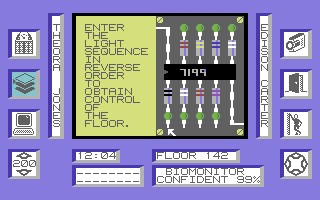
The security-code mini-game is a standout feature, simulating circuit activation on an LED-style display. You must guide a pointer along circuit lines, lighting up segments to form the desired digit before the timer runs out. Failure forces players to backtrack to the secondary elevator and start over, raising the stakes on every code entry. This constant push-and-pull between exploration, combat, and puzzle-solving keeps the gameplay engaging but can also feel unforgiving for newcomers to the cyberpunk genre or isometric action titles.
Graphics
Max Headroom’s graphics capture the raw, early cyberpunk aesthetic that defined its television origins. Floors are depicted with crisp, vector-like lines, using simple but effective shading to convey depth in the isometric environment. Walls, doors, and office fixtures are distinct and easily readable, ensuring you can navigate even the most complex floor layouts at a glance.
Character and enemy sprites are modest in size but carry the jittery, stuttering presentation reminiscent of Matt Frewer’s latex-masked performance. The robotic foes have a utilitarian, industrial design, reinforcing the oppressive atmosphere of Network 23’s corporate fortress. Animations are economical yet purposeful, with flickering monitors and flashing alarms amplifying the sense of urgency whenever the security systems are triggered.
The user interface is cleanly divided between Carter’s and Jones’s toolsets, ensuring that information about health, time remaining, floor number, and hacking circuits is always within easy view. While the color palette remains restrained—with grays, muted blues, and neon accents—it successfully evokes a world that exists “twenty minutes in the future,” where every corridor and console hums with technological menace.
Story
Drawn directly from the cult 1984 British television movie and its subsequent 1987 U.S. series, the game’s narrative thrust puts you in the boots of Edison Carter, the intrepid reporter whose near-fatal accident births the digital alter ego Max Headroom. The premise of a corporate-empires battle for ratings and consumer loyalty translates neatly into a mission-based structure, where retrieving Max becomes both a personal rescue and a strike against Network 23’s monopolistic grip.
Story beats unfold through brief text interludes and the occasional cutscene, echoing the original’s satirical commentary on media and technology. Although the game focuses on floor-by-floor infiltration rather than branching dialogue or character development, the lore is sufficiently rich for fans. The backstory provides context for every hack attempt, elevator ride, and gunfight, reinforcing the notion that Max exists as the living embodiment of free expression trapped inside a corporate machine.
Secondary elements—like snippets of overheard conversations and system logs accessible via Jones’s hacking interface—add depth to the narrative without bogging down the action. While the story doesn’t stray far from the established TV canon, it remains faithful to the cynical cyberpunk vision that made Max Headroom an enduring pop-culture icon.
Overall Experience
Max Headroom offers a unique blend of action, puzzle-solving, and retro-futuristic storytelling. Its difficulty curve can be steep, particularly for players unaccustomed to isometric navigation or precision code entry under time pressure. However, overcoming these challenges yields a genuine sense of accomplishment—especially when you finally breach a higher floor after a string of failed hacking attempts.
The game’s presentation and mechanics may feel dated by modern standards, but for enthusiasts of classic cyberpunk and ’80s gaming, these qualities are part of the appeal. The sound design—buzzing elevators, electronic beeps, and the occasional robotic laser burst—complements the visual aesthetic and heightens the tension as you race against the countdown timer on each floor.
Ultimately, Max Headroom stands as a faithful adaptation of its source material, offering a concise but satisfying single-player experience. Fans of the TV show will appreciate the accurate world-building and the incorporation of Max’s glitchy persona, while newcomers will find a challenging action-puzzle hybrid that remains engaging from the 200th floor all the way down to the building’s ground level.


Reviews
There are no reviews yet.