 Retro Replay Retro Replay gaming reviews, news, emulation, geek stuff and more!




Retro Replay Review
Gameplay
Project Future’s core challenge kicks off immediately with your first mission: infiltrate the SS Future spaceship, retrieve each segment of the self-destruct code across 256 distinct screens, and initiate detonation before the vessel collides with Earth. From the outset, the game emphasizes precision movement and careful planning—every step matters when droids can emerge inexplicably and regenerate behind you. This relentless pressure gives each level a puzzle-like quality, as you must memorize spawn points and time your advances perfectly.
(HEY YOU!! We hope you enjoy! We try not to run ads. So basically, this is a very expensive hobby running this site. Please consider joining us for updates, forums, and more. Network w/ us to make some cash or friends while retro gaming, and you can win some free retro games for posting. Okay, carry on 👍)
Throughout the mission you’ll encounter power-up crates containing a suit of armour, advanced weaponry upgrades that add vertical firing, or a high-speed scooter to blaze through three consecutive screens. These temporary boosts introduce strategic depth: do you save your armour for a crowded gauntlet of droids, or deploy your scooter to zip past particularly treacherous sections? Choosing when and where to use each buff becomes as critical as the platforming itself.
Controls are tight and responsive—your avatar accelerates, decelerates, and jumps with intuitive physics that feel fair even when the onslaught intensifies. Collecting extra lives scattered across the level eases the sting of failure, but you’ll still find yourself recycling through early screens frequently as you learn enemy patterns. This “trial by fire” approach can frustrate newcomers, yet it rewards persistence by turning each narrow escape into a small victory.
Replayability is high due to secret shortcuts and alternative routes hidden throughout the SS Future. Veteran players will race through known paths in record time, while completionists can hunt additional collectibles that unlock experimental weapons or cosmetic upgrades. Between the escalating difficulty curve and the variety of optional tasks, Project Future offers a gameplay loop that’s both challenging and compelling.
Graphics
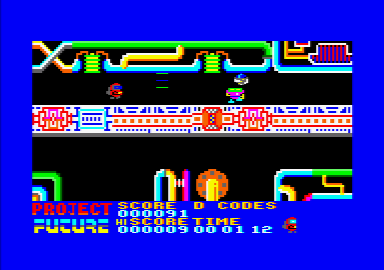
Visually, Project Future strikes a neat balance between retro charm and futuristic sheen. Each screen in the SS Future spaceship features distinctive color palettes—icy blues in cryogenic labs, pulsating reds in reactor chambers, and ominous purples in alien bio-labs—helping players quickly gauge their location. Background animations, such as warning lights flashing or steam vents hissing, give each environment a sense of lived-in authenticity.
The character and enemy sprites are crisply defined, ensuring you can spot regenerating droids or incoming projectiles at a glance. Weapon effects—ranging from horizontal laser blasts to explosive rounds—are rendered with satisfying flashes and small shockwaves, lending weight to each encounter. Even on high-density screens, the action remains clear and uncluttered, thanks to a well-designed HUD that only appears when necessary.
Project Future’s graphical performance is rock solid: no frame drops, even during the most chaotic firefights. This consistency is crucial when split-second reactions determine success or failure. Animations for pickups—like the armour suit materializing or the scooter buzzing into your inventory—are brief but visually distinct, reinforcing the reward of each find.
While the game doesn’t boast cutting-edge 3D effects, its polished 2D aesthetic feels deliberate and timeless. Fans of classic side-scrollers will appreciate the minimalist yet expressive art style, and newcomers will find it immediately readable. The artistic direction complements the high-stakes gameplay, reinforcing the sense that every corridor and control room you traverse is part of an imminent planetary crisis.
Story
The narrative in Project Future is straightforward but effective: you’re a freshly graduated cadet from Space College, tasked with preventing the catastrophic crash of the SS Future. Early mission briefings convey the stakes succinctly, using archived transmissions and status logs rather than lengthy cutscenes. This approach keeps you focused on gameplay while still reminding you why each self-destruct code fragment matters.
As you progress through the 256 screens, environmental storytelling plays a key role. Scorched walls hint at previous skirmishes, audio logs recount desperate crew attempts to contain the crisis, and scattered datapads fill in backstory lore—revealing corporate rivalries and experimental AI gone awry. These details slowly deepen your investment in the mission’s outcome, making each new room feel like a piece of a larger puzzle.
Characterization is sparse, but cleverly conveyed. Your cadet doesn’t speak, yet the choice to collect extra lives and power-ups implies a determined survivor who adapts on the fly. Enemy droids, though faceless, exhibit varied behaviors—some charge directly while others lay traps—giving them personality through gameplay rather than dialogue. This minimalist narrative style ensures the pacing never stalls.
By the time you reach the ship’s core and input the final code fragment, the story has set you up for a dramatic self-destruct countdown. The tension ramps up as alarms blare and corridors collapse, culminating in a last-second dash to the extraction point. It’s a satisfying payoff that reinforces the high stakes introduced at the very start of your Space College career.
Overall Experience
Project Future delivers a tightly constructed action-platformer that blends puzzle elements, strategic power-up management, and relentless combat across 256 memorably varied screens. Its learning curve is steep, but that sense of overcoming seemingly impossible odds keeps you coming back. Each victory feels earned, and the game’s design ensures there’s always another secret to unearth or mastery to achieve.
While the absence of an elaborate 3D engine or voice-acted cutscenes may leave some players craving more spectacle, the game’s purity of focus is its greatest asset. Every visual and mechanical choice serves the core mission: navigate treacherous corridors, outsmart regenerating droids, and save Earth from imminent doom. This unwavering clarity of purpose makes for a cohesive and immersive experience.
Whether you’re a fan of retro-inspired platformers or simply enjoy methodical, high-stakes challenges, Project Future offers hours of engrossing gameplay. The combination of level memorization, timely power-up deployment, and tight controls elevates what could have been a rote side-scroller into a tactical thrill ride. Even after completing the main mission, hidden collectibles and time-trial modes extend the replay value substantially.
Overall, Project Future stands out as a meticulously crafted sci-fi adventure. Its mix of demanding gameplay, polished visuals, and streamlined storytelling yields an experience that’s both approachable and deeply rewarding. If you’re ready to test your reflexes and strategic thinking under the looming threat of planetary destruction, this is one mission you won’t want to miss.


Reviews
There are no reviews yet.