 Retro Replay Retro Replay gaming reviews, news, emulation, geek stuff and more!
Retro Replay Review
Gameplay
The Graphic Adventure Creator (GAC) shines as a versatile toolkit for crafting interactive fiction. With allowances for up to 255 nouns, 255 verbs, 255 adverbs, and a staggering 9,999 rooms, designers can build sprawling worlds without worrying about early limits. That said, you must keep your entire adventure under 23K in size, which encourages concise writing and efficient use of resources.
(HEY YOU!! We hope you enjoy! We try not to run ads. So basically, this is a very expensive hobby running this site. Please consider joining us for updates, forums, and more. Network w/ us to make some cash or friends while retro gaming, and you can win some free retro games for posting. Okay, carry on 👍)
One of GAC’s standout features is its robust conditional logic system. You can define high-priority conditions that trigger automatically—perfect for checking life, health, or non-interactive events as players move between rooms. Local-priority conditions let you fine-tune room-specific interactions, while low-priority conditions monitor the player’s inventory or global flags. This three-tiered approach ensures your narrative can branch, react, and adapt in satisfying ways.
Interacting with your creation is a breeze thanks to GAC’s intuitive parser. It not only recognizes “it” references—so players can “take box and open it”—but also handles multiple commands per line. To speed up development, GAC includes a quick-start file preloaded with common verbs (“take,” “look”), responses (“What now?” “Pardon?”), and messages. Two sample adventures—one graphical, one text-only—let you reverse-engineer working scenarios and get started immediately.
Graphics
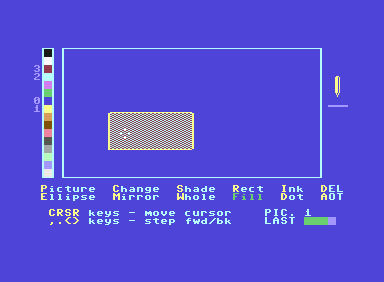
While GAC is first and foremost an interactive fiction engine, it offers a simple but capable background graphics utility. Users can draw scenes pixel by pixel or import low-res images, adding visual flair to their text adventures. The built-in drawing tool strikes a balance between ease of use and creative control, enabling designers to sketch environments without needing a separate art package.
Included in the package is a short sample graphic adventure that highlights how visuals can enhance immersion. Even with basic line art and limited palette, the graphics breathe life into key locations—an eerie castle hall, a mist-shrouded forest, and more. This demo proves that, with clever design, simple images can complement storytelling rather than overshadow it.
Keep in mind that graphical ambitions must fit within the strict 23K limit, and resolution is modest by modern standards. Yet for retro enthusiasts, these constraints spark creativity. You’ll learn to optimize your artwork, reuse graphical assets across rooms, and lean on text where images get too heavy. The result is a harmonious blend of words and visuals that feels authentically “80s” and refreshingly hands-on.
Story
At its core, GAC empowers storytellers to build branching narratives with remarkable depth. Defining up to 255 verbs and adverbs opens avenues for nuanced player commands—“carefully pry box open,” “softly call out,” and so on. Combining these with a robust noun list and expansive room map, you can craft mysteries, puzzles, or epic quests in granular detail.
The conditional framework fosters dynamic storytelling. High-priority triggers can simulate timed events—doors slamming shut, hidden enemies emerging—while local and low-priority checks keep track of puzzle states, item locations, and player choices. Rather than linear scripts, you get a living world that reacts to every decision, creating tension and replay value.
For authors daunted by blank pages, GAC’s quick-start sample adventures provide concrete templates. Peek at the text-only example to see elegant room descriptions, snappy dialogue, and inventory puzzles in action. Then adapt or expand them, tailoring story beats to your vision. Whether you aim for a gothic horror tale or a lighthearted treasure hunt, GAC’s structure gives your narrative both backbone and flexibility.
Overall Experience
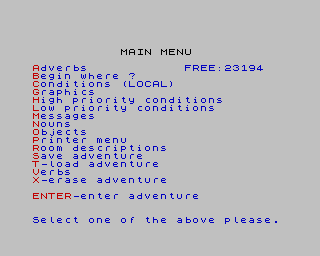
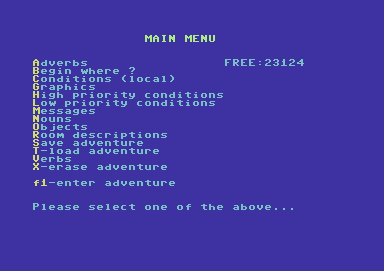
Getting started with GAC is surprisingly straightforward. The installation process is minimal, documentation is clear, and the quick-start file has you modifying a working adventure within minutes. As you grow more comfortable, you’ll appreciate the logical layout of menus, the clarity of condition-setting screens, and the instant feedback when testing your game.
From a value standpoint, The Graphic Adventure Creator is a bargain for aspiring designers and educators. It transforms the daunting task of programming from scratch into a guided, creative process. In classrooms, it can serve as an entry point to coding logic; for hobbyists, it’s a canvas for imaginative worlds. The supportive community around GAC also means plenty of user-created tutorials, scripts, and shared adventures to explore.
In sum, GAC strikes an engaging balance between technical rigor and creative freedom. While its 23K limit and retro-era graphics might feel quaint today, these very constraints foster innovation and charm. If you’ve ever dreamed of building your own text or graphic adventure without diving deep into low-level code, The Graphic Adventure Creator is an inspiring and practical choice.


Reviews
There are no reviews yet.