 Retro Replay Retro Replay gaming reviews, news, emulation, geek stuff and more!




Retro Replay Review
Gameplay
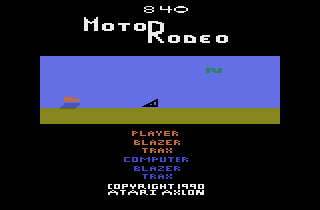
MotoRodeo stands out on the Atari 2600 for bringing true split-screen monster truck racing to a platform primarily known for its simpler titles. From the moment you power on the console, you’re greeted with the option to configure not only whether your opponent is a human or the computer, but also whether you’ll be behind the wheel of a blazing racer or a hulking truck. Further customization comes in the choice between traditional tires—which help you conquer obstacles more easily—and trax, which launch you higher when you hit a ramp. This level of pre-race configuration was virtually unheard of on 2600 cartridges, giving MotoRodeo early bragging rights in the customization department.
(HEY YOU!! We hope you enjoy! We try not to run ads. So basically, this is a very expensive hobby running this site. Please consider joining us for updates, forums, and more. Network w/ us to make some cash or friends while retro gaming, and you can win some free retro games for posting. Okay, carry on 👍)
Once the race begins, controls feel intuitive despite the platform’s limitations. Pushing the joystick forward accelerates your truck, while pulling down on the stick executes a wheelie that can help you maintain speed across uneven ground. In mid-air, tilting left or right affects your spin and landing angle; mastering these aerial maneuvers is key to racking up big points. When you find yourself bogged down in mud, a rapid left-right wiggle frees you, rewarding quick reflexes. Collectible nitro bursts add an extra layer of strategy—pressing the button and pushing forward unleashes a speed boost you’ll want to save for straightaways or crucial overtaking moments.
Another innovative feature is the use of the Atari difficulty switch. Set to “A,” you engage in a point-based contest, where executing perfect landings, crushing cars, and hitting on-screen targets all add to your score. Switch it to “B,” and the mode shifts to a pure timing race, where being the first across the finish line secures victory regardless of tricks performed. This toggle effectively gives players two distinct ways to enjoy the same tracks, doubling replay value without any extra code.
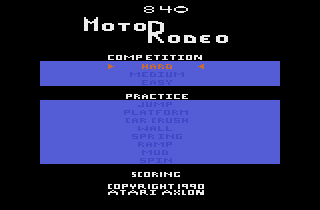
For those wanting practice before diving into full competitions, MotoRodeo provides dedicated obstacle-training sessions. You can focus on mastering tricky platforms and ramps without worrying about an opponent breathing down your neck. This practice mode is particularly helpful for newcomers who may be overwhelmed by the split-screen action and varied terrain. By the time you’re ready to face off in a full race, you’ll have refined your wheelies, jumps, and mud-escape techniques to near perfection.
Graphics
Graphically, MotoRodeo pushes the Atari 2600 hardware to its limits. The screen is split vertically, presenting two separate racing lanes simultaneously—a bold design choice that leads to occasional sprite flicker but never detracts from the core experience. Each vehicle is rendered in bright, contrasting colors so that you and your opponent are easily distinguishable even in the heat of competition. Given the 2600’s palette, the backdrops are kept simple but effective, with sand pits, ramps, and obstacles clearly outlined against a uniform background.
Despite the system’s restrictions, the developers managed to imbue each environment with character. Crashed cars along the track appear in a different shade, letting you know where hazards lie. Ramps and platforms have distinctive shapes, and the mud bog is a dark patch that visibly slows your tractor’s progress before you wiggle free. While modern gamers might find the visuals rudimentary, there’s an undeniable charm in seeing a monster truck race distilled to its pixel-perfect essentials.
One subtle but appreciated detail is how the trucks animate during wheelies and jumps. When you pull off a successful spin, the vehicle’s sprite rotates ever so slightly, giving a sense of motion that belies the 2600’s simple graphics engine. Nitro bursts trigger a brief flicker around the front of the truck, effectively conveying sudden acceleration. It’s these little touches that transform MotoRodeo from a basic racing game into a visually engaging spectacle—even if “spectacle” in this case means 8-bit artistry.
Overall, while MotoRodeo won’t rival 16-bit or 32-bit titles, it offers one of the most ambitious graphical presentations on the Atari 2600. The decision to employ split-screen racing, combined with clear, colorful sprites and expressive animations, elevates the visuals from “functional” to genuinely impressive given the era and hardware.
Story
MotoRodeo doesn’t come with a deep narrative or character arcs—instead, the “story” unfolds through the sheer adrenaline of head-to-head monster truck competition. The premise is straightforward: you and an opponent—be it man or machine—compete across four grueling tracks, each dotted with ramps, mud pits, and obstacles to be crushed. The simplicity allows players to jump right into the action, focusing on speed, stunts, and strategic nitro use rather than cutscenes or plot points.
That said, there’s a sense of tournament progression built into the game. Choosing Easy, Medium, or Hard difficulty doesn’t just change AI aggression; it implicitly tells a story of rising stakes, from local fair circuits to championship arenas. As you switch on the difficulty switch and push for the highest score or fastest time, you craft your own narrative of underdog triumph or reigning champion—without a single line of dialogue.
The alternating competitive modes—scoring versus timing—also lend a meta-story to each play session. One race might be the “Trick Masters Cup,” where points are king, while the next on the same cartridge becomes the “Speed Demon Challenge,” a pure dash to the tape. This organic storytelling through varied objectives keeps each session feeling fresh and personal, a clever workaround for consoles that lacked onboard memory for elaborate stories.
In short, MotoRodeo’s narrative heartbeat lies not in characters or cutscenes but in the evolving challenges you set for yourself. The trophy you imagine, the crowd’s roar you envision, and the bragging rights you seek—those intangible elements form the game’s true storyline, driven by your imagination and competitive spirit.
Overall Experience
There’s a nostalgic thrill in seeing MotoRodeo’s split-screen monster truck racing on a platform as venerable as the Atari 2600. The game’s depth lies not just in its control nuances—wheelies, mid-air spins, mud escapes, and nitro bursts—but also in its flexible difficulty switch, which seamlessly transforms the mode from score-chasing to pure racing. Players get a robust package that keeps delivering fresh challenges, whether you’re perfecting a stunt or battling for first place.
Accessibility is another highlight. You can pick up the joystick and have fun within minutes, thanks to clear instructions on controls and scoring laid out right at the start. Yet true mastery demands practice, making the included obstacle tutorials invaluable. Competitive couch gaming takes on new life when two players—human or CPU—face off in their respective halves of the screen, trading crashes, big jumps, and last-second finishes.
MotoRodeo may not boast the flashy production values of later racing titles, but its blend of customization, split-screen action, and creative use of the Atari’s hardware results in a standout experience. Whether you’re a retro collector seeking the pinnacle of 2600 racing or a newcomer curious about gaming history, this cartridge delivers engaging, replayable thrills. In a library built on simplicity, MotoRodeo stands tall as one of the platform’s most ambitious and satisfying racing adventures.
For anyone looking to dive into classic console racing, MotoRodeo is a must-have. Its intuitive yet deep gameplay, inventive visuals on limited hardware, and endless competition loops guarantee that every race feels like a new challenge. Fire up your Atari, grab a friend (or face off against the computer), and prepare for monster truck mayhem in its purest 8-bit form.


Reviews
There are no reviews yet.