 Retro Replay Retro Replay gaming reviews, news, emulation, geek stuff and more!
Retro Replay Review
Gameplay
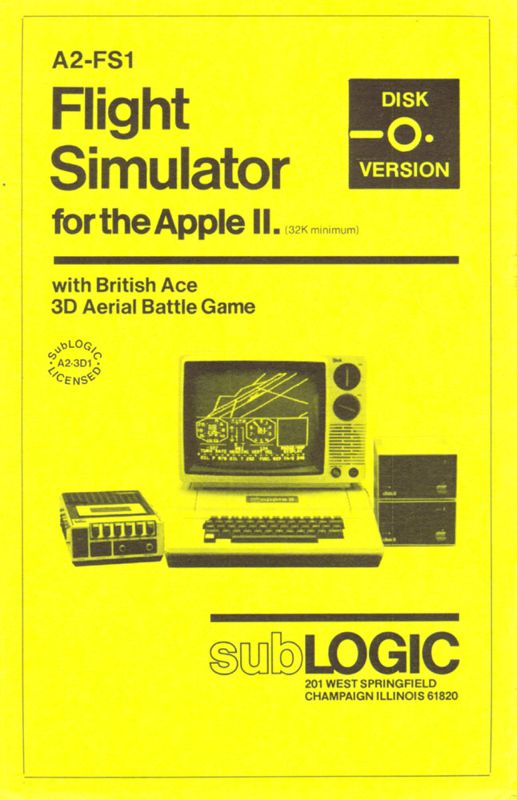
Flight Simulator traces its roots back to the very beginnings of home computing and still impresses with its straightforward yet deeply engaging mechanics. In its original incarnation on the Apple II and TRS-80, you pilot a single aircraft across a simple 6×6 grid dotted with polygonal “mountains.” At first glance, it’s a bare‐bones sandbox: there’s no autopilot, no flight school mode—only you, the instruments, and the horizon.
(HEY YOU!! We hope you enjoy! We try not to run ads. So basically, this is a very expensive hobby running this site. Please consider joining us for updates, forums, and more. Network w/ us to make some cash or friends while retro gaming, and you can win some free retro games for posting. Okay, carry on 👍)
What makes the gameplay enduring is its blend of relaxed flight and optional combat. By pressing “W,” you switch into the WW1 “British Ace” mode, transforming your fly-around into a dogfight scenario. Enemy planes streak across the sky, you lock on with the rudimentary sight reticle, and every successful shot or downed enemy base brings a surprising rush of satisfaction given the simulation’s humble graphical pedigree.
Controls are mapped intuitively: throttle up and down, rudder and ailerons by simple keystrokes, with real-time response that belies the monophonic meltdown of tape-loaded data. Even in this earliest form, Flight Simulator balances authenticity with accessibility, inviting newcomers to learn by doing, and rewarding veterans who master the tilt and torque of the primitive instrument panel.
Graphics
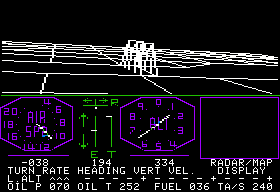
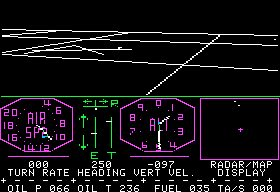
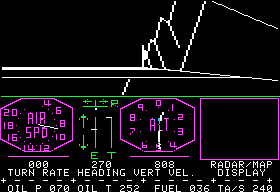
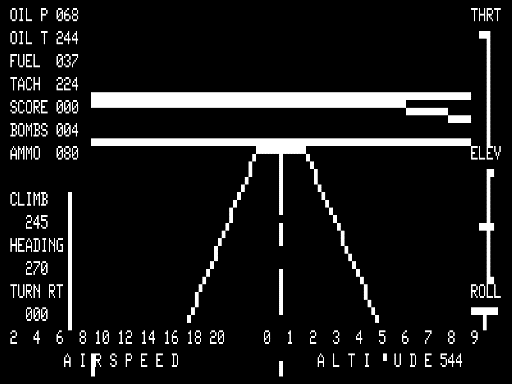
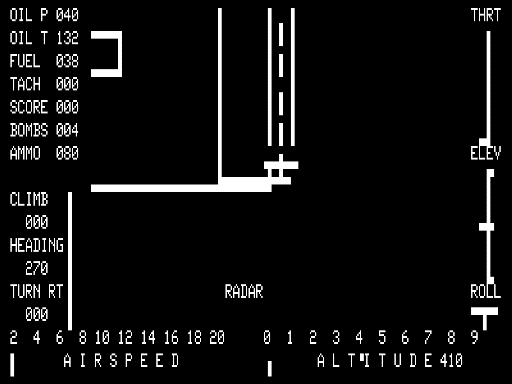
By contemporary standards, Flight Simulator’s visuals are laughably minimal: on the TRS-80 you see only a 128×48 monochrome display of numbers and bars, while the Apple II adds a scaled-down instrument panel at the bottom and a sparse horizon view above. Mountains appear as blocky pyramids, and aircraft are mere wireframe shapes—but that simplicity is part of its retro charm.
The Apple II update in 1981 brought subtle refinements: smoother animation, slightly richer shading on the mountains, and a tidier cockpit layout. Even so, there’s no texture mapping, no anti-aliasing—just raw vector lines and numeric readouts. This stripped-down aesthetic forces you to focus on flight fundamentals rather than graphical spectacle.
Fast-forward to the first PC release (Microsoft Flight Simulator v1.0 in 1982), and you’ll recognize many of the same design cues from the 8-bit editions. The instrument dials become crisper, the horizon scrolls more fluidly, and terrain elevation feels a bit more nuanced. Yet at every stage, Flight Simulator remains less about eye candy and more about the visceral thrill of aviation rendered in its purest digital form.
Story
Flight Simulator has never pretended to be a narrative‐driven title—it offers no elaborate plot, branching dialogue, or character arcs. Instead, its “story” is the one you write with every takeoff and landing. The only built-in scenario is the WW1 “British Ace” mode, which casts you as a lone pilot tasked with bombing enemy bases and fending off hostile fighters.
Within this minimalist framework, imagination fills the gaps. You decide your flight path, weather conditions, and aerial objectives. Each sortie becomes a personal adventure: will you circle the mountain peaks for scenic exploration, or dive straight into combat? The lack of a canned narrative lets you create your own tales of triumph and near-misses.
For players seeking traditional storytelling, Flight Simulator may feel skeletal. But for those who cherish open-ended experiences and the emergent drama of pilot vs. sky, its open-ended “narrative” is far more compelling than any cutscene or voiceover ever could be.
Overall Experience
Evaluated on its own historical terms, Flight Simulator is nothing short of groundbreaking. It defined home-computer flight simulation, inspired countless sequels, and fostered a community of virtual aviators long before 3D graphics cards existed. As a piece of gaming history, it offers invaluable insight into the genre’s evolution.
Modern players buying a retro compilation or vintage hardware should approach Flight Simulator with tempered expectations: you won’t find dynamic weather engines, photorealistic terrain, or multiplayer dogfights across continents. What you will discover, however, is the pure joy of mastering a challenge that strips away every extraneous flourish.
For collectors and enthusiasts of simulation history, Flight Simulator is an essential experience. It may not dazzle with modern trappings, but its elegant simplicity and open-ended design laid the foundation for decades of aviation virtuality. As an introduction to flight sims or a nostalgic trip for veterans, it remains a rewarding journey through digital skies.


Reviews
There are no reviews yet.