 Retro Replay Retro Replay gaming reviews, news, emulation, geek stuff and more!
Retro Replay Review
Gameplay
KnightQuest brings an ambitious Dungeons & Dragons–inspired rule set to the Apple II, offering deep character creation and tactical challenges. Players choose from four professions—fighter, thief, cleric, and mage—and three races: Human, Dwarf, or Elf. Each profession unlocks unique abilities, and the system’s artificial intelligence handles encounter outcomes with dice-roll mechanics that mimic true tabletop play.
(HEY YOU!! We hope you enjoy! We try not to run ads. So basically, this is a very expensive hobby running this site. Please consider joining us for updates, forums, and more. Network w/ us to make some cash or friends while retro gaming, and you can win some free retro games for posting. Okay, carry on 👍)
The game’s magic system is one of its most substantial draws. With 17 spells ranging from HEAL and RESURRECT to BLAST and INVISIBILITY, every adventurer can experiment with offensive, defensive, and utility magic. Mastering the interplay of spells like FORCEFIELD to block enemy attacks or SCARE to control crowds adds strategic depth, especially when facing dungeon traps or powerful monsters.
However, KnightQuest’s complexity is a double-edged sword. The Apple II’s limited RAM leads to painfully slow response times when casting spells or moving between screens. Long load times for new areas and noticeable input lag undercut the excitement of exploring its richly detailed worlds. Enthusiasts may tolerate the wait for the sake of depth, but newcomers could become frustrated by the system’s sluggish pace.
Graphics
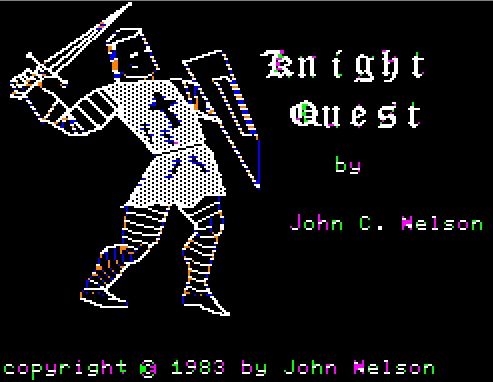
Visually, KnightQuest sticks to the minimalist aesthetic of classic Eamon adventures. The Apple II’s text-mode and low-resolution graphics render rooms and monsters in simple character art, relying heavily on the player’s imagination. This approach keeps memory usage down—but in KnightQuest’s case, memory is already stretched to its limits.
There are occasional line-drawn maps and rudimentary icons for treasure chests, keys, and potions, but no elaborate sprites or animations. Ambient sound is nonexistent, and the color palette is limited to what the Apple II’s hi-res modes can produce. Fans of retro text adventures will find charm in the sparse visuals, while others may see it as a missed opportunity.
Performance hiccups further complicate the graphical presentation. Screen redraws take noticeable time, and flipping between inventory, map screens, and main views can feel cumbersome. Though some grit and stutter are expected on period hardware, KnightQuest pushes the Apple II beyond its comfort zone, and the visual experience sometimes suffers as a result.
Story
KnightQuest is bundled with three handcrafted adventures that showcase its RPG engine: Amateur Alley, Curse of the Hellsblade, and Quest for the Firedragon. Amateur Alley serves as a beginners’ introduction, presenting low-risk puzzles and straightforward combat. It evolves into an easy yet satisfying tutorial that eases new adventurers into the system’s mechanics.
Curse of the Hellsblade ups the stakes with a dark narrative and formidable foes. Players unravel the mystery behind a cursed weapon, navigating traps, deciphering ancient languages—from Elvish to Trollish—and forging alliances with reluctant NPCs. The immersive storytelling shines through its text descriptions, even if graphical reinforcement is minimal.
Quest for the Firedragon offers the grand finale: a multi-layered dungeon, epic boss fights, and artifact hunts. With 26 different artifact types—ranging from Key and Portal to Vitamin and Trap—the game encourages thorough exploration and creative problem-solving. Each item can be manipulated or combined, lending a pioneering sandbox feel seldom seen in contemporaneous Apple II titles.
Overall Experience
KnightQuest is an undeniably ambitious update to the venerable Eamon engine, striving for a true D&D–style RPG on the Apple II. Its robust character classes, extensive spell list, multifaceted artifact system, and multilingual elements create a playground for hardcore role-playing fans. For those willing to invest time into learning its systems, KnightQuest can deliver hours of strategic fun.
Yet the Apple II hardware buckles under the weight of these enhancements. Slow load times, memory-choked gameplay, and the absence of sound or rich visuals remind players of the platform’s limitations. KnightQuest stands as a testament to creative ambition, but it may have been better suited for the later IBM PC environment, where John C. Nelson ultimately shifted his efforts.
In the end, KnightQuest is a niche gem: a powerful, feature-packed RPG engine that pushes the boundaries of what the Apple II can handle. Serious retro-gaming enthusiasts and dedicated text-adventure aficionados will appreciate its depth, while casual players or those sensitive to performance issues may find the experience frustrating. Potential buyers should weigh their tolerance for slow operation against the system’s impressive breadth of content.



Reviews
There are no reviews yet.