 Retro Replay Retro Replay gaming reviews, news, emulation, geek stuff and more!
Retro Replay Review
Gameplay
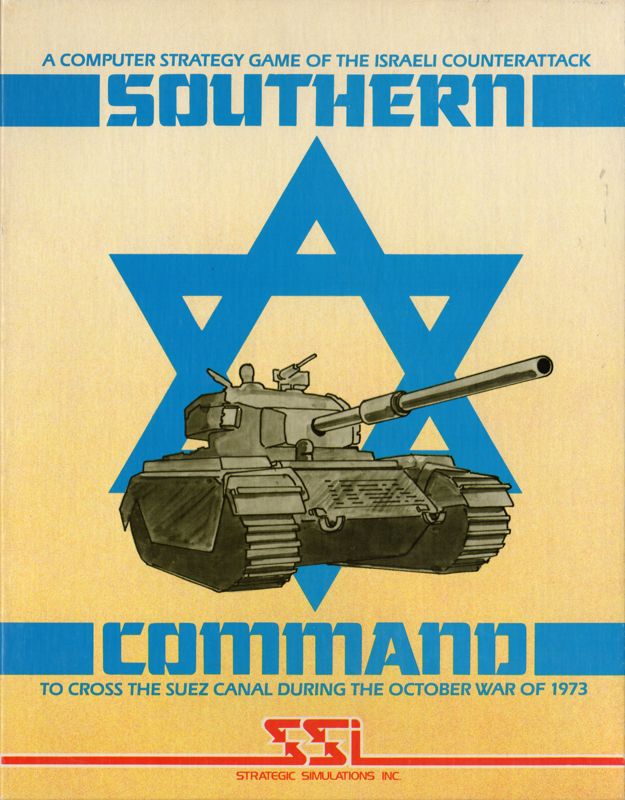
Southern Command places you at the helm of the Israeli Defense Forces in a meticulously simulated encounter from the 1973 Arab–Israeli War. The core of the experience revolves around a hex-based map that faithfully reproduces terrain features and key strategic objectives along the Suez Canal front. Each hex hosts units with detailed statistics for movement, attack strength, defense ratings, and supply status, evoking the feel of a classic paper wargame brought to life by computer precision.
(HEY YOU!! We hope you enjoy! We try not to run ads. So basically, this is a very expensive hobby running this site. Please consider joining us for updates, forums, and more. Network w/ us to make some cash or friends while retro gaming, and you can win some free retro games for posting. Okay, carry on 👍)
The game’s combat resolution system is where the computer truly shines. Instead of relying on simple dice-rolling or randomized modifiers, every engagement is subject to a layered calculation that factors in terrain, unit cohesion, supply lines, and even weather conditions. This depth ensures that tactical planning and operational foresight are rewarded—each decision to advance, dig in, or concentrate firepower carries real weight.
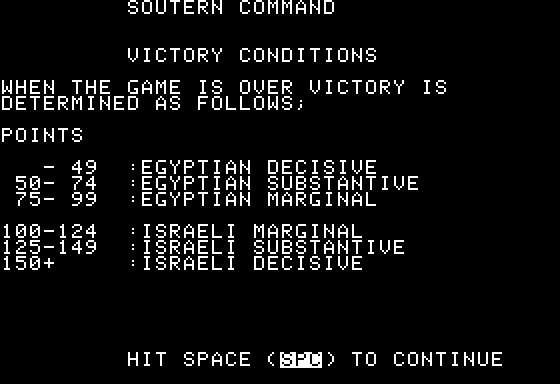
Balancing the historical imbalance of forces is achieved through carefully designed victory conditions and rules of engagement. Israeli units are prohibited from crossing into enemy territory until an Arab unit has already made that move, ensuring that frontal assaults are never trivially easy. Meanwhile, achieving the highest victory level demands you push forward decisively and capture key objectives under tight time constraints, framing a constant tension between caution and aggression.
Artificial intelligence controls the Arab forces with surprising competence. The AI commander will exploit gaps in your lines, launch counterattacks, and withdraw to defensible terrain when overmatched. While the AI does not exhibit human-level creativity, its methodical adherence to the same rules and statistics you use makes every matchup feel fair and appropriately challenging.
Graphics
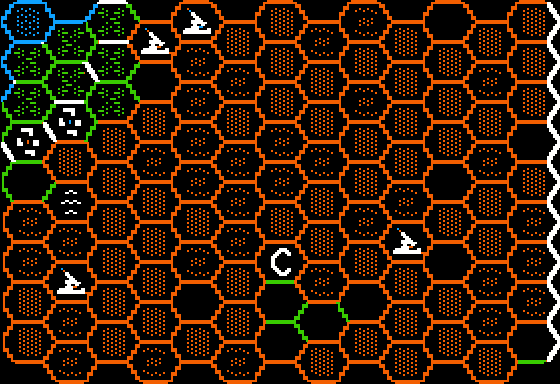
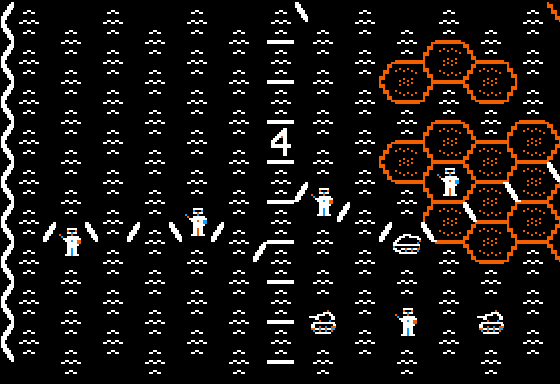
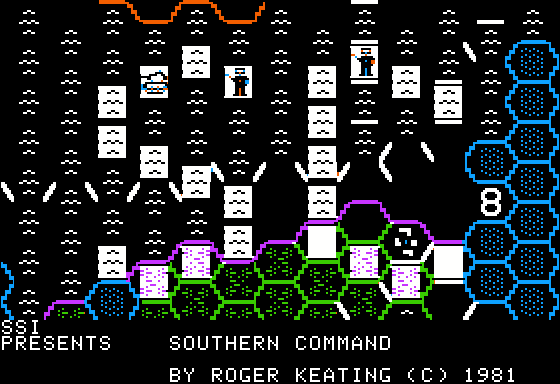
Southern Command’s visuals are functional rather than flashy, reflecting its origins as a desktop wargame. Terrain hexes are clearly delineated, with color-coded overlays to indicate roads, canals, elevation, and zones of control. Unit counters are represented by simple icons annotated with key stats so that you can quickly assess the composition and readiness of forces at a glance.
The user interface sticks to a classic wargame layout: a map window dominates the screen, flanked by panels showing unit details, turn phases, and a log of recent actions. While the palette leans toward drab greens and browns, the strong contrast between friendly and enemy units helps prevent misclicks in the heat of battle. Animations are minimal—primarily unit movement arrows and combat result markers—but they serve to underscore each decision without slowing the pace.
Camera zoom is limited to two levels, but this is seldom an issue given the game’s emphasis on operational planning over individual unit tactics. Tooltips and pop-up modifiers provide instant feedback on attack odds, movement costs, and supply checks. This transparency is crucial for newcomers to hex wargaming who want to learn advanced concepts without resorting to outside reference materials every turn.
While there’s no photo-realistic 3D rendering or particle effects, Southern Command’s graphics style is perfectly suited to its purpose. The priority is clarity and accuracy, ensuring that every factor influencing a battle outcome is presented in an unambiguous manner. For players who appreciate function over form, the visual design will feel refreshingly straightforward.
Story
Though Southern Command is primarily a wargame rather than a narrative-driven experience, it is steeped in historical context. The game manual opens with an overview of the Yom Kippur War’s opening moves, detailing the strategic significance of the Suez Canal crossing by Egyptian forces and the subsequent Israeli counteroffensive. This background not only sets the scene but also informs your tactical priorities throughout the campaign.
Each mission begins with a briefing that outlines your objectives—holding key defensive positions, repelling enemy advances, or launching counterattacks to sever supply lines. Supplementary historical notes appear after significant turns, recounting real-world parallels and explaining why certain maneuvers succeeded or failed in the actual conflict. These vignettes enrich the dry statistics and remind players that each hex holds a story of lives and decisions.
The emphasis on historical fidelity extends to unit designations and order of battle. You’ll command real Israeli brigades equipped with specific tanks, infantry, and artillery units, while facing Egyptian and Syrian formations that follow their authentic wartime organization. This attention to detail fosters a sense of immersion that goes beyond mere map conquest—it becomes a study in how commanders on both sides navigated the operational challenges of 1973.
While there are no animated cutscenes or character arcs, the interwoven historical commentary and scenario objectives provide enough narrative substance to engage strategy enthusiasts. You won’t find personal subplots or voice-acted dialogue, but the game’s commitment to portraying the ebb and flow of a defining twentieth-century battle delivers its own dramatic tension.
Overall Experience
Southern Command is a deep, methodical wargame tailor-made for players who relish hex-based strategy and historical simulation. The learning curve can be steep—novices may need a few scenarios to grasp supply mechanics, combat resolution layers, and victory conditions—but the in-game tutorials and extensive manual make the process manageable. Persistence pays off, as every victory feels genuinely earned.
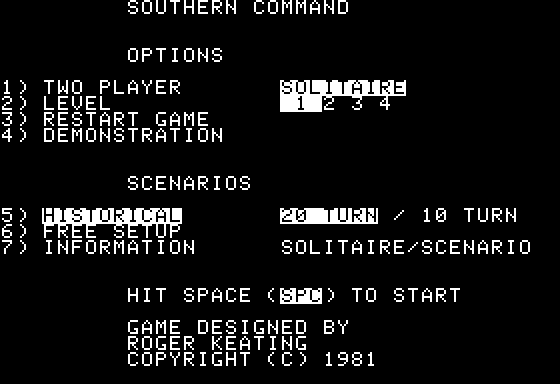
The pacing is deliberate: each turn represents several hours of battle, and a full scenario can span dozens of turns. This measured tempo encourages long-term planning and risk assessment rather than frantic micromanagement. Replayability is high, thanks to adjustable difficulty levels, optional fog of war settings, and the AI’s variable strategic priorities.
Southern Command shines as a digital evolution of traditional paper wargaming. By offloading complex calculations to the computer, it frees you to focus on grand strategy and tactical finesse without getting bogged down in manual record-keeping. If you’ve ever longed for a high-fidelity simulation of the Yom Kippur War’s critical western front, this title delivers that experience in spades.
Ultimately, Southern Command offers an engrossing blend of historical authenticity, strategic depth, and computer-assisted detail. It’s best suited for dedicated wargamers and history buffs who appreciate a no-frills presentation in favor of robust mechanics. For those willing to invest the time to master its systems, the game provides a rewarding glimpse into one of modern warfare’s most pivotal engagements.



Reviews
There are no reviews yet.