 Retro Replay Retro Replay gaming reviews, news, emulation, geek stuff and more!



Retro Replay Review
Gameplay
Star Cruiser delivers a classic arcade experience reminiscent of early Space Invaders and Galaxian titles, but with its own distinctive twists. Players pilot a nimble starfighter across the bottom of the screen, dodging swarms of alien craft while lining up precision shots. The controls are immediately responsive, allowing for quick lateral movements and rapid-fire blasts—essential skills when dozens of Space Egg–shaped enemies descend in tight formations.
(HEY YOU!! We hope you enjoy! We try not to run ads. So basically, this is a very expensive hobby running this site. Please consider joining us for updates, forums, and more. Network w/ us to make some cash or friends while retro gaming, and you can win some free retro games for posting. Okay, carry on 👍)
Despite its simple premise, the gameplay introduces incremental challenges that keep each wave feeling fresh. As you clear one formation of large, egg-like targets, the next wave may shift direction more aggressively or descend faster, demanding sharper reflexes. While there are no complex power-up systems, the increasing speed and variety of movement patterns provide a steady ramp-up in difficulty that encourages repeated attempts and pattern memorization.
One of Star Cruiser’s most engaging aspects is its balance of immediacy and strategy. You quickly grasp the fundamental loop—dodge, fire, reload—the moment the game begins. Yet mastering the positioning, anticipating enemy dives, and maximizing survival time adds layers of depth. Casual players can enjoy intuitive pick-up-and-play fun, while hardcore fans will appreciate the tight collision detection and the subtle risk-reward of venturing into the densest parts of the swarm for higher scores.
Graphics
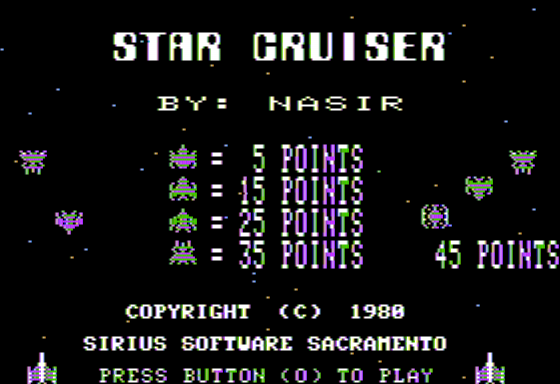
Graphically, Star Cruiser makes the most of the Apple II’s modest palette and resolution. The screen features crisp, blocky sprites that evoke the pixel art charm of early 1980s arcade machines. Enemies appear as bright, Space Egg–shaped icons in contrasting hues, ensuring they stand out clearly against the pitch-black backdrop of space. This high visibility is more than aesthetic—it’s a deliberate design choice that enhances gameplay by making targets easy to track even during chaotic waves.
The animation is straightforward but effective. Enemy ships bob and swoop in clearly defined patterns, while your starfighter’s thrusters flicker to indicate movement. When foes are hit, they disintegrate into a brief shower of pixels, providing satisfying feedback without taxing the hardware. Though there’s no scrolling background or elaborate set pieces, the minimalist presentation keeps the action focused and free from visual clutter.
Sound effects complement the visuals with retro bleeps and bloops that recall arcade cabinets of yesteryear. Each shot you fire echoes with a crisp pew-pew, and enemy explosions punctuate critical hits with a retro zing. While faint background music is absent—typical of early Apple II titles—this decision underscores the game’s lean, performance-oriented design, ensuring that players remain locked into the playfield without auditory distractions.
Story
At its core, Star Cruiser’s narrative is elegantly simple: you are the last line of defense against invading alien forces intent on conquering your quadrant. There’s no lengthy exposition or branching dialogue trees—just a quick setup that invites you to step into the cockpit and start blasting. This streamlined approach echoes the arcade roots of the genre, where immediate action outweighs intricate storytelling.
That said, the game’s manual and packaging provide a brief backstory that frames each wave as a critical battle to protect humanity’s outposts. This minimal lore fuels the sense of urgency and stakes without bogging down the gameplay. For many players, this is more than sufficient: the thrill of wave after wave of attackers serves as an implicit storyline of survival against the odds.
In lieu of in-game cutscenes or character development, Star Cruiser uses its escalating difficulty curve to tell a story of progression and mastery. Each successive wave feels like a new chapter in an interstellar struggle, and your growing skill becomes the only narrative thread you actively shape. It’s a storytelling style that may feel skeletal by modern standards, but it retains a certain purity that fans of retro shooters will appreciate.
Overall Experience
Star Cruiser stands as a testament to the enduring appeal of early arcade-style shooters. Its straightforward mechanics, clean visuals, and escalating challenge make it accessible to newcomers while offering enough nuance for seasoned players seeking high-score glory. There’s an immediacy to the action that resonates even decades after its initial release on the Apple II.
While it may lack the bells and whistles of later space shooters—no power-ups, branching levels, or elaborate bosses—its focus on tight, responsive controls and clear enemy design ensures every minute feels purposeful. Whether you’re a nostalgia-driven retro collector or a modern gamer curious about the roots of the genre, Star Cruiser provides an authentic slice of gaming history that still holds up as a fun, bite-sized challenge.
In the end, the real draw of Star Cruiser lies in its simplicity. It’s a compact, pick-up-and-play experience that rewards practice and pattern recognition. If you’re looking for a quick blast of classic arcade action or a way to appreciate the foundational mechanics that shaped countless shooters to follow, Star Cruiser is well worth your time—and your quarters.


Reviews
There are no reviews yet.