 Retro Replay Retro Replay gaming reviews, news, emulation, geek stuff and more!



Retro Replay Review
Gameplay
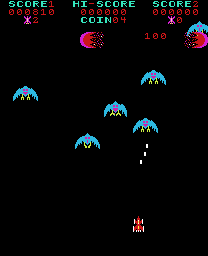
Phoenix delivers a fast-paced, arcade-style challenge that instantly evokes the nostalgia of classic shooters like Space Invaders. You control the Phoenix, maneuvering horizontally along the bottom of the screen to dodge incoming fire and line up your laser cannon for precise shots. From the first wave of bird-like creatures to the final clash with the mothership, every moment demands quick reflexes and strategic positioning.
(HEY YOU!! We hope you enjoy! We try not to run ads. So basically, this is a very expensive hobby running this site. Please consider joining us for updates, forums, and more. Network w/ us to make some cash or friends while retro gaming, and you can win some free retro games for posting. Okay, carry on 👍)
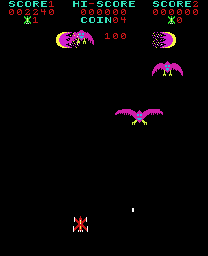
The game’s progression through four distinct tiers of avian foes keeps the action feeling fresh. Early levels introduce smaller, agile attackers that dive-bomb in unpredictable patterns, while later stages feature larger groups moving in tight formations. Each wave builds on the last, forcing you to adapt on the fly and master both offense and defense. Your force field ability adds an extra layer of strategy, allowing you to absorb one hit per cycle—timing its activation can mean the difference between victory and a sudden Game Over.
Once you’ve vanquished the fourth avian squadron, the climactic battle against the heavily shielded mothership begins. This boss encounter is a genuine test of endurance, as its rotating shields and barrage of missiles require careful target selection and agile dodging. Upon destroying the mothership, the game restarts at a higher speed, ensuring that even veteran players must stay alert. The increasing difficulty curve makes Phoenix an endlessly replayable title for those who thrive on high-score competition.
Graphics
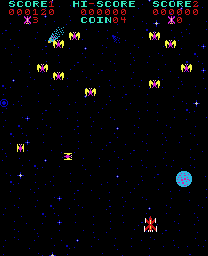
Phoenix embraces a retro pixel-art aesthetic that pays homage to arcade classics while adding its own modern touches. The vibrant color palette brings each enemy type to life: the smaller bird-creatures glow in electric hues, while the massive mothership boasts shifting metallic shades that emphasize its formidable shields. Background elements, such as distant stars and drifting asteroid fields, add depth without distracting from the core action.
Animation is another strong suit of Phoenix’s visual design. Enemy dive patterns are smooth and fluid, with each creature breaking formation in a believable way. Explosions are rendered with cascading pixels, giving each ship destruction a satisfying impact. Even the Phoenix’s laser beams and shield effects are crafted to feel weighty and responsive, creating a visual feedback loop that rewards accurate shots and well-timed defenses.
Despite its simplicity, Phoenix’s user interface is clean and intuitive. Score, lives, and shield status are displayed unobtrusively at the top of the screen, freeing up the play area for the real action. The crispness of the sprites ensures that even on modern displays, you can appreciate the retro charm without any noticeable blurring or scaling artifacts. Overall, the graphics strike a perfect balance between nostalgic flair and functional clarity.
Story
While Phoenix focuses primarily on arcade action, its premise gives the game a clear narrative drive. You are the commander of the last surviving starfighter tasked with stopping an alien warship that has been siphoning resources from your home planet. The minimal storyline is delivered through short text interludes between cycles, but these snippets are enough to instill a sense of urgency and personal stakes.
The progression from bird-like minions to the final mothership provides a natural escalation in the narrative. Each defeated wave feels like a meaningful push deeper into enemy territory, and the ultimate showdown against the colossal flagship carries real weight—even if the story beats are presented in broad strokes. This approach keeps the focus squarely on the core gameplay loop while offering just enough context to keep you engaged.
After each victorious run, you receive a brief communiqué hinting at the aliens’ growing desperation and new assault tactics. These narrative teasers add flavor to the otherwise straightforward arcade action, motivating you to chase higher scores and see how far you can push your Phoenix into hostile space. Though not the most elaborate tale, the story in Phoenix effectively complements the high-score chase with a clear, motivating goal.
Overall Experience
Phoenix stands out as a modern tribute to golden-age arcade shooters, delivering tight controls, relentless challenge, and addictive replay value. Whether you’re a longtime fan of Space Invaders–style gameplay or a newcomer seeking a pure, action-packed experience, this title offers hours of immediate fun. The simple yet deep mechanics make it easy to pick up but difficult to master—a hallmark of great arcade design.
The game’s escalating difficulty ensures that no two play sessions feel the same. As speed ramps up and enemy patterns become more devious, you’ll find yourself refining strategies, learning enemy tells, and squeezing every possible point out of each wave. Leaderboards and local high-score tracking further enhance the competitive spirit, making Phoenix an ideal choice for solo challenge-hunters and group gatherings alike.
With its striking retro visuals, solid sound design, and relentless arcade pacing, Phoenix provides a finely tuned package that honors its influences while carving out its own identity. The combination of laser cannon fire, force field tactics, and boss battles delivers a satisfying progression curve that keeps you coming back for one more run. For players craving an old-school arcade blitz with modern polish, Phoenix is a must-have addition to any shooter collection.


Reviews
There are no reviews yet.