 Retro Replay Retro Replay gaming reviews, news, emulation, geek stuff and more!


Retro Replay Review
Gameplay
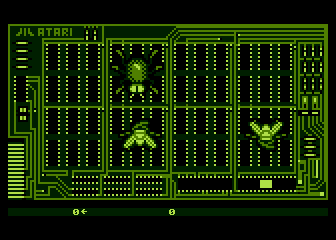
Bug Hunt turns a simple late-night debugging scenario into a frantic, light-gun-powered shooting gallery. Players use the Atari XG-1 light gun to pick off an array of insects that have infested a computer circuit board. From stationary, lumbering beetles to fast-darting flies, each critter offers a unique challenge: some yield modest points, while the more agile pests demand quick reflexes and precise aim to net high scores.
(HEY YOU!! We hope you enjoy! We try not to run ads. So basically, this is a very expensive hobby running this site. Please consider joining us for updates, forums, and more. Network w/ us to make some cash or friends while retro gaming, and you can win some free retro games for posting. Okay, carry on 👍)
The core loop spans seven increasingly difficult waves. Early levels allow for a generous margin of error—only 25% accuracy is needed to advance—but later stages demand near-pinpoint precision, with an 80% hit rate required to tackle the final swarm. This progression curve rewards players who master the light gun’s calibration and anticipate the bugs’ movement patterns, fostering a satisfying sense of improvement over repeated runs.
Accuracy isn’t just for bragging rights. At the end of the game, your overall hit percentage converts into a tongue-in-cheek performance rating, ranging from entry-level “CEO” to top-tier “Engineer” or “Programmer.” Chasing higher ranks encourages replayability, as you refine your technique, minimize missed shots, and learn the spawn locations of tougher insects.
While the game’s mechanics are straightforward, minor quirks—such as occasional misreads if your CRT isn’t properly synced—add a dash of unpredictability. Hardcore players will appreciate the tight window for error in later waves, while newcomers can enjoy the pick-up-and-play nature of this arcade-style shooter.
Graphics
Visually, Bug Hunt embraces the limitations of the Atari XEGS hardware with colorful, cartoon-style insect sprites set against the stark backdrop of a circuit board. Each bug is rendered in bright hues, making them easy targets against the dark PCB tracks. Despite the low resolution, the designers achieve remarkable clarity: you can instantly distinguish a spider from a butterfly, or a tick from a frog.
The choice of a static circuit board as the background helps bugs stand out, but it also reinforces the game’s tech-themed premise. Subtle animations—like the flicker of solder joints or the occasional spark—add life to the scene without overwhelming the action. When dozens of insects swarm the screen, you still have a clear view of both targets and the board’s intricate pathways.
Of course, playing on a modern LCD can introduce issues with light-gun compatibility. For the optimal experience, a properly tuned CRT display remains the gold standard. Under those conditions, Bug Hunt’s visuals pop, the gun’s cursor tracks smoothly, and the vibrant insect artwork truly shines in stark contrast to the black background.
While it won’t rival modern shooters in polygon count or texture detail, the game’s retro aesthetic holds its own as a charming relic of 1980s design. Its simplicity is part of the appeal, delivering fast-paced action without unnecessary visual clutter.
Story
Bug Hunt doesn’t dwell on deep narrative arcs—its premise is told almost entirely through the game’s manual and brief opening text. You’re a lone technician burning the midnight oil, trying to debug a new circuit board, when suddenly the malfunctioning hardware spawns real, living pests. Armed only with your trusty XG-1, you must defend the board from a full-blown infestation.
This minimal storyline provides just enough context to ground the gameplay. The juxtaposition of high-tech electronics and lowly creepy-crawlies injects a playful sense of whimsy, making each burst of rapid-fire insect slaughter feel like a tongue-in-cheek triumph against technological warfare.
Progress through the waves and the game’s comedic rank titles—ranging from “Manager” to “Hacker” and “Engineer”—serve as a running commentary on corporate hierarchies. Achieving an “Engineer” rating might not save the world, but it does offer a small narrative reward for your sharpshooting prowess.
While purists seeking a deep plot may find the story sparse, fans of arcade shooters will appreciate the straightforward setup. It’s a classic scenario of “reason to shoot,” and that simplicity ensures you spend your time pulling the trigger rather than slogging through dialogue trees.
Overall Experience
Bug Hunt stands out as a rare example of a light-gun game on the Atari XEGS platform. Its pick-up-and-play design, combined with the tactile satisfaction of the XG-1, delivers an engaging retro experience. Whether you’re revisiting the classic era or discovering it for the first time, the game offers addictive, wave-based shooting that rewards practice and precision.
Replay value hinges on chasing higher performance ratings and the sheer fun of blasting animated bugs out of existence. The seven waves strike a good balance—long enough to test your skills, but short enough to encourage multiple playthroughs in a single sitting. The built-in ranking system adds a competitive edge, perfect for friendly high-score battles at gatherings.
That said, prospective buyers should be aware of its limitations. There’s no co-op or multiplayer mode, and after you’ve mastered the spawn patterns, the core loop can feel repetitive. Additionally, the necessity of a CRT display and proprietary light gun makes it a niche purchase, primarily suited for dedicated retro collectors or Atari XEGS enthusiasts.
Overall, Bug Hunt is a standout novelty in the Atari library. It may not offer the narrative depth or graphical sophistication of later titles, but its unique hardware integration and satisfying challenge make it a memorable addition to any classic shooter lineup. If you own the XG-1 or an XEGS with the bundled gun, this arcade-style bug-blasting romp is well worth adding to your collection.



Reviews
There are no reviews yet.