 Retro Replay Retro Replay gaming reviews, news, emulation, geek stuff and more!
Retro Replay Review
Gameplay
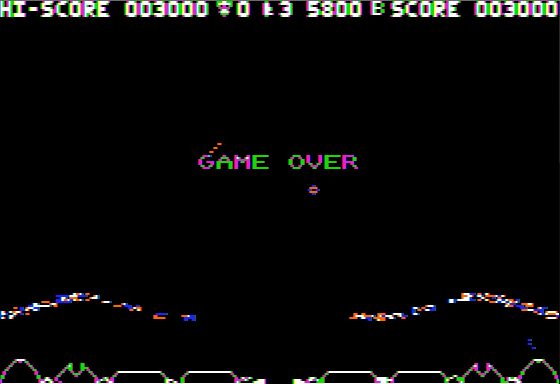
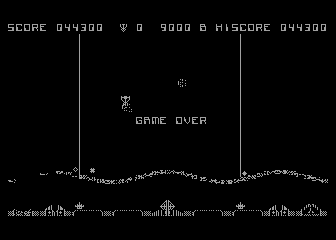
Marauder’s gameplay is built around two distinct but complementary stages that keep the action varied and intense. In Stage 1 – Landing, you pilot one of three agile jets through a gauntlet of lasers, turrets, flying bombs, and barriers. The controls are crisp and responsive, allowing for precise maneuvers and blistering strafing runs. Success depends on your ability to line up shots while weaving through incoming fire, and the risk-reward system for speed kills adds an extra layer of strategy for high-score chasers.
(HEY YOU!! We hope you enjoy! We try not to run ads. So basically, this is a very expensive hobby running this site. Please consider joining us for updates, forums, and more. Network w/ us to make some cash or friends while retro gaming, and you can win some free retro games for posting. Okay, carry on 👍)
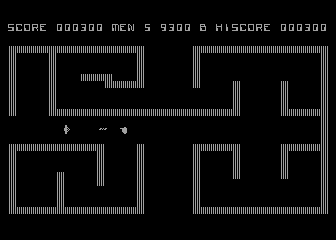
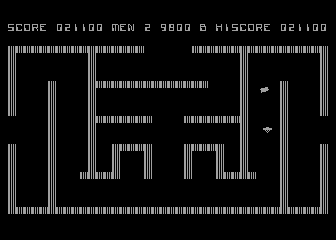
Transitioning into Stage 2 – Sabotaging, the pace shifts from aerial dogfights to tense infiltration. Here you guide one of six crew members through dimly lit corridors filled with guards. The stealth mechanics reward patience; guards have limited vision cones and won’t detect you if you stay out of sight or carefully time your shots. Each successful takedown or evasion contributes points, and destroying the power station under time pressure keeps the adrenaline pumping.
The interplay between jet combat and on-foot stealth is where Marauder truly shines. You’ll find yourself refining your approach in each stage—learning attack patterns, memorizing guard patrol routes, and optimizing jet loadouts. Replay value is high, thanks to bonus multipliers for speed and efficiency. Enemies respawn and defenses become more aggressive after each power station destruction, ensuring that each loop feels progressively more challenging.
Graphics
Marauder sports a mid-century sci-fi aesthetic with vibrant color contrasts and detailed environmental designs. The exterior base lighting is dynamic, casting long shadows from radar towers and searchlights that heighten the sense of danger during your descent. Explosion and laser effects feel weighty, adding satisfying feedback to both your offensive strikes and incoming enemy fire.
In the sabotage stage, the fortress interiors shift to darker palettes, illuminated by emergency lighting and sporadic sparks from damaged machinery. Textures on walls, floor grates, and power conduits are well-defined, creating believable corridors that feel like part of a lived-in facility. Character sprites and guard models are detailed enough to distinguish uniforms and weapon types at a glance, aiding in tactical decision-making.
Performance remains steady even when the screen is filled with tracer rounds and multiple explosions. On modern hardware the framerate holds firm, with minimal pop-in or slowdown. The game includes customizable graphical settings for lighting, particle effects, and draw distance, allowing players on a range of systems to find the right balance of fidelity and performance.
Story
While Marauder’s narrative is straightforward, it effectively contextualizes the high-octane action. You play as an elite pilot-commando tasked with crippling an enemy’s power infrastructure. The dual-stage structure underscores the escalating stakes: first you breach the outer defenses, then you must survive within the heart of the facility. The urgency to complete your mission before reinforcements can arrive is palpable, driving you forward through each stage.
The game hints at a larger conflict through brief radio chatter and mission briefs, suggesting a world locked in a resource-based war. Character backstories are minimal, but the sense of camaraderie among the six crew members adds weight to each death or recovery. The looping mission structure—where scientists rebuild destroyed generators—reinforces the idea that you’re striking at the very heart of your enemy’s war machine.
Although there are no lengthy cutscenes or branching dialogues, the story is communicated efficiently through environmental cues and mission summaries. Each level’s briefing provides context, and the escalating difficulty mirrors the narrative of an enemy determined to defend its critical assets at all costs. For players seeking a lore-heavy experience, the story may feel light, but it never interrupts the core gameplay.
Overall Experience
Marauder delivers a compelling blend of fast-paced aerial combat and stealthy infiltration that will appeal to fans of both genres. The two-stage format prevents monotony, ensuring that you’re constantly adapting your tactics. Speed bonuses and high-score chasing give the game strong arcade appeal, while the steadily increasing difficulty keeps seasoned players engaged.
The graphical presentation and performance are solid, with eye-catching effects and detailed environments that bring the fortified base to life. Stealth mechanics in the sabotage stage are intuitive yet deep, rewarding careful planning as much as quick reflexes. The looping mission design, with rebuilt power stations and more guards, provides a compelling reason to revisit stages and perfect your runs.
While the narrative is light on exposition, it serves its purpose by framing your objectives and heightening the sense of an ongoing war. Marauder’s strengths lie in its addictive gameplay loop, tight controls, and satisfying feedback from both jet and on-foot combat. For players looking for an action-packed experience with layers of strategy and replayability, Marauder is a formidable choice.

Reviews
There are no reviews yet.