 Retro Replay Retro Replay gaming reviews, news, emulation, geek stuff and more!
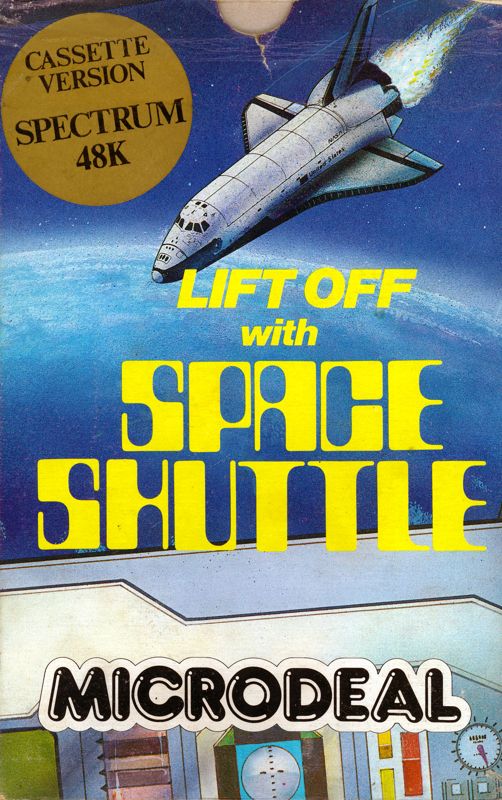


Retro Replay Review
Gameplay
Shuttle Simulator delivers a methodical and highly structured gameplay experience that revolves around five distinct mission stages: Launch, Park, Arm, Entry, and Final Approach. Each stage poses its own set of challenges, from guiding the spacecraft out of Earth’s gravity well to delicately capturing a free-floating satellite with the robotic arm. Controls are primarily handled with a joystick, giving the player a tactile sense of piloting the shuttle as they adjust attitude, thrust, and trajectory in real time.
(HEY YOU!! We hope you enjoy! We try not to run ads. So basically, this is a very expensive hobby running this site. Please consider joining us for updates, forums, and more. Network w/ us to make some cash or friends while retro gaming, and you can win some free retro games for posting. Okay, carry on 👍)
The cockpit view dominates the screen, presenting a tightly packed array of instruments, gauges, and indicators that track altitude, speed, mission progress, and shuttle attitude. A narrow stripe in the center offers an outside view to help orient the player visually during critical maneuvers. Instruments are fully functional, and even minor adjustments can significantly alter your flight path, making attention to detail essential throughout each phase.
To ease newcomers into the complexity of spaceflight, Shuttle Simulator does not immediately abort the mission upon missing a parameter. Instead, it awards points based on how accurately you complete each stage, encouraging experimentation and learning without punishing the player too harshly. This design choice strikes a balance between realism and accessibility, allowing you to refine your approach over multiple attempts.
While the learning curve can be steep—particularly when coordinating between the cockpit instruments and the external camera view—the reward comes in the form of a deeply satisfying simulation. Mastering the timing and precision necessary for satellite capture or re-entry lining up is a testament to the game’s commitment to authentic shuttle operation, making every successful mission feel like a genuine accomplishment.
Graphics
Given its vintage origins, Shuttle Simulator’s graphics are deliberately minimalist but functional. The cockpit is rendered in simple wireframe and block colors, focusing the player’s attention on the myriad of dials and readouts rather than on elaborate textures or shading. This clean presentation ensures that crucial information remains legible even during high-stress maneuvers.
The outside view, displayed as a slim viewport down the center of the screen, offers a basic 3D representation of the shuttle and target satellite. While the models lack fine detail, their clarity is sufficient for gauging proximity and orientation. The designers opted for pedagogical simplicity here, allowing players to quickly interpret spatial relationships without getting bogged down by visual clutter.
Despite its sparse visuals, the game effectively conveys the vastness of space and the precision required for orbital flight. Stars, Earth’s curvature, and the satellite itself are depicted with simple polygons, but the sense of scale remains intact. This stripped-down style can even heighten immersion, as the focus stays squarely on the mechanics of shuttle operations.
Color contrast and interface layout are thoughtfully arranged to minimize confusion. Alarms, warnings, and stage-completion indicators light up in bright hues when specific criteria are met or missed, providing immediate feedback. For players interested in pure simulation rather than flashy visuals, Shuttle Simulator’s graphical approach is both purposeful and serviceable.
Story
Shuttle Simulator’s narrative premise is straightforward: NASA has tasked you with retrieving a failed satellite that poses a significant risk if left adrift. Though the backstory is minimal, the clear mission objectives—launch, rendezvous, capture, and return—give each stage a tangible purpose, driving the gameplay forward with a sense of urgency.
The mission briefing, while concise, sets the tone for an authentic shuttle operation. You’re constantly reminded of the high stakes involved in spaceflight, from the initial ascent through atmospheric drag to the delicate final approach to Earth. This narrative framework, though light on dialogue or cutscenes, is woven seamlessly into the gameplay mechanics and instrument panels.
Throughout the mission, the absence of cinematic story beats is compensated by real-time data updates and mission stage notifications. As you progress, status messages confirm successful rendezvous, satellite grappling, or altitude milestones. This style of storytelling—rooted in procedural and instrumental feedback—immerses you in the role of shuttle pilot without breaking from the simulation’s core focus.
Ultimately, the story is less about characters and more about the unfolding of each technical milestone. For players who relish mission-based narratives driven by objective completion rather than elaborate plot twists, Shuttle Simulator offers a compelling, if understated, tale of space exploration and engineering achievement.
Overall Experience
Shuttle Simulator stands out as a purist’s flight sim, designed for those who appreciate the intricacies of spacecraft operation over overt entertainment. Its deliberate pace and emphasis on instrument-based navigation create an experience that is as intellectually demanding as it is rewarding. Each successful maneuver deepens your understanding of orbital mechanics and shuttle systems.
Newcomers may find the game daunting at first, but the built-in safety net of point-based stage scoring encourages trial and error without harsh penalties. As you gain familiarity with the controls and learn to interpret the cockpit readouts, the simulator reveals its layered complexity, making every retry feel fresh and educational.
Replay value comes from the desire to perfect each stage, chase higher scores, and execute textbook-perfect missions. Whether you aim to fine-tune your launch trajectory, master the robotic arm, or nail the re-entry alignment, there’s always room for improvement. This focus on player growth makes Shuttle Simulator more than a one-and-done title—it’s a platform for honing real-time decision-making skills.
In sum, Shuttle Simulator is a rewarding niche experience for simulation enthusiasts and space aficionados alike. Its modest graphics and sparse storytelling might deter casual players, but for anyone seeking a genuine taste of NASA-style shuttle operations, this title remains a noteworthy and instructive journey through the stages of spaceflight.


Reviews
There are no reviews yet.