 Retro Replay Retro Replay gaming reviews, news, emulation, geek stuff and more!
Retro Replay Review
Gameplay
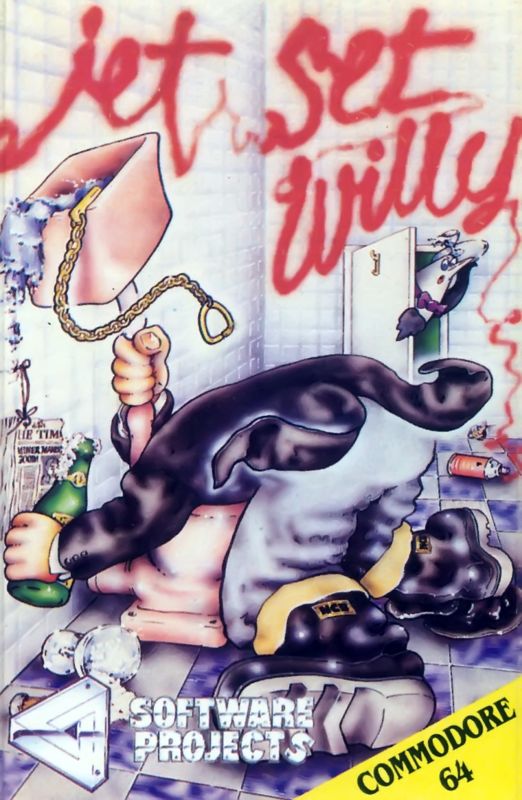
Jet Set Willy builds upon the tight mechanics of its predecessor, Manic Miner, by offering a sprawling non-linear world that rewards careful exploration. From the very start, players can venture into any of the mansion’s 60+ rooms, each filled with unique challenges such as spikes, roaming guardians, and perilous drop-offs. This freedom of movement was groundbreaking at the time and demands that players plan routes meticulously, often consulting hand-drawn maps to avoid deadly backtracking.
(HEY YOU!! We hope you enjoy! We try not to run ads. So basically, this is a very expensive hobby running this site. Please consider joining us for updates, forums, and more. Network w/ us to make some cash or friends while retro gaming, and you can win some free retro games for posting. Okay, carry on 👍)
Control of Willy feels precise for an early 1980s platformer, with responsive jumps and the ability to grab ropes mid-leap, adding depth to traversal. The instant-death design—hit a monster, touch a hazard, or fall too far, and you’re returned to the room’s entrance—creates high-stakes tension. While this can lead to frustration, it also makes each successful passage feel hard-earned and rewarding, especially when chaining together sequences of rooms without losing a life.
A unique facet of Jet Set Willy is its manual protection system: players must refer to a colour-coded sheet to unlock the game. Though many modern players find this cumbersome, it’s an authentic piece of gaming history that encourages a tangible connection to the experience. More importantly, the mansion’s intricate layout and multiple entrances to certain rooms turn the game into one of the earliest action-titles to make mapping a genuine strategic asset.
The difficulty curve can spike abruptly, with some rooms requiring pixel-perfect timing and memorization of enemy patterns. However, the non-linear structure allows skilled players to bypass particularly brutal sections and return later with more confidence. Those seeking a rigorous, puzzle-like platforming challenge will find Jet Set Willy both demanding and endlessly replayable.
Graphics
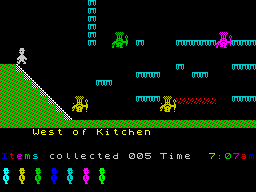
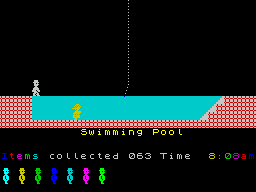
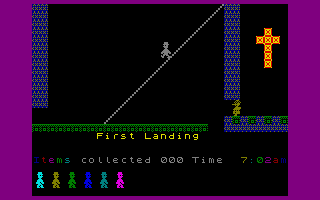
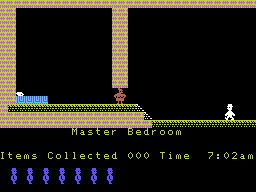
Visually, Jet Set Willy embraces the limitations of the ZX Spectrum and Commodore 64 hardware, presenting a charming 8-bit palette that accentuates each room’s personality. The static single-screen rooms are crisply drawn, with colourful backgrounds that change as you explore the mansion’s various wings—from the Gothic library to the nautical-themed conservatory.
Character sprites are simple but distinctive: Willy’s bright outfit makes him stand out against the environment, and each hazard or guardian has just enough animation to signal danger without cluttering the screen. The occasional flicker or attribute clash on the Spectrum version is a minor quirk that many retro enthusiasts actually find endearing, a reminder of the creativity developers employed to overcome technical constraints.
Room designs are imaginative, featuring everything from floating skulls to giant scissors, each presented with a playful yet ominous flair. The repetition of certain tile sets is balanced by the variety of colour schemes and obstacle placements, ensuring that no two areas feel exactly the same. Though there’s no scrolling, the static screens give the game a sense of solidity and allow players to study layouts at a glance.
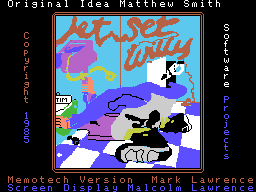
Sound effects are minimal—jumps, falls, and enemy contacts are accompanied by simple bleeps—but they serve their purpose in providing feedback. A catchy, albeit repetitive, title tune plays on load-up, setting a jaunty tone that contrasts hilariously with the brutal trial awaiting Willy inside his own home.
Story
Jet Set Willy’s narrative is delightfully straightforward: after striking it lucky in the mining business (as seen in Manic Miner), Willy’s ambition has led him to purchase an opulent mansion. His housekeeper, diligently pale from overwork, demands that he tidy up the entire estate before he can rest. It’s a humorous premise that frames the platforming mayhem as a domestic chore.
While there’s no evolving plot or character development, the whimsical hazards and themed rooms convey a playful sense of storytelling. Each area feels like a miniature chapter in Willy’s cleanup saga—a dusty trophy room, a booby-trapped music hall, even a room filled with sentient wardrobes. This loose theme gives the game cohesion without bogging it down in exposition.
The lack of cutscenes or dialogue is characteristic of the era and leaves much to the player’s imagination. You’re not just jumping over objects; you’re helping Willy earn his rest by clearing out spectral heads, oversized household items, and other oddities that threaten his progress. The absurdity of the challenge becomes part of the charm, making for a narrative that’s less about depth and more about setting a tone of lighthearted absurdity.
For modern players accustomed to story-driven experiences, Jet Set Willy’s plot may feel thin, but it remains emblematic of early video game design where context was provided sparingly. The simple “tidy your mansion” hook is enough to motivate exploration and frames every room-clearing triumph with a smile.
Overall Experience
Playing Jet Set Willy today is a journey into gaming history, offering a mix of nostalgia and genuine challenge. Its sprawling mansion layout and emphasis on mapping distinguish it from other platformers of its era, encouraging players to think like cartographers as well as performers. The steep difficulty and permissive non-linearity combine to create an experience that’s as much about puzzle-solving as it is about reflexes.
The balance between frustration and reward is delicate; repeated deaths can feel punishing, yet each narrow escape and successful room clearance carries significant satisfaction. The game’s quirks—the manual protection sheet, attribute clash colour glitches, and static single-screen design—are reminders of a pioneering spirit in early home computing and contribute to its cult status.
Graphically simple but colourful, Jet Set Willy holds its own as a piece of interactive art from the dawn of the platform genre. The absence of modern conveniences like checkpoints or tutorials may deter some, but for those willing to invest time in mapping and memorization, the mansion’s many secrets and shortcuts become deeply gratifying to uncover.
Ultimately, Jet Set Willy stands as a must-play for retro enthusiasts and platforming purists. Its blend of exploration, precision, and inventive level design makes it an indelible part of gaming’s lineage. While it may not cater to every contemporary player’s taste, its historical importance and enduring charm ensure that Willy’s chaotic cleanup mission remains a riveting adventure decades after its release.


Reviews
There are no reviews yet.