 Retro Replay Retro Replay gaming reviews, news, emulation, geek stuff and more!


Retro Replay Review
Gameplay
Match delivers a deceptively simple core concept that evolves into a deeply engaging puzzle experience. At its heart, you’re presented with a grid of stone tiles, each engraved with a distinct symbol. Your goal is to clear the board by pairing identical stones that can be linked by a continuous line—whether adjacent, bending around one corner, or weaving through two corners. The clean ruleset makes it easy to pick up, but mastering the art of visualizing paths under pressure is where the real fun begins.
(HEY YOU!! We hope you enjoy! We try not to run ads. So basically, this is a very expensive hobby running this site. Please consider joining us for updates, forums, and more. Network w/ us to make some cash or friends while retro gaming, and you can win some free retro games for posting. Okay, carry on 👍)
The game’s three distinct level packs offer a gradual learning curve followed by randomized chaos. Level 1 spans eleven stages, shifting from straightforward adjacent matches to puzzles that require careful route planning. Level 2 features four predefined layouts, challenging you to memorize patterns and devise the most efficient removal order. Level 3 throws in random stone sets and varying grid sizes, ensuring no two sessions ever feel quite the same.
Time is both your ally and adversary in Match. Every level comes with a ticking clock, adding a pulse-pounding urgency to your decisions. Early stages grant generous time allowances, but as you advance, the countdown accelerates, forcing split-second judgments. This dynamic keeps the momentum high, transforming what could be a leisurely tile puzzle into a thrilling race against time.
Beyond raw tile-matching, Match rewards strategic foresight. Clearing a pair might open up new connection routes or trap remaining stones behind impassable clusters. Learning to sequence removals—sometimes deliberately leaving a simpler match for last—becomes its own form of tactical chess. For puzzle aficionados, this layering of pathfinding and time management is precisely what elevates Match above many of its peers.
Graphics
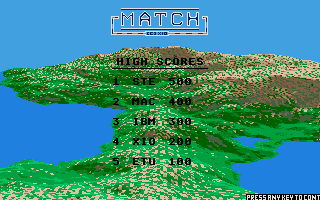
Though written in GFA Basic, Match’s presentation is refreshingly clear. Each stone tile features crisp line art and contrasting colors, making symbols instantly recognizable even during a frenzied match. The minimalist background and unobtrusive UI ensure that your focus remains on the puzzle grid, without distractions from flashy effects or overbearing animations.
Subtle visual cues enhance playability: when two stones can be legally connected, they highlight in soft hues, gently guiding your eye toward available moves. As levels grow more complex, these outlines become invaluable, preventing needless time wasted hunting for matches. It’s a smart design choice that balances immersion with practical assistance.
While Match doesn’t compete with modern 3D puzzle titles, its vintage charm is part of the appeal. The straightforward interface loads instantly, and transitions between stages are quick and glitch-free. For players who appreciate a no-frills aesthetic, the game’s graphical restraint feels intentional rather than outdated.
On higher-resolution displays, the stone sets scale neatly without pixelation, retaining their sharpness across a range of screen sizes. Whether you’re playing on an old-school retro setup or a contemporary emulator, the visuals remain consistent, ensuring that the focus always stays on strategy rather than squinting at blurry icons.
Story
Match doesn’t hide the fact that its emphasis is squarely on puzzles rather than narrative. There’s no elaborate backstory about ancient temples or mystical artifacts—just an elegant motif of matching and removal. While some players may miss a traditional storyline, others will appreciate the purity of a game that lets mechanics speak for themselves.
In lieu of a detailed plot, Match suggests a loose thematic connection: you’re an adept stone-weaver restoring balance by linking and removing chaotic pairs. This minimal framing gives you just enough context to feel purposeful without bogging you down in exposition. Each cleared board signifies a step closer to restoring order, however abstract that goal may be.
The progression through stages offers its own narrative arc. Early easy puzzles feel like training grounds in a stone-weaving academy, while the later randomized grids feel like gauntlet trials designed to test your mastery. That implicit story of personal growth—from novice matcher to seasoned strategist—becomes a satisfying journey in its own right.
Ultimately, if you seek a game driven by character arcs or world-building, Match may leave you wanting. But for those who find storytelling in emergent challenges and self-imposed goals, the absence of a conventional tale is a refreshing reprieve. Here, you write your own story through each puzzle you conquer.
Overall Experience
Match succeeds as a lightweight yet deeply challenging puzzle package. Its accessible ruleset ensures you’re solving your first board within seconds, while the later stages demand the kind of spatial reasoning and time management that seasoned gamers crave. The ticking clock transforms each match from a casual pastime into an intense duel with time itself.
The combination of predefined and randomized levels offers tremendous replay value. You’ll return to Level 2 layouts to shave precious seconds off your personal best, then dive into the ever-changing grids of Level 3 for endless variety. This balance of memorization and improvisation keeps the experience fresh, even after dozens of playthroughs.
While Match’s visuals and lack of narrative may feel spartan compared to blockbuster puzzle titles, its core gameplay shines through. The responsive controls, clear feedback, and escalating challenge curve demonstrate the enduring appeal of simple mechanics executed well. It’s a testament to how much depth can be found in the classic tile-matching formula.
For anyone seeking a quick-thinking, time-pressured puzzle challenge, Match is a must-try. Its elegant design, combined with three layers of levels, caters equally to newcomers and hardcore puzzle enthusiasts. If you’re after an experience that rewards both pattern recognition and split-second strategy, this GFA Basic gem delivers in spades.


Reviews
There are no reviews yet.