 Retro Replay Retro Replay gaming reviews, news, emulation, geek stuff and more!


Retro Replay Review
Gameplay
Midi-Maze stakes its claim in history as one of the first home-micro multiplayer first-person shooters, linking up to sixteen Atari STs via MIDI cables. The premise is simple yet compelling: navigate a tiled, 90°-cornered labyrinth and outwit your opponents with nothing more than a basic blaster and cunning tactics. While the core mechanics revolve around point-and-shoot encounters, the ability to switch between solo training against AI drones and full-blown free-for-all or team matches adds layers of replay value.
(HEY YOU!! We hope you enjoy! We try not to run ads. So basically, this is a very expensive hobby running this site. Please consider joining us for updates, forums, and more. Network w/ us to make some cash or friends while retro gaming, and you can win some free retro games for posting. Okay, carry on 👍)
The pacing of Midi-Maze hinges on its minimalist weapon system. Your only tool is a gun with a slight reload delay, forcing you to balance aggression with caution. This stripped-down approach emphasizes map knowledge and quick reflexes over inventory management. Veteran players will quickly learn to anticipate ambush points and utilize the grid-like structure of corridors to funnel opponents into chokepoints.
Networking through MIDI cables may sound archaic today, but in its time it delivered remarkably smooth, near-arcade responsiveness for up to sixteen participants. Join a four-player free-for-all, or coordinate tactics in team matches where communication is just as crucial as marksmanship. For newcomers wary of human competition, the option to practice against drones provides an accessible learning curve before stepping into a live match.
Graphics
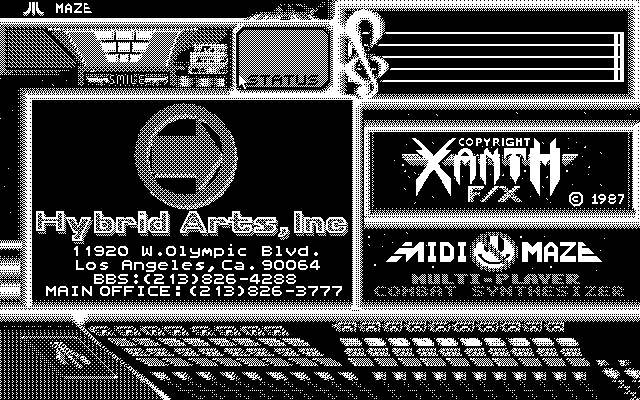
Visually, Midi-Maze embraces a pared-down aesthetic. All environments are rendered using filled polygons, producing chunky, block-like walls and sharply defined angles. While this approach lacks the texture richness of later 3D engines, it lends the game an almost abstract charm. The maze’s stark lines and flat shading keep performance smooth, even when the action heats up.
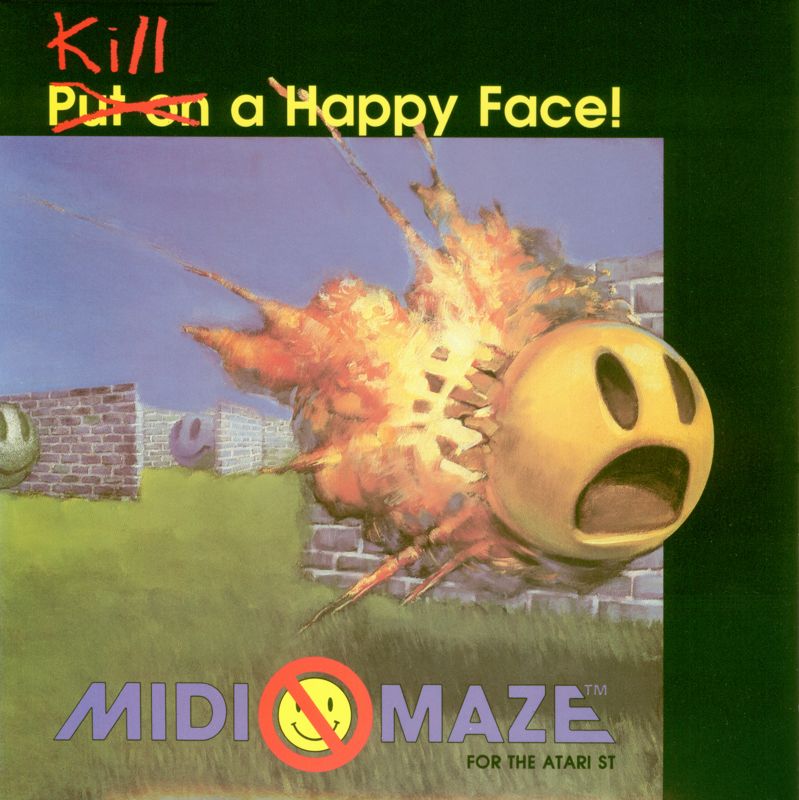
Player avatars are represented by oversized, floating smiling faces—a whimsical design choice that injects humor into each encounter. These cartoonish icons hover above the floor, making it easy to spot friend or foe as they weave through corridors. Though simplistic, the graphics clearly convey position, orientation, and proximity, ensuring that split-second decisions are based on reliable visual feedback rather than fancy effects.
Color palettes are limited but effective. Contrasting wall hues help distinguish different sections of the maze, while neutral floors maintain visual clarity during firefights. Occasional pulsing strobes or colored gates break up the monotony of gray corridors, creating landmark points that seasoned players learn to use for swift navigation and surprise attacks.
Story
Unlike narrative-driven shooters, Midi-Maze doesn’t weave an elaborate plot or character backstory. Instead, it resurrects the pure essence of competition first explored in the 1970s classic Maze War. The objective is simple: survive and score points by eliminating opponents in a virtual labyrinth.
This stripped-back scenario places the emphasis squarely on emergent storytelling. Every match crafts its own drama—epic streaks of dominance, near-miraculous escapes from drone ambushes, or tense stand-offs in narrow corridors. In that way, players become both the protagonists and the authors of their own high-octane tales.
The lack of a traditional storyline frees Midi-Maze to focus on pure gameplay dynamics. There’s no campy sci-fi trappings or lengthy cut-scenes—just you, your gun, and the maze. For many fans, this raw format is a refreshing break from modern shooters overloaded with plot exposition and scripted events.
Overall Experience
For retro enthusiasts and curious newcomers alike, Midi-Maze offers a unique window into the early days of networked FPS gaming. Its nostalgic charm lies in the way it transforms MIDI cables—typically reserved for music—into conduits for frantic multiplayer action. There’s something undeniably thrilling about seeing up to sixteen smiling faces dart around a polygonal maze, each representing a real opponent across linked machines.
While modern shooters boast photo-realistic graphics and sprawling open worlds, Midi-Maze’s strength is in its simplicity. Matches are quick to set up, easy to understand, and rely on pure skill rather than complex loadouts or upgrade trees. This makes it an excellent choice for game nights or LAN parties where fast-paced, pick-up-and-play action is key.
It’s important to note the hardware requirements: you’ll need multiple Atari STs and the appropriate MIDI cabling to recreate the original experience. Emulation can capture much of the gameplay, but nothing quite matches the thrill of real-time, cable-linked gunfights. If you have the vintage gear or the patience to emulate, Midi-Maze stands as a landmark title—a charming, historically significant milestone in the evolution of FPS gaming.


Reviews
There are no reviews yet.