 Retro Replay Retro Replay gaming reviews, news, emulation, geek stuff and more!
Retro Replay Review
Gameplay
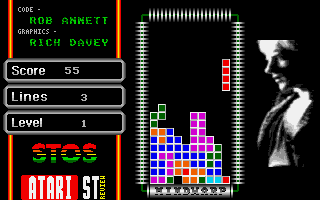
Mind Warp adheres closely to the classic falling-block formula, presenting formations of three or four blocks that cascade from the top of the playfield. Your task is to rotate and position these shapes into complete horizontal lines, causing them to vanish and clear space for the next blocks. This simple yet addictive loop captures the essence of why puzzle gamers keep coming back for “just one more level.”
(HEY YOU!! We hope you enjoy! We try not to run ads. So basically, this is a very expensive hobby running this site. Please consider joining us for updates, forums, and more. Network w/ us to make some cash or friends while retro gaming, and you can win some free retro games for posting. Okay, carry on 👍)
As you progress, the game tracks your performance by counting completed lines—reaching the tenth line propels you to the next level. With each level jump, the speed of falling pieces accelerates, demanding sharper reactions and more strategic planning. Early stages feel leisurely, allowing newcomers to grasp controls and develop stacking strategies, while later stages introduce real-time pressure that pushes your reflexes to the limit.
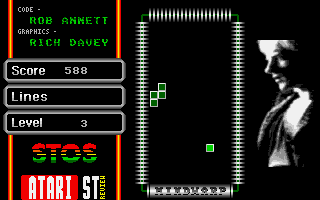
Starting at level three, Mind Warp ups the ante by adding pre-placed blocks into the playfield. These fixed obstacles force you to adapt your approach mid-game, carving out pockets and navigating around immovable barriers. The added complexity keeps each level feeling fresh, transforming familiar shapes into new spatial puzzles and testing your ability to think several moves ahead.
Control responsiveness is solid thanks to STOS’s efficient handling of input on the Atari ST platform. Rotations and lateral moves register without noticeable lag, making precision stacking a satisfying endeavor. Whether you’re a seasoned puzzle veteran or stepping into falling-block challenges for the first time, Mind Warp’s core gameplay loop delivers an engaging balance of familiarity and escalating difficulty.
Graphics
Designed in STOS, Mind Warp’s visual presentation delivers crisp, clean block shapes against a contrasting background. The bright, solid colors of each piece ensure immediate visual recognition, which is critical as the action speeds up. While the aesthetic is minimalistic, it remains highly functional—every block and pre-placed obstacle is clearly distinguishable even in the heat of play.
The game area is framed by a simple but effective UI that displays your current level, line count, and next block formation. This unobtrusive overlay keeps focus squarely on the action, while still providing all the necessary information at a glance. The clarity of the interface highlights how STOS can be leveraged to create efficient, no-frills puzzle experiences.
Animations are smooth, with blocks dropping and locking into place without any distracting flicker or tearing. The Atari ST’s palette may be limited compared to modern machines, but Mind Warp uses color contrast intelligently to differentiate piece types and emphasize cleared lines. Each vanishing line triggers a brief flash effect that adds a satisfying visual payoff.
While there’s no elaborate background art or dynamic camera movement, the stripped-down graphical style contributes to the game’s pure puzzle focus. The lack of visual clutter ensures that your attention remains on managing the grid, planning rotations, and clearing lines—exactly where it needs to be.
Story
Mind Warp foregoes an overt narrative, instead weaving its “story” through escalating mental challenges and hypnotic puzzle rhythms. The title itself hints at bending your perceptions and testing your spatial reasoning as shapes twist and shift under mounting time pressure. Each level can feel like a brief journey into a puzzle realm where quick thinking is your only guide.
The absence of cutscenes or character-driven plot may disappoint players seeking a traditional storyline, but this minimalism is intentional. By stripping away narrative layers, Mind Warp presents an uninterrupted puzzle experience that harks back to arcade-era simplicity. Your progress is marked solely by line counters and level numbers—a clear, unambiguous measure of your skill growth.
Though you won’t encounter quest logs or dialogue, the game constructs an implicit story of mastery and escalation. Early stages represent your apprenticeship, learning the foundational mechanics. Mid-game introduces adversity through pre-placed blocks, turning the narrative arc toward conflict. The final levels, where speed and complexity converge, become an ultimate test of your resolve.
For players who find narrative in gameplay mechanics, Mind Warp offers a satisfying progression tale. Each new stage tells a chapter of your evolving skillset, and each cleared line echoes the triumph of overcoming yet another mental hurdle.
Overall Experience
Mind Warp delivers a solid puzzle package that will appeal to fans of the Tetris formula seeking a nostalgic yet challenging diversion. Its STOS-powered engine ensures responsive controls and consistent performance, while the gradual ramp-up in difficulty keeps sessions engaging without feeling unfair. Whether you’re chasing personal high scores or simply enjoying the meditative rhythm of block-stacking, this game provides ample replay value.
Beginners will appreciate the gentle learning curve in the first two levels, offering a comfortable entry point. As you advance, the introduction of pre-placed blocks and accelerated drop speeds injects fresh demands on your strategy and reflexes. This pacing strikes a careful balance, ensuring neither too abrupt a spike in difficulty nor too sluggish a grind.
On the presentation front, Mind Warp embraces minimalism with clear visuals and an uncluttered UI. Though it lacks flashy animations or a cinematic storyline, its focused design underscores the purity of the puzzle action. If you value gameplay over bells and whistles, the straightforward aesthetic enhances rather than detracts from your experience.
In summary, Mind Warp stands out as a competent Tetris-inspired title for enthusiasts of classic block-dropping challenges. Its core mechanics are familiar yet well-executed, and the incremental twists—from rising speed to fixed obstacles—inject enough variety to keep you engaged. For anyone looking to warp their mind in pursuit of perfect lines, Mind Warp is a worthy addition to your puzzle collection.


Reviews
There are no reviews yet.