 Retro Replay Retro Replay gaming reviews, news, emulation, geek stuff and more!
Retro Replay Review
Gameplay
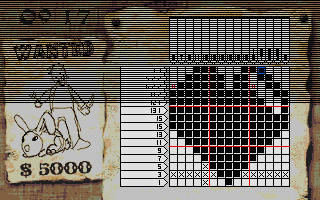
PicrossST delivers a classic nonogram experience on the Atari ST, providing players with a 15×15 grid to decode using only numerical clues on the top and left edges. Each number indicates how many consecutive squares must be filled in that row or column, and multiple numbers signify separate blocks with at least one blank space between them. This simple premise quickly evolves into a satisfying mental workout as puzzles grow more intricate.
(HEY YOU!! We hope you enjoy! We try not to run ads. So basically, this is a very expensive hobby running this site. Please consider joining us for updates, forums, and more. Network w/ us to make some cash or friends while retro gaming, and you can win some free retro games for posting. Okay, carry on 👍)
The game eases newcomers in by automatically revealing one row and one column at random at the start of each puzzle. This gentle nudge helps you establish initial reference points, allowing you to see immediately how deduction chains together. After that initial guidance, it’s entirely up to you to analyze number patterns, cross-reference lines, and avoid costly mistakes.
Using the Atari ST’s mouse, you toggle each square between filled, blank, and uncertain states much like Minesweeper’s flagging mechanic. If you mark a square as empty incorrectly, you incur a time penalty, incentivizing careful thought over guesswork. This risk–reward system adds tension and makes each correct fill all the more rewarding.
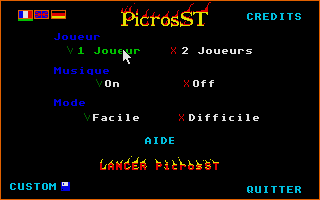
Beyond solo play, PicrossST offers a cooperative two-player mode where both participants work together on the same grid—ideal for puzzle aficionados who want to collaborate rather than compete. The included grid editor further extends replayability by letting you craft and share your own nonograms, ensuring the challenge never runs dry.
Graphics
On the Atari ST, PicrossST’s visuals are functional and clean, favoring clarity over flash. The monochromatic or two-tone palettes ensure numbers and grid lines remain crisp and easy to distinguish, even when you’re hunched over a particularly tricky section of the puzzle.
Icons for filled squares and empty markers are simple but instantly recognizable, with no distracting animations or superfluous decorations. This minimalism allows your focus to stay on logic and deduction, not on eye candy or processing overhead.
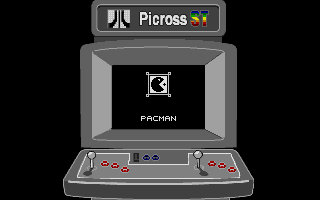
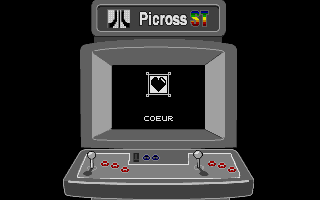
Though the pictures revealed are modest pixel art silhouettes—animals, household objects, geometric shapes—they pop nicely against the static background. Watching a blurred collection of squares transform into a recognizable image provides a small but satisfying visual payoff each time you complete a puzzle.
Story
As with many logic-based puzzle games, PicrossST does not offer a traditional narrative or character progression. Instead, the “story” unfolds as each grid resolves into a simple line drawing. This evolving image serves as both reward and narrative, with each new puzzle telling a tiny visual tale.
The sense of progression comes from puzzle difficulty rather than plot twists: you begin with straightforward fills and gradually face denser number combinations that demand deeper deduction. The silent narrative of each image—be it a cat, a sailboat, or a stylized heart—gives you a momentary glimpse of success before you advance to the next challenge.
While there’s no overarching storyline or voice acting, the series of emerging pictures becomes its own kind of storytelling, where your growing skill set is the true protagonist. Fans of puzzle-centric experiences often find this form of visual reveal more engaging than a cutscene-driven plot.
Overall Experience
PicrossST shines as a faithful nonogram implementation for retro enthusiasts and logic puzzle fans alike. Its straightforward interface and incremental difficulty curve make it accessible to beginners, while the subtle time penalties and larger grids provide depth for veterans.
The cooperative two-player option adds a social dimension, turning solitary deduction into a shared brain-teaser. Meanwhile, the built-in grid editor invites creativity, letting you design bespoke puzzles or recreate favorite icons pixel by pixel.
Although it lacks modern graphical flair and a narrative campaign, PicrossST turns those apparent shortcomings into strengths: it’s fast-loading, distraction-free, and laser-focused on the core mechanics that make nonograms addictive. Each completed puzzle yields a neat visual reward and a satisfying sense of mental accomplishment.
For anyone seeking a pure, no-frills logic challenge on the Atari ST, PicrossST is a standout title. Its blend of intuitive controls, thoughtful assistance, and robust editing tools ensure that both new players and seasoned puzzlers will find plenty to enjoy—and plenty more to create on their own.


Reviews
There are no reviews yet.