 Retro Replay Retro Replay gaming reviews, news, emulation, geek stuff and more!

Retro Replay Review
Gameplay
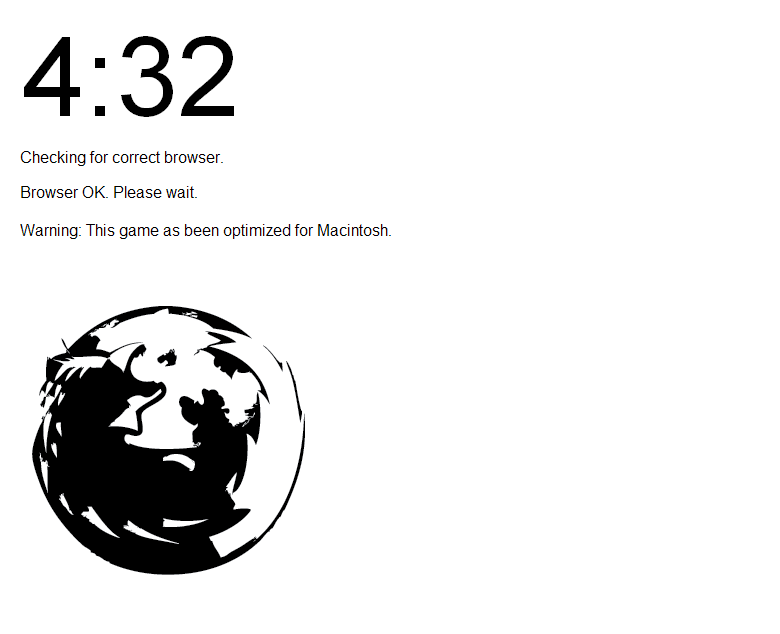
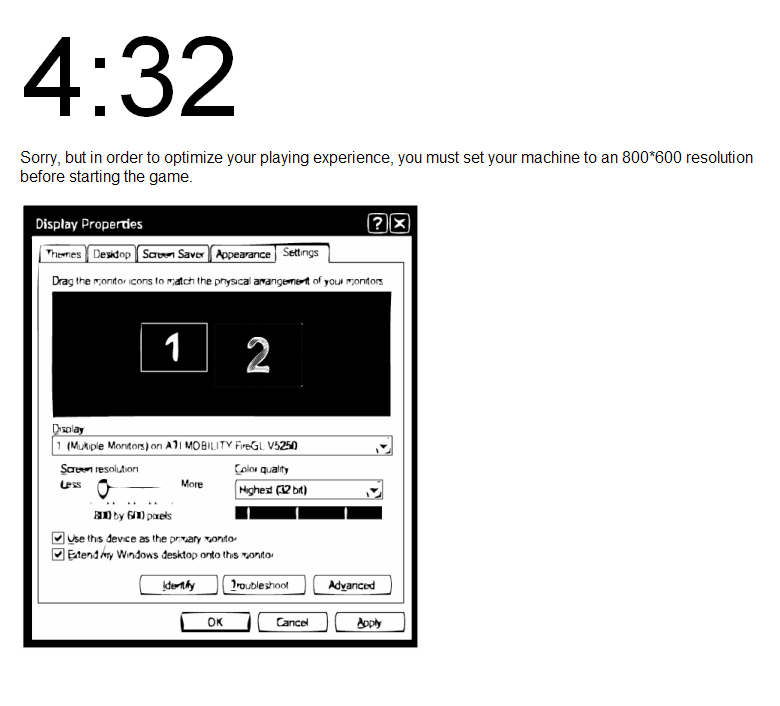
At its core, 4:32 delivers a surprisingly clever commentary on what we traditionally consider “gameplay.” Instead of presenting you with a level, an enemy, or a puzzle, the title demands that you first jump through a series of hoops—installing plugins, swapping browsers, adjusting your display settings, and even changing your system’s language or color profiles. Each step feels like a mini-challenge, subverting expectations and forcing you to ask: am I actually playing?
(HEY YOU!! We hope you enjoy! We try not to run ads. So basically, this is a very expensive hobby running this site. Please consider joining us for updates, forums, and more. Network w/ us to make some cash or friends while retro gaming, and you can win some free retro games for posting. Okay, carry on 👍)
The game operates entirely within your browser, yet it treats every aspect of your setup as part of its design. By requiring these arbitrary technical configurations, 4:32 transforms the setup process—normally an inconvenient preamble—into the main event. You find yourself clicking through countless dialogues and option menus, believing you’re inching closer to the “real” game, when in fact the journey is the destination.
This deliberate deception echoes the theme of the 2010 Global Game Jam’s prompt, and it echoes Petri Purho’s earlier experiment, 4 Minutes and 33 Seconds of Uniqueness. In 4:32, however, the twist is that the wasted time isn’t a bug but the very point. The true gameplay emerges not from virtual worlds or invented mechanics, but from your growing awareness of how much time you devote to mere preparation.
Graphics
Graphically, 4:32 is minimalistic, but that’s entirely intentional. There is no lush environment or polished sprite animation waiting at the end of your technical trials—just a clean, sparse interface that constantly reminds you of what’s missing. Every dialog box, each plugin prompt, and even the default browser messages are given center stage in a controlled, almost clinical design.
The stark, functional visuals serve to underscore the game’s thesis: a flashy presentation would distract from the agony of anticipation. Instead, you’re confronted with bland system windows, default font styles, and generic icons. This purposeful austerity reinforces the concept, turning every bland asset into a statement on wasted potential.
Despite—or perhaps because of—its stripped-down approach, 4:32 manages to feel cohesive. The user interface never steps outside the realm of real-world system prompts, blurring the line between the game environment and your own operating system. This seamless integration elevates the entire experience, making the act of “getting ready to play” both the setting and the plot.
Story
There is no traditional narrative in 4:32, yet the experience conveys a powerful conceptual story about time, expectation, and deception. Each technical hurdle you overcome reveals a layer of the game’s philosophy: that the rituals surrounding play can be as time-consuming as the play itself. This absence of characters, dialogue, or plot twists shifts your focus inward, prompting reflection on how much of your day you surrender to loading screens and setup routines.
Inspired by John Cage’s composition 4’33″—a piece defined by silence—4:32 similarly uses absence to craft its tale. There are no onscreen avatars, no bosses to defeat, and no objectives beyond meeting the next requirement. This narrative by negation challenges players to reconsider what constitutes “story” in an interactive medium.
Every system dialog becomes a narrative beat, every plugin installation a plot twist. You realize that you are both the protagonist and the audience, forcibly aware of your own role in the drama. The story unfolds not through scripted events, but through your emotional journey from curiosity to frustration—and finally, to a startling revelation about the very nature of game time.
Overall Experience
4:32 is less a conventional game and more an experiential essay on digital modernity. It confronts you with the absurdity of waiting—showing how easily patience can be consumed by routine technical demands. If you enter expecting traditional gameplay, you’ll feel tricked. But if you embrace its commentary, you’ll find a surprisingly profound meditation on the invisible costs of play.
As a browser-based title created for the Global Game Jam, it may not appeal to players seeking action, exploration, or narrative depth. Instead, it rewards those willing to engage in meta-critical thought. Its value lies not in high scores or end credits, but in the self-awareness it provokes: how often do we let peripheral tasks overshadow the main attraction?
For players interested in experimental design, digital art, or the philosophy of gaming, 4:32 offers a compact yet potent experience. It may leave you questioning every update you install and every patch you download—ultimately revealing that sometimes the greatest adventure is simply starting the game.


Reviews
There are no reviews yet.