 Retro Replay Retro Replay gaming reviews, news, emulation, geek stuff and more!

Retro Replay Review
Gameplay
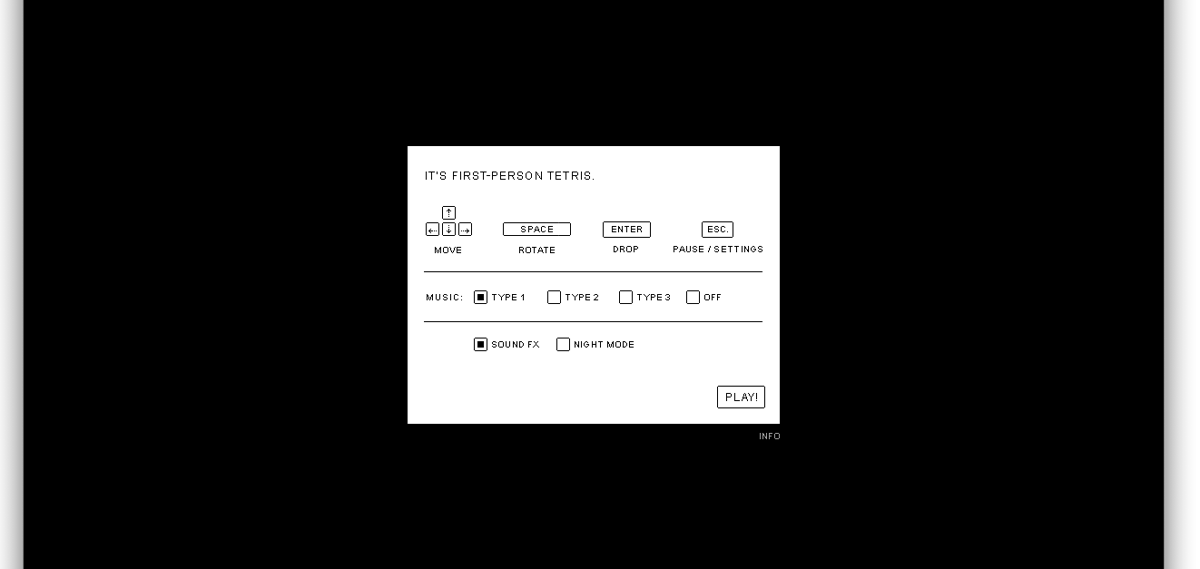
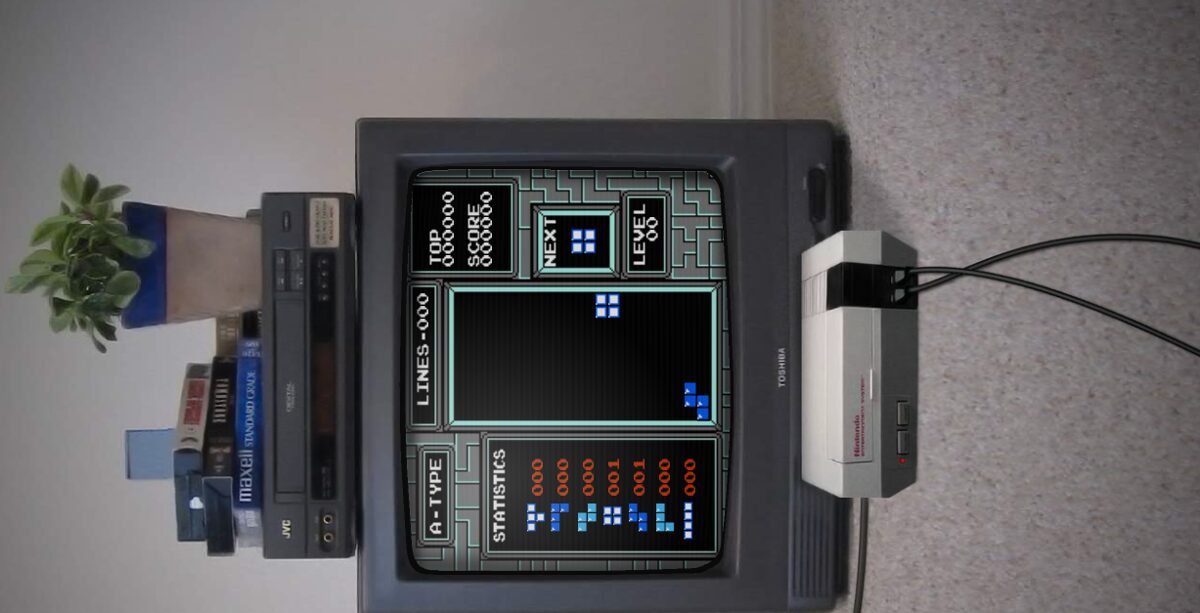
First-Person Tetris takes the classic falling‐block puzzle formula and flips it from the ground up by literally putting you inside the tetromino. Rather than watching pieces tumble down from above, you become the active block, held stationary in the center of the screen while the playfield spins, zooms, and whirls around you. This inversion of perspective injects a fresh challenge into familiar Tetris mechanics—spins and drops remain, but your spatial awareness must constantly recalibrate to an ever‐shifting room.
(HEY YOU!! We hope you enjoy! We try not to run ads. So basically, this is a very expensive hobby running this site. Please consider joining us for updates, forums, and more. Network w/ us to make some cash or friends while retro gaming, and you can win some free retro games for posting. Okay, carry on 👍)
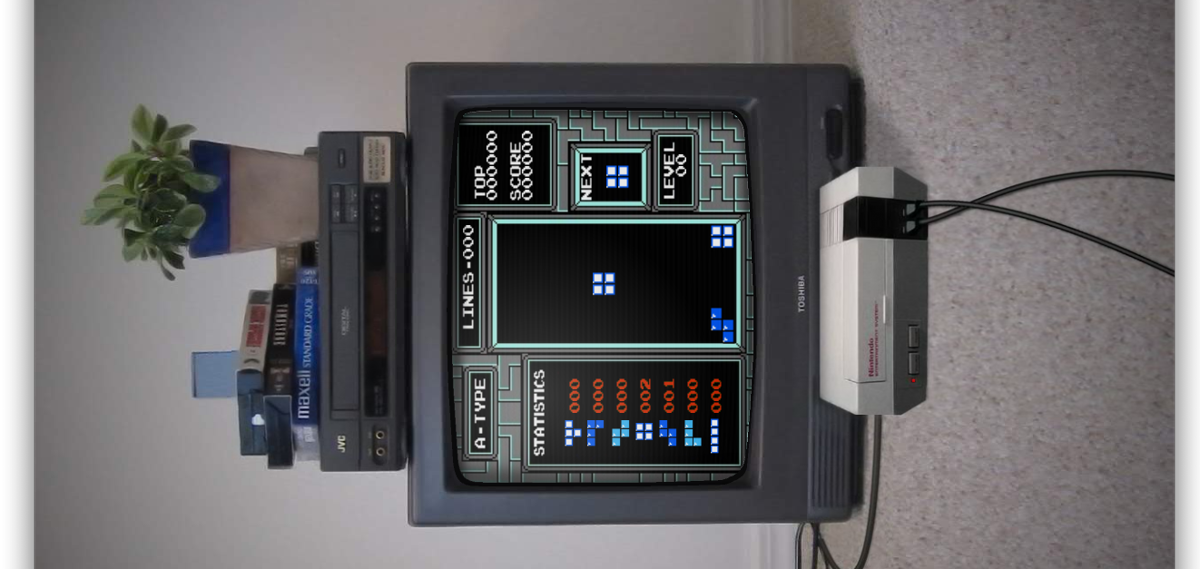
The core rules of Tetris are faithfully preserved: line clears, piece rotations, and increasingly frantic speeds form the backbone of the experience. What changes is your comfort level. Because “down” is no longer static, fast descents feel like hurtling through a funhouse, and tight rotation maneuvers can catch you off‐guard when the backdrop suddenly shifts. For players seeking a reflex‐driven puzzle test, the result is exhilarating—if disorienting.
Recognizing that motion sickness could be a barrier, the developer wisely added a “night mode.” In this alternative visual setting, the twisting rec room fades into near‐pitch blackness, leaving only the glowing, neon‐colored blocks in view. This option softens the sensory onslaught without altering the fundamental challenge, allowing players to focus on stacking lines rather than bracing for every spin.
Graphics
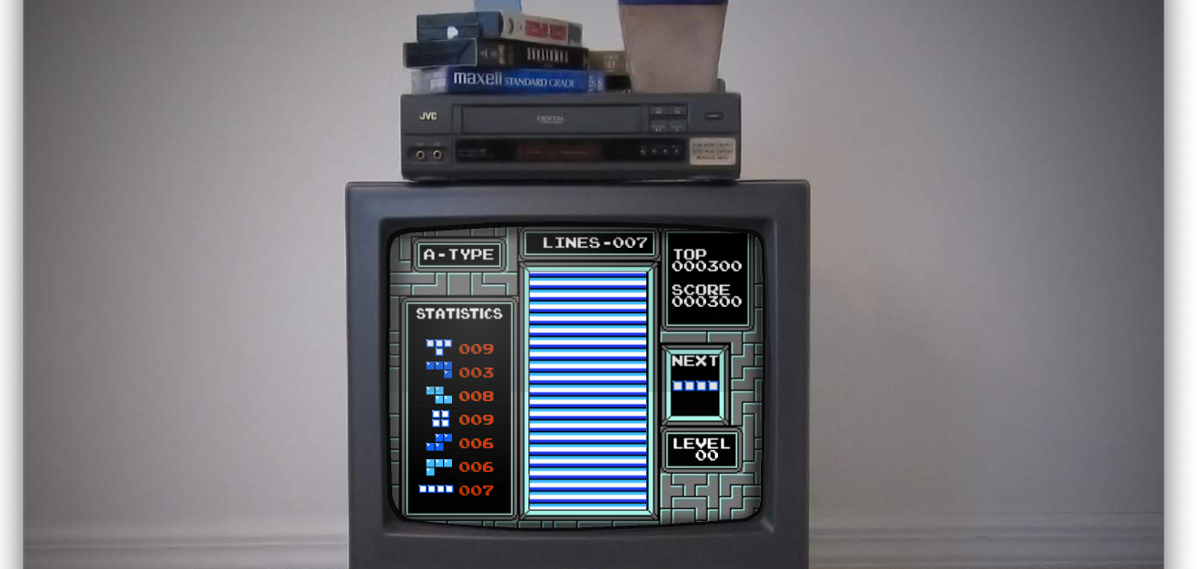
Visually, First-Person Tetris pays homage to the grainy charm of 1980s gaming hardware. The core playfield is rendered as though on an old CRT television, complete with scanlines, flicker, and the slight curvature of a vintage screen. Surrounding that view is a static “rec room” backdrop—an NES console stacked beside a VHS player, posters on the wall, and an analogue television stand—all of which sway and lurch in concert with your block’s movements.
The texturing of the environment leans heavily into low‐resolution aesthetics, replicating the feel of non‐HD visuals. While purists may find the effect endearing, those craving crisp, modern graphics could be let down by the intentional blur and static. Yet, it’s precisely this retro frame that reinforces the game’s concept: you’re not just controlling a block, you’re inhabiting a piece of gaming history.
Night mode streamlines the visuals, stripping away the rec room entirely and bathing the experience in stark contrast. The glowing blocks pop against the dark void, and the sense of immersion intensifies. In this mode, you’ll notice how each Tetris piece is sculpted with simple but clear shading, and how the ambient glow pulses slightly with every rotation—subtle touches that enhance the overall atmosphere.
Story
While Tetris is traditionally a narrative‐leaning void—pieces fall, lines clear, and the challenge escalates—First-Person Tetris recontextualizes the “story” by making you the protagonist: a solitary tetromino navigating a shifting world. It’s less a tale with characters and plot and more an experiential concept piece about perspective, control, and the boundaries of a familiar framework.
The game’s “narrative” unfolds through environmental cues rather than cut‐scenes. As the rec room contorts, you sense a subtle commentary on how we engage with technology: are we merely manipulating pixels on a screen, or are those pixels, in some sense, living entities with their own viewpoint? That philosophical layer rewards players who look for deeper meaning in design choices—though it remains entirely optional if you’d rather simply chase a high score.
Night mode can be read as a narrative pivot, too—moving from the playful chaos of a family rec room into a more solitary, almost cosmic void. The lack of literal story dialogue or exposition may frustrate those expecting a traditional campaign, but it’s consistent with the game’s avant‐garde approach: the focus is on sensation, not storyline.
Overall Experience
First-Person Tetris is a bold experiment that won’t be for everyone, but it succeeds admirably as a proof‐of‐concept. For longtime Tetris fans, it offers a new lens on an age‐old formula, forcing a reevaluation of muscle memory and mental mapping. The core satisfaction of line clears and combo chains remains intact, but it’s filtered through a disorienting, dizzying kaleidoscope.
Motion sensitivity is the game’s biggest potential drawback. The constant lurching of the rec room can induce nausea if you’re prone to motion sickness. Thankfully, the inclusion of night mode shows the developer’s awareness of this issue, providing a way to enjoy the mechanics without wrestling with the shifting backdrop. Even so, we recommend short play sessions at first to gauge your tolerance.
In the end, First-Person Tetris stands as a fascinating twist on a time‐tested classic. It’s unlikely to dethrone traditional Tetris titles for those seeking pure, unadulterated puzzle flow, but as a conversation piece and a fresh mental exercise, it shines. If you’re intrigued by novel gameplay perspectives and don’t mind a little queasiness in pursuit of innovation, this block‐by‐block ride is well worth your time.



Reviews
There are no reviews yet.