 Retro Replay Retro Replay gaming reviews, news, emulation, geek stuff and more!

Retro Replay Review
Gameplay
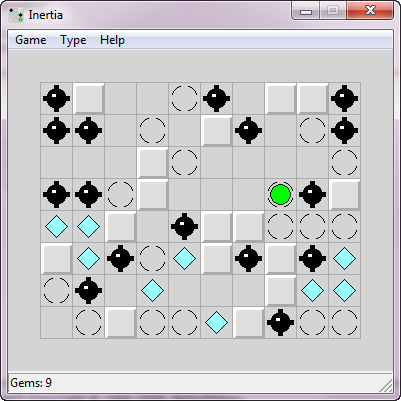
Inertia offers a unique twist on classic sliding-puzzle mechanics by introducing the challenge of momentum. Players control a green ball that glides across the grid in horizontal, vertical, or diagonal directions, and once it’s set in motion, it won’t stop until it encounters a barrier. This mechanic forces you to plan each move carefully, as a mistimed slide can send you hurtling past gems or, worse, straight into a mine.
(HEY YOU!! We hope you enjoy! We try not to run ads. So basically, this is a very expensive hobby running this site. Please consider joining us for updates, forums, and more. Network w/ us to make some cash or friends while retro gaming, and you can win some free retro games for posting. Okay, carry on 👍)
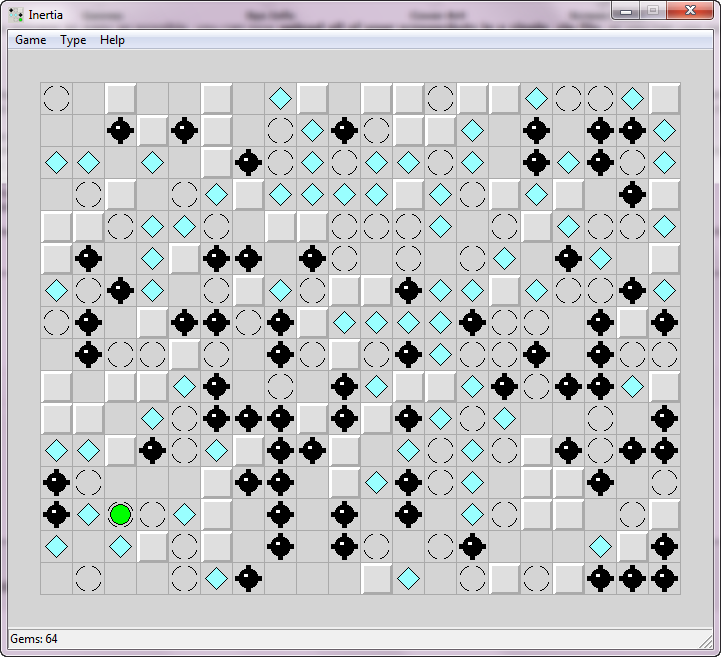
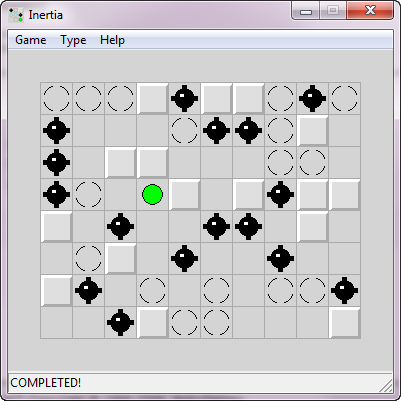
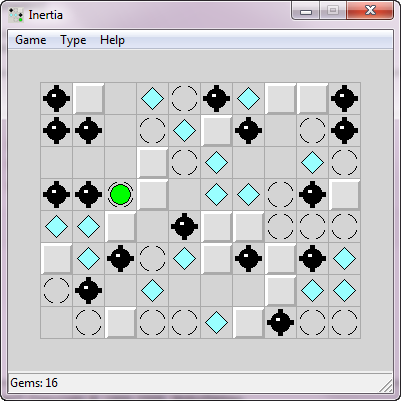
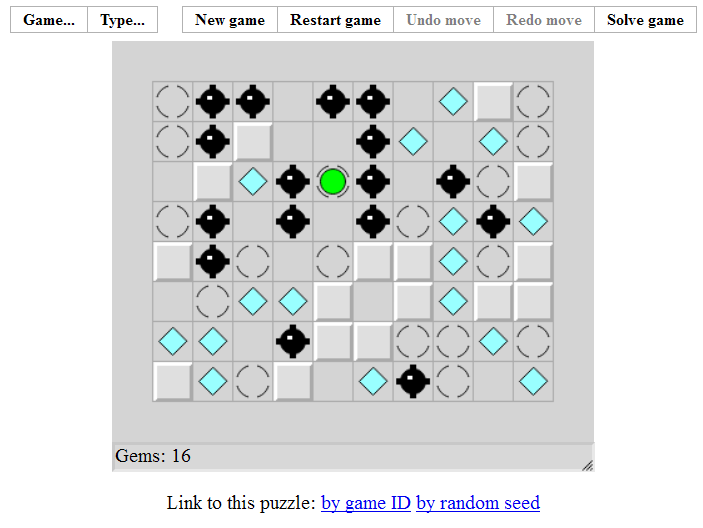
The board is thoughtfully constructed with four distinct cell types: empty spaces, walls, circles, and mines. Walls and circles function as stopping points, allowing you to navigate tight corners and reverse direction strategically. Empty cells provide no resistance, so mastering the placement and timing of your slides is essential to avoid unintended overshoots. Meanwhile, mines are hidden hazards that sneak into your path if you’re not paying attention.
Collecting all gems on a level feels immensely satisfying, but the real challenge lies in the endgame requirement: the ball must come to a natural stop after grabbing the final gem. This means that even after clearing the board of collectibles, you need a well-thought-out exit strategy. It elevates each puzzle from a simple scavenger hunt into a test of spatial reasoning and foresight.
As you progress through Inertia’s increasingly complex boards, you’ll find the perfect balance between trial-and-error experimentation and strategic planning. Early levels serve as a gentle introduction to the inertia concept, but later stages layer in tight corridors, sparse stopping points, and stealthy mine placements. The gradual ramp-up keeps the gameplay fresh and the sense of achievement high when you finally conquer a particularly fiendish puzzle.
Graphics
Inertia’s visual design is clean and minimalistic, ensuring that every element on the board is instantly recognizable. Gems sparkle in vibrant hues, contrasting sharply against a muted background palette. This clarity is vital when you’re making split-second decisions about where to send the ball and when to anticipate stopping points.
The simple geometric shapes used for walls, circles, and mines help maintain a laser-focus on gameplay. Walls are rendered as solid blocks, circles are highlighted with subtle outlines, and mines are marked with a cautionary icon. The consistent art style supports quick pattern recognition, which is crucial for mapping out your slides several turns in advance.
Animation is smooth and precise. The ball’s momentum feels convincing, and it glides gracefully across the grid with no stutter or lag. When you collide with a stopping cell, the ball decelerates and comes to rest with a satisfying click, reinforcing the tactile feedback you need to trust the game’s physics.
Although Inertia doesn’t push the boundaries of high-end graphical fidelity, its aesthetic choices are purposeful. The restrained color scheme reduces visual clutter, and the simple, flat art style means you’re never distracted by unnecessary effects. In a puzzle game where precision matters, these design decisions are more than welcome—they’re essential.
Story
Inertia doesn’t rely on an elaborate narrative to engage players; instead, it crafts an implicit storyline through its core mechanics. You assume the role of a gem-collecting explorer traversing a hazardous grid. Each level represents a new sector of uncharted terrain, dotted with hidden mines and guarded by the laws of inertia.
Although there’s no voiced dialogue or cutscenes, the sense of progression comes from unlocking more intricate boards and facing tougher mine configurations. The narrative emerges organically as you piece together the puzzle design, forging your own sense of discovery with every slide across the board.
The absence of a traditional storyline allows Inertia to maintain an unbroken focus on puzzle-solving. It’s a design philosophy similar to classic board games or minimalist mobile titles, where the challenge is the narrative. For players who prefer mechanics over melodrama, this streamlined approach can be quite refreshing.
Ultimately, the story you experience in Inertia is the one you write with each successful run. Every level cleared without a mine explosion feels like a small triumph, and the overarching theme of mastering momentum becomes your personal hero’s journey. In this way, the game’s “story” is a celebration of player skill and persistence rather than scripted events.
Overall Experience
Inertia delivers a polished and intellectually stimulating puzzle experience that stands out in a crowded genre. The central inertia mechanic feels both intuitive and challenging, offering a fresh perspective on slide-based gameplay. You’ll find yourself testing new routes, refining angles, and sometimes reloading levels dozens of times to optimize your path.
Replayability is high, thanks to the game’s level variety and the satisfaction of shaving moves off your best runs. If you’re a completionist or enjoy chasing personal records, you’ll appreciate the subtle layer of self-competition Inertia provides. Each level feels like a standalone brain teaser, yet collectively they form a coherent progression in difficulty.
While the lack of a traditional story or character progression might deter players seeking narrative depth, Inertia’s unobtrusive design keeps the focus squarely on puzzle mastery. The clean graphics and responsive controls ensure that nothing gets in the way of solving each board. If you value elegant simplicity and well-crafted challenges, you’ll find plenty to love here.
For fans of logic puzzles, spatial reasoning games, or anyone looking for a low-key but deeply engaging experience, Inertia is an excellent pick. Its learning curve is balanced, entry-level puzzles ease you into the mechanics, and advanced levels provide a rigorous test for seasoned players. Overall, it’s a thoughtfully designed title that rewards patience, planning, and precision—qualities that make it a standout choice for puzzle aficionados.


Reviews
There are no reviews yet.