 Retro Replay Retro Replay gaming reviews, news, emulation, geek stuff and more!





Retro Replay Review
Gameplay
Killer Flu delivers a tense and thought-provoking simulation that places you in the role of a microscopic agent of chaos. The core mechanic revolves around selecting individuals in public spaces and using a roulette-style infection spinner to determine whether you can successfully infect them with a chosen flu strain. Each spin is fraught with anticipation, as you balance the odds of infecting new hosts against the risk of a failed attempt, which could waste precious time and resources.
(HEY YOU!! We hope you enjoy! We try not to run ads. So basically, this is a very expensive hobby running this site. Please consider joining us for updates, forums, and more. Network w/ us to make some cash or friends while retro gaming, and you can win some free retro games for posting. Okay, carry on 👍)
The game’s pacing is driven by a real-time infection clock. Once a person is infected, they move on to various locations—workplaces, schools, public transit hubs—potentially sparking fresh outbreaks. Your objective is to reach a predetermined infection count before the seasonal immunity threshold kicks in and renders your campaign moot. This mechanic encourages you to plan routes, prioritize high-density areas, and select strains with the right balance of transmissibility and incubation period.
As you advance, new flu strains with varying properties become available—some spread rapidly but burn out quickly, while others incubate slowly but maintain virulence over a longer period. Experimenting with combinations adds a layer of strategic depth, rewarding careful observation of population movement patterns. The escalating difficulty and the introduction of countermeasures like vaccination drives and hygiene campaigns keep the experience fresh and challenging.
Controls are intuitive: point-and-click targeting, quick-access strain selection, and a clear infection-tracker overlay. A dynamic tutorial system guides newcomers through the basic mechanics, while optional advanced tooltips delve into the underlying epidemiological models for players seeking a deeper simulation experience. The balance strikes a fine line between accessibility for casual gamers and depth for strategy enthusiasts.
Graphics
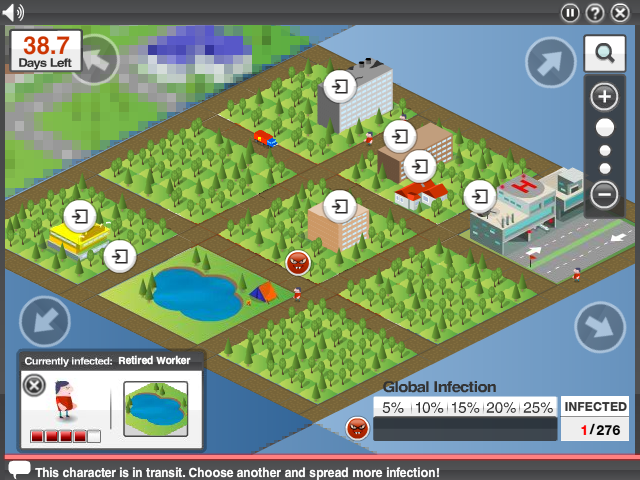
Visually, Killer Flu adopts a clean, data-driven aesthetic. City maps are rendered in muted color palettes, with heatmap overlays that pulse to reflect infection hotspots and emerging clusters. This minimalistic approach ensures that key information—such as infection rates, immunity levels, and population density—remains front and center, without unnecessary graphical clutter.
Character models are simple but effective “icon citizens,” each with a color-coded health bar that updates in real time. Watching these little avatars scatter across the cityscape or crowd into transportation nodes adds a surprisingly engaging visual dimension to what could otherwise be a dry spreadsheet of numbers. Animations for infection events—small particle effects and status-change icons—provide satisfying feedback with every successful spin.
The UI design is both stylish and functional, featuring clear tooltips, real-time charts, and progress meters. Menus slide in and out with smooth transitions, and the strain-selection wheel is highlighted with contrasting colors to indicate transmissibility, mutation risk, and incubation time. This graphical clarity helps you make quick decisions under pressure.
While the game doesn’t aim for photo-realism, its cohesive visual language effectively communicates the stakes of a spreading pandemic. Subtle background animations—hovering drones releasing vaccine aerosols or citizens donning masks—lend atmospheric context and reinforce the narrative themes without overwhelming the primary strategic view.
Story
Unlike narrative-heavy titles, Killer Flu presents its story through emergent gameplay scenarios and concise mission briefs. Each level or challenge unlocks a short dossier outlining the current flu strain’s origin, mutation history, and demographic targets. These notes weave a loose narrative thread that connects your actions to a broader global crisis.
Between missions, brief animated interludes visualize media reports, hospital overcrowding, and public responses to the outbreak. These vignettes underscore the human impact of your microscopic machinations, creating a surprising emotional resonance even as you push infection numbers ever higher. Though there’s no traditional protagonist, the game effectively portrays the tension between public health efforts and viral evolution.
The real-world parallels—seasonal flu, vaccination campaigns, immunization thresholds—lend an educational underpinning to the experience. You’ll come away with a better understanding of epidemiological dynamics, such as R0 values and herd immunity, all framed within a compelling “what-if” scenario. This educational dimension is subtly integrated, never feeling like a textbook lesson.
For players craving a deeper narrative, an optional “Archive Mode” compiles news snippets, survivor testimonials, and scientific research reports that you unlock by hitting certain infection milestones. This mode fleshes out the game’s world and provides context for each strain’s backstory, making your experiments feel part of a living, evolving pandemic saga.
Overall Experience
Killer Flu strikes a rare balance between accessible gameplay and rigorous simulation. It’s easy to pick up and play for quick sessions, yet layers of strategic nuance emerge as you explore strain properties and citywide spread dynamics. Whether you’re a strategy gamer seeking a new challenge or an educational enthusiast curious about pandemic modeling, this title has something to offer.
The game’s tension is palpable: every roulette spin carries weight, each new hotspot raises stakes, and the ticking immunity clock keeps you on edge. Despite its serious subject matter, the polished presentation and intuitive controls make it an engrossing experience rather than a grim chore. Occasional moments of dark humor—such as a “best infected carrier” leaderboard—add levity without undermining the game’s gravity.
Re-playability is high, thanks to randomized city layouts, unlockable strains, and escalating countermeasures that demand fresh tactics each run. Custom challenge modes let you tweak variables like vaccination speed or public awareness, extending your playtime well beyond the core campaign. A built-in scenario editor further empowers creative experimentation, allowing you to simulate worst-case situations or historical flu pandemics.
In summary, Killer Flu offers a unique blend of strategy, simulation, and emergent storytelling. Its straightforward yet deep mechanics, clear visuals, and subtle educational value make it a standout title for players intrigued by the hidden world of viruses and the delicate balance of public health. This is one simulation you’ll both enjoy and remember.


Reviews
There are no reviews yet.