 Retro Replay Retro Replay gaming reviews, news, emulation, geek stuff and more!


Retro Replay Review
Gameplay
Same Game delivers an immediately accessible yet deeply strategic puzzle experience. At its core, you clear the board by clicking on clusters of two or more matching colored cells, watching them vanish in satisfying bursts. What begins as a simple click quickly becomes a cerebral challenge: you must anticipate how the remaining cells will consolidate, both vertically and horizontally, to maximize future groupings.
(HEY YOU!! We hope you enjoy! We try not to run ads. So basically, this is a very expensive hobby running this site. Please consider joining us for updates, forums, and more. Network w/ us to make some cash or friends while retro gaming, and you can win some free retro games for posting. Okay, carry on 👍)
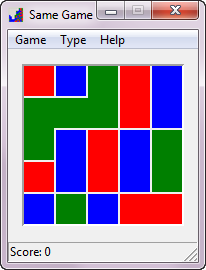
The variety in difficulty settings keeps the formula fresh. Beginners can start on a compact 5×5 grid with just three colors, letting them focus on pattern recognition and basic tactics. As you ramp up the challenge, the board expands to a sprawling 20×15 grid with four or more colors, demanding tighter planning, sharper foresight, and patience as the field becomes more crowded and complex.
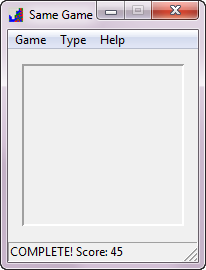
Every move in Same Game carries weight. A hasty click might break a potential large combo into smaller, unusable fragments, while careful planning can yield chain reactions that clear vast swaths of the board in a single turn. This elegant push-and-pull of decision-making ensures each session feels like a satisfying puzzle, with every cleared cell bringing you one step closer to that perfect solution—complete board clearance.
Graphics
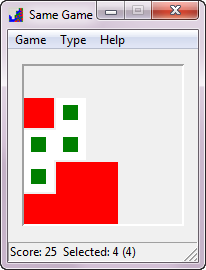
Visually, Same Game embraces a clean, minimalist style that’s as functional as it is calming. Each colored cell is rendered in bold, flat hues—reds, blues, greens, and more—making clusters instantly recognizable. There’s no unnecessary frills here; the focus is on clarity and readability, ensuring you can zero in on your next move without distraction.
Despite its simplicity, subtle animations bring the board to life. When a cluster disappears, cells above animate smoothly downward, and entire columns shift left, producing a fluid, organic feel. These motion cues are not just eye candy—they’re essential feedback that helps you track how the board evolves after each play, reinforcing your strategic planning in real time.
On modern displays, the bright palette pops, and the high contrast between colors aids both quick identification and extended play sessions without eye strain. If you appreciate straightforward design that prioritizes gameplay over flashy visuals, Same Game’s understated presentation will feel just right.
Story
Unlike narrative-driven titles, Same Game doesn’t weave an elaborate tale or present a cast of characters. Here, the “story” unfolds through your interaction with the board—each playthrough is a unique journey from a cluttered grid to total clearance. The satisfaction arises from puzzle mastery rather than plot twists.
That said, the absence of a traditional storyline is a deliberate design choice. By stripping away narrative trappings, the game zeroes in on pure puzzle mechanics. Players immersed in the challenge become storytellers of their own success, charting their progress through adaptive strategies and personal high scores instead of scripted dialogue or cutscenes.
For those who seek narrative immersion, the minimalist presentation may feel sparse. However, puzzle enthusiasts often find that the emergent “stories” they craft—overcoming a near-failed board, executing a perfect chain reaction, or setting a new best time—offer a uniquely rewarding form of engagement that transcends conventional storytelling.
Overall Experience
Same Game’s greatest strength lies in its elegant simplicity. It’s easy to pick up—no tutorials or complex menus to wade through—yet the difficulty curve rewards deep thinking. Whether you have five minutes on your commute or an hour at home, the game scales to your available time. Each session ends with a clear success or failure condition: clear the board to win, leave even one cell to lose, ensuring that every play feels meaningful.
Replayability remains high thanks to the random distribution of colors on each new board. No two puzzles play out identically, so you’ll continually refine your tactics and discover fresh patterns. The incremental increase in grid size and color count provides a paced challenge for both newcomers and seasoned puzzlers alike.
In summary, Same Game offers a compelling package for anyone seeking a mentally stimulating, visually relaxed puzzle title. Its timeless mechanics, varied difficulty settings, and satisfying feedback loops make it a worthy addition to your collection—especially if you appreciate games that reward careful planning, adaptability, and the sweet thrill of clearing the last cell.


Reviews
There are no reviews yet.