 Retro Replay Retro Replay gaming reviews, news, emulation, geek stuff and more!


Retro Replay Review
Gameplay
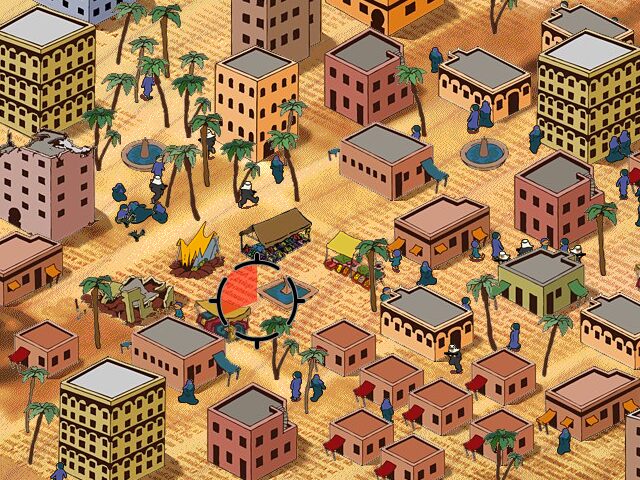
September 12th presents a deceptively simple set of controls that belie a deeper strategic and moral complexity. Players navigate a top-down, isometric view over a busy Middle Eastern marketplace, with the sole mechanic of scrolling the camera and launching missile strikes. At first glance, the act of targeting and firing seems straightforward, but the game quickly reveals its true challenge: the indiscriminate nature of missile warfare and the cyclical consequences of collateral damage.
(HEY YOU!! We hope you enjoy! We try not to run ads. So basically, this is a very expensive hobby running this site. Please consider joining us for updates, forums, and more. Network w/ us to make some cash or friends while retro gaming, and you can win some free retro games for posting. Okay, carry on 👍)
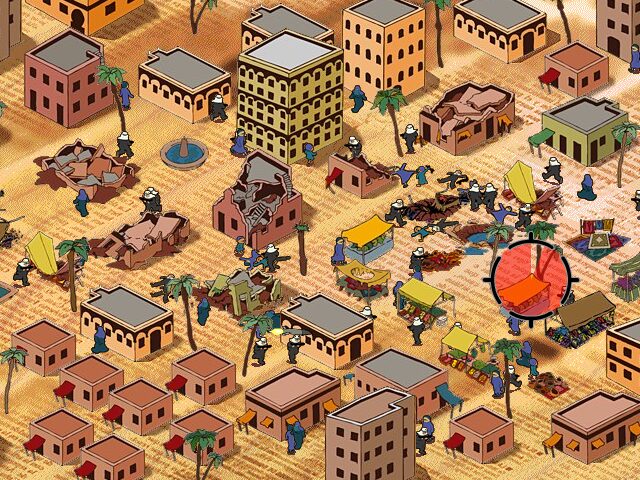
Every missile strike you execute will destroy more than just the immediate suspect; buildings collapse in spectacular blasts, innocent bystanders perish, and the wreckage itself becomes a catalyst for further violence. When a civilian stumbles upon a fallen comrade or the rubble of a destroyed structure, that character transforms into a new terrorist threat. This feedback loop forces players to rethink each shot, balancing the impulse to eliminate terrorists against the likelihood of creating an even larger insurgent force.
As the game progresses, the battlefield shifts between destruction and reconstruction: buildings slowly rebuild, and many terrorists “cool down,” reverting to civilians. Yet a residue of violence always remains, ensuring the market never returns to its pre-strike serenity. This evolving environment turns each session into a tense moral puzzle, asking players to weigh the long-term consequences of their actions and to grapple with uncomfortable questions about the efficacy of military force.
Despite its limited control scheme, September 12th offers a surprisingly rich sandbox for experimentation. Players who prefer to methodically pick off terrorists from a distance will soon realize that precision alone cannot eliminate the threat. Conversely, those who embrace widespread devastation must contend with exponential growth in insurgent numbers. The balance between surgical and total warfare becomes an ongoing, uncomfortable negotiation that drives home the game’s central thesis.
Graphics
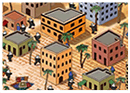
September 12th employs a deliberately austere visual style, using muted earth tones and minimalistic character models to evoke the dusty atmosphere of a war-torn market district. The isometric perspective provides a clear, strategic vantage point, allowing you to survey civilian clusters, hidden terrorists, and vulnerable buildings in equal measure. While the graphics are not cutting-edge, their simplicity underscores the game’s focus on message over spectacle.
Building destruction is rendered with satisfying bursts of debris and lingering dust clouds, reinforcing the sense of irreversible damage inflicted by each missile. Character animations are sparse but effective: civilians wander the stalls, children play with dogs, and terrorists weave between the crowds. When transformations occur—either through death or radicalization—the sudden shift in a character’s posture and attire serves as a chilling visual reminder of the game’s social commentary.
The user interface is similarly unadorned, with a basic targeting reticule and a cooldown indicator for missile launches. There are no flashy health bars or complex HUD elements, which keeps the player’s attention squarely on the battlefield. Though some players may find the graphical presentation too bare-bones, this design choice amplifies the game’s stark message, stripping away distractions to lay bare the human cost of armed intervention.
Environmental details, such as market stalls, crumbling walls, and the slow regeneration of destroyed structures, add layers of authenticity without bogging down performance. Whether you’re on a modern gaming PC or a mid-range laptop, September 12th runs smoothly, ensuring that the emotional weight of each strike is felt rather than hindered by technical limitations.
Story
September 12th forgoes a traditional narrative in favor of an emergent storytelling model driven by player decisions. There is no protagonist or scripted cutscene sequence; instead, the story unfolds organically through the consequences of your actions. Each missile you fire, each building you shatter, creates new plot threads as civilians become terrorists and the cycle of violence repeats.
The absence of explicit dialogue or character backstories might initially feel sparse, but this minimalist approach is intentional. By removing authorial voice and letting the gameplay mechanics convey the message, the game forces players to confront the real-world implications of collateral damage. The story is not told—it is lived, in every explosion and every transformed civilian figure wandering the marketplace.
The game’s political statement about the United States’ War on Terror is unambiguous yet respectful of player agency. Rather than lecturing, September 12th invites reflection on the morality and effectiveness of using force to combat an insurgency born from widespread devastation. The narrative emerges from the cycle of cause and effect you help create, making each playthrough a unique moral fable.
For players seeking a traditional storyline with defined missions and characters, the emergent narrative model may feel unsettling. However, this very discomfort is the point. September 12th transforms abstract policy debates into a visceral, interactive experience, offering a sobering perspective on how well-intentioned strikes can fuel the very threat they aim to eliminate.
Overall Experience
September 12th is more than a game; it’s a provocative social experiment that challenges players to rethink preconceived notions about military intervention. The simplicity of its mechanics highlights the complexity of its message, resulting in an experience that is at once accessible and intellectually demanding. This is not a game for those seeking adrenaline-fueled action or instantly gratifying victories; it is a contemplative exercise in cause and effect.
Repeated sessions reveal new insights as you explore different strategies—whether that means firing sparingly and accepting a slow creep of violence, or unleashing continuous bombardment and watching the insurgency swell. Each approach yields its own set of consequences, encouraging you to weigh short-term gains against long-term stability. In doing so, September 12th fosters critical thinking rarely found in mainstream titles.
Despite its heavy-handed subject matter, the game maintains a surprising level of balance. There are no unwinnable scenarios, but there are clear moral pitfalls that make “winning” a hollow victory. The designers strike a careful line between challenge and commentary, ensuring that the experience remains engaging rather than descending into a bleak exercise in futility.
Ultimately, September 12th stands out as a bold, uncompromising statement on modern warfare’s unintended consequences. It’s best suited for players interested in political and ethical issues, as well as educators looking for an interactive discussion tool. While it may not appeal to everyone, those willing to engage with its challenging message will find it a rewarding and eye-opening journey.


Reviews
There are no reviews yet.