 Retro Replay Retro Replay gaming reviews, news, emulation, geek stuff and more!


Retro Replay Review
Gameplay
Urban Dead throws you into the ruins of Malton, a grid-based city overrun by George A. Romero–style zombies. At the start, you choose an occupational class—doctor, scavenger, mechanic, and more—each with its own starter gear and skills. From that moment on, every action you take, whether looting a pharmacy or treating a wounded survivor, costs turns. You receive one turn every thirty minutes, with a soft cap of about 50 turns per day, so planning your moves carefully is vital.
(HEY YOU!! We hope you enjoy! We try not to run ads. So basically, this is a very expensive hobby running this site. Please consider joining us for updates, forums, and more. Network w/ us to make some cash or friends while retro gaming, and you can win some free retro games for posting. Okay, carry on 👍)
What truly sets Urban Dead apart is that there are no AI enemies. Every “zed” you encounter is a human player who once walked the streets as a survivor before succumbing to infection. Combat thus becomes a tense mind game, pitting human cunning against human desperation. Do you set up barricades and hold a safehouse against the horde? Or do you coat your weapons in antiseptic and make a run for the next supply cache? The tools at your disposal—shortwave radios, spray-paint for tagging territory, medical kits for reviving fallen comrades—encourage both cooperation and betrayal in equal measure.
As you earn experience by healing survivors, salvaging supplies, or slaying infected foes, you unlock new skills through a class-specific progression system. Doctors learn advanced triage, while scavengers become more adept at finding rare weapons. Meanwhile, zombies level up by tearing through barricades and spreading the infection, giving them access to devastating mutations. This asymmetric progression keeps both sides engaged, and the constant tug-of-war over key buildings drives emergent stories every day.
Beyond Malton, Urban Dead has sporadically opened new maps—Monroeville in 2008 (now closed) and Borehamwood with limited zombie revivification. Each map maintains the same core mechanics but adds fresh districts, unique landmarks, and new community traditions. Whether you’re forging alliances in a high-rise hospital or leading a horde through a suburban block, the pace is never frantic. Instead, the game rewards patience, strategy, and a taste for slow-burn tension.
Graphics
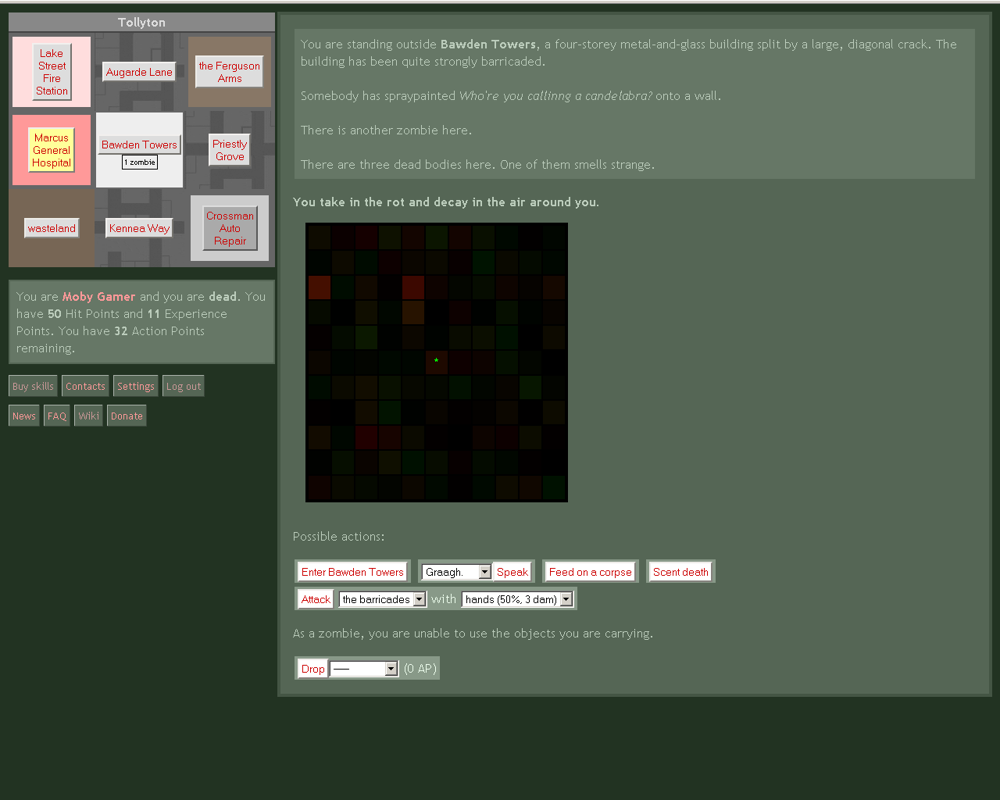
Urban Dead’s visual style is as stripped-down as its gameplay mechanics. Instead of lush 3D environments, you navigate a simple top-down grid where buildings, streets, and barricades are represented by colored tiles and icons. While this might strike some players as archaic, it actually serves to heighten immersion—your mind fills in the gaps, imagining the creaking doors and musty corridors of an abandoned city.
The game’s UI centers on a map pane and a status bar that tracks health, infection level, and your current turn count. Icons change color to denote zombies versus survivors, and tooltips provide concise summaries of items in your inventory. There’s no flashy lighting or particle effects, but the minimalism keeps the interface responsive and accessible even on older hardware or slow internet connections.
Text overlays and simple pop-up dialogs handle everything from combat results to chat messages. This raw presentation places the focus squarely on player interaction and decision-making rather than visual spectacle. If you’re someone who prefers substance over style and values imagination over photorealism, Urban Dead’s graphics will feel refreshingly unpretentious.
Custom map markers, spray-paint tags, and barricade visuals add just enough variety to keep exploration interesting. Veteran players often decorate key locations with graffiti or coded symbols, turning empty blocks into canvases for community lore. In a game where every human and zombie is player-controlled, these small touches help build a sense of place despite the sparse art assets.
Story
The narrative of Urban Dead unfolds through the collective actions of its players. There’s no pre-written campaign or cinematic cutscene; instead, the plague’s origin is traced back to the twisted machinations of the NecroTech corporation. Rumors swirl that their experimental bioweapons lab in the city’s heart triggered the outbreak, and every day survivors band together to uncover evidence—or to bury it forever.
Emergent storytelling is at the heart of the experience. One day you might be part of a rescue mission to clear a hospital’s rooftop, and the next you could be ambushed by a rival survivor faction guarding a convoy of medical supplies. Infected players who’ve climbed the ranks in the zombie hierarchy often role-play as “Alpha Zeds,” leading hordes into coordinated assaults. These ad-hoc dramas create a shifting tapestry of alliances, betrayals, and heroic last stands.
While there’s no overarching plot arc, seasonal events and community-driven campaigns inject periodic bursts of excitement. Players have organized everything from treasure hunts in abandoned malls to “zombie peace treaties” negotiated via shortwave radio. It’s this player-made lore that gives Urban Dead its uncanny sense of living, breathing history, where your own deeds might be remembered—or reviled—by the next generation of survivors.
For those who love collaborative storytelling, the pandemic theme offers rich thematic fodder. You’ll encounter graffiti manifestos, rescue mission broadsides, and cryptic radio broadcasts that hint at deeper conspiracies. The lack of an imposed storyline means every community spawn point can become the stage for new legends, and your character’s journal entries—scrawled in chat logs—could shape the city’s mythos.
Overall Experience
Urban Dead defies modern MMORPG conventions with its deliberate pacing and player-driven world. If you’re accustomed to nonstop action and blockbuster visuals, the turn-based, text-lean nature of this game may feel jarring at first. But for anyone seeking a strategic, social sandbox set against a zombie apocalypse, it delivers a uniquely addictive experience.
The daily turn cap encourages you to log in regularly without overwhelming your schedule, and each action carries weight. Will you risk your life scavenging a gas station for fuel, or will you fortify a safehouse and trade supplies with other players? These small decisions accumulate into a broader sense of progression and community investment.
Despite its age and modest presentation, Urban Dead remains free-to-play with no mandatory subscriptions or pay-to-win mechanics. The game’s longevity—over a decade of consistent updates and dedicated players—speaks to its robust core design and the passion of its community. Newcomers will find an active Discord, wikis brimming with strategy guides, and veteran players ready to shepherd them through their first infirmary breach.
Ultimately, Urban Dead is more than a game; it’s a social experiment in survival horror. It rewards creativity, cooperation, and cunning, weaving emergent narratives that stay with you long after your character’s last turn. If you crave an MMO where every enemy is human, every victory feels earned, and every raid or rescue has real stakes, this minimalist apocalypse is waiting for you.


Reviews
There are no reviews yet.