 Retro Replay Retro Replay gaming reviews, news, emulation, geek stuff and more!


Retro Replay Review
Gameplay
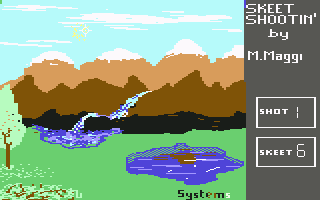
The core of Skeet Shootin’ revolves around the simple yet addictive act of tracking and blasting clay pigeons as they soar against the backdrop of the Alpine peaks. From the moment each clay disk launches from the bottom of the screen, players must swiftly align their shotgun’s aim, account for speed and trajectory, and fire before the target escapes the frame. The game strikes a satisfying balance between immediacy and precision, rewarding quick reflexes and a measured approach to each shot.
(HEY YOU!! We hope you enjoy! We try not to run ads. So basically, this is a very expensive hobby running this site. Please consider joining us for updates, forums, and more. Network w/ us to make some cash or friends while retro gaming, and you can win some free retro games for posting. Okay, carry on 👍)
Beyond the basic ten-disk routine, Skeet Shootin’ gradually introduces variations in launch angles, flight speeds, and environmental factors such as wind gusts that subtly shift your reticle if you stand still for too long. These dynamic elements keep every session fresh, ensuring that no two clay disks feel identical. As you progress, you’ll unlock optional challenge modes—like double clays or timed relays—that test both your speed and your patience in new and rewarding ways.
Controls are straightforward and responsive: you adjust your aim with the right thumbstick (or mouse, on PC), then press the trigger button to fire. There’s a gratifying recoil animation and impact effect each time you connect, reinforcing the sense that every shot truly matters. Missing several disks in a row will see your confidence tested, but the game cleverly offers a “slow-mo aim assist” upgrade that helps newer players get more comfortable with these breakneck sequences.
While Skeet Shootin’ doesn’t feature an overarching campaign, it compensates with robust progression systems. You can earn experience points to level up your shooter profile, unlock cosmetic shotgun skins, and even purchase performance-enhancing gear like stabilized stocks or high-velocity ammo. These upgrades don’t break the game’s balance but add a layer of long-term engagement for completionists and leaderboard chasers alike.
Graphics
Skeet Shootin’ makes full use of its Alpine setting, delivering sweeping vistas of snow-capped peaks, crystal-clear skies, and lush pine forests. The background panoramas shift subtly as you move between ranges, with dynamic lighting that captures the warm glow of sunrise or the crisp blues of midday. Even the faint puff of your exhaled breath on cold mornings adds a nice touch of realism to the shooting lanes.
The clay disks themselves are impeccably rendered: you can see the subtle curves of their shells, the way they catch ambient light, and the tiny cracks that appear when they shatter under shotgun blast. Particle effects are crisp and satisfying—each explosion of debris feels weighty, and the shards that sparkle through the air look and sound the part. Whether you’re playing on a high-end PC or a console, the frame rate remains rock-solid, ensuring no skip ever compromises your aim.
Textures throughout the game, from the rough wood of the shooting stands to the metallic gleam of your shotgun, are finely detailed without ever feeling overbearing. Load times between sessions are short, so you spend less time waiting and more time lining up your next perfect shot. Subtle weather effects—like a gentle snowfall or drifting mist—enrich the atmosphere, though gameplay performance remains unaffected even when the scene grows busy.
Overall, the visual presentation is polished and purposeful. It never tries to reinvent the wheel with hyper-realistic foliage or GPU-crushing ray-traced shadows. Instead, it focuses on clarity, ensuring players can always spot a clay disk hurtling through the air. The resulting graphics package is both beautiful and functional, enhancing immersion without sacrificing performance or readability.
Story
Though Skeet Shootin’ is fundamentally a sports simulation rather than a narrative-driven adventure, it weaves a subtle sense of progression and personal achievement into your sessions. You begin as a novice shooter warming up on the basic ranges, and through steady practice and earned accolades, you work your way up to more challenging locations perched high in the Alps. Each new level comes with its own backdrop, ambient soundscape, and difficulty curve, giving the illusion of a journey even without characters or cutscenes.
The game’s “career mode” frames your rise as a skeet marksman in terms of competitions, local club invitations, and occasional exhibition matches set against panoramic Alpine amphitheaters. You don’t engage in dialogue or meet NPC rivals face-to-face, but you do collect trophies, earn invitations to tougher events, and unlock commemorative banners that hang in your virtual shooting lodge. It’s a minimalist approach to storytelling that still provides context for why you’re taking shot after shot.
For players seeking deeper lore, the developers have included a series of unlockable concept art galleries and archived tournament footage. These extras hint at past champions, legendary feats, and even a few fictional personalities—like the “Ghost of Mont Blanc,” a sniper rumored to hit clay disks from half a mile away. While optional, these bits of flavor text reward dedicated players who want to learn more about the sport’s traditions and the game world’s local legends.
Ultimately, Skeet Shootin’s narrative framework is subtle by design. It keeps the focus on the core shooting mechanics while sprinkling in enough thematic beats to foster a sense of purpose and accomplishment. If you’re hoping for an epic saga or branching dialogue choices, you might leave wanting more, but as a backdrop for the target practice, it succeeds neatly.
Overall Experience
Skeet Shootin’ delivers a focused and highly replayable shooting experience set against one of the world’s most beautiful backdrops. Its straightforward premise—simply aim, shoot, and accumulate points—belies a surprising depth of challenge and reward. Whether you’re a casual gamer looking for a relaxing target practice session or a hardcore marksman chasing leaderboard supremacy, the game caters to both ends of the skill spectrum with grace.
The pacing remains tight from start to finish, with no artificial padding or unnecessary diversions. Sessions typically last five to ten minutes apiece, making it easy to jump in for quick bursts or settle in for a marathon aiming to break personal bests. The seamless progression system and unlockables provide a steady stream of goals, keeping even the most seasoned players coming back to shave milliseconds off their reaction times.
Multiplayer leaderboards and weekly challenges inject a competitive edge, allowing you to compare your total hits or best streaks with friends and the global community. While there’s no direct head-to-head mode, the asynchronous competitions feel robust enough to foster friendly rivalries. And if you ever need a break from the intense shooting, you can switch to a “Zen Mode,” where you simply fire at floating disks without a timer, all set to soothing Alpine wind and birdcalls.
In conclusion, Skeet Shootin’ is a polished, satisfying title that stands out in the casual sports genre. Its engaging gameplay loops, crisp visuals, and subtle narrative framing collectively create an experience that’s easy to pick up but hard to put down. For anyone intrigued by the idea of clay-pigeon shooting in a stunning mountain setting, this game offers exactly what you need: challenging, rewarding, and endlessly fun marksmanship.


Reviews
There are no reviews yet.