 Retro Replay Retro Replay gaming reviews, news, emulation, geek stuff and more!
Retro Replay Review
Gameplay
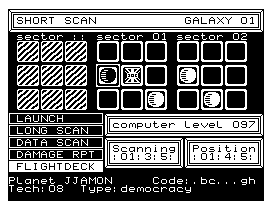
Total Eclipse adopts the spirit of its inspiration, Elite, but shifts the focus from real-time dogfighting to strategic trading and navigation. Players traverse a two-dimensional galaxy map divided into 12 galaxies and 10 sectors, each containing 36 cells. The simplicity of the map belies the depth of options available—empty space, hypergates, black holes, asteroids, abandoned cruisers and a variety of planets and space stations all populate the grid. Choosing your next destination involves careful planning, resource management and risk assessment.
(HEY YOU!! We hope you enjoy! We try not to run ads. So basically, this is a very expensive hobby running this site. Please consider joining us for updates, forums, and more. Network w/ us to make some cash or friends while retro gaming, and you can win some free retro games for posting. Okay, carry on 👍)
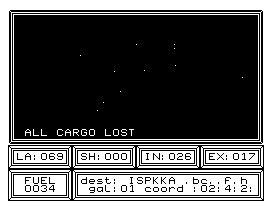
The core loop centers around scanning, trading and upgrading your ship. With the short-range scanner you can survey 36 nearby cells, detecting threats or points of interest at the cost of precious computer energy. RAM upgrades unlock a long-range scanner and eventually a galaxy-wide data scan—transforming navigation from guesswork into informed strategy. Meanwhile, mining asteroids for “asteroil” or salvaging derelict cruisers adds secondary objectives that reward exploration and strategic risk-taking.
Encounters with pirates and random events break up the trading routine. If you refuse or fail to pay protection money on a planet, you might face a 3D space skirmish where quick reflexes and evasive hyperjumps can save your cargo and your hull. The panic hyperjump, though risky with only a 66.6% survival rate, offers a thrilling escape mechanic. Victory in combat not only keeps you alive but delivers loose cargo that can be scooped up in real time, blending arcade action with the broader economic sandbox.
Graphics
For its era and platform, Total Eclipse delivers a clean, functional visual presentation that balances 2D and 3D elements effectively. The galaxy map is rendered in crisp lines and contrasting colors that make each cell’s contents immediately identifiable. Hypergates glow vividly, black holes swirl ominously, and space stations maintain a utilitarian iconography that never confuses the eye.
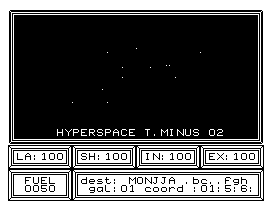
The 3D combat sequences are rudimentary by modern standards but remain satisfying. Enemy ships are represented by wireframe or flat-shaded polygons that rotate smoothly as you track them with your crosshairs. Explosions and laser fire are conveyed through simple geometric flashes, which—combined with responsive controls—deliver a surprisingly immersive arcade feel.
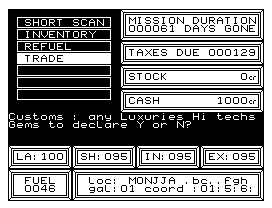
Menus and UI screens come together in a consistent style: blocky fonts, straightforward icons and translucent overlays that hint at the days when memory was precious. While there’s no elaborate animation, the transitions between scanning, trading and combat are quick enough to keep the pace brisk. The visual design prioritizes clarity, ensuring that players never lose track of vital information during tense moments.
Story
Total Eclipse does not present a linear narrative with cutscenes or voiced dialogue. Instead, it offers an open-ended sandbox where the “story” emerges through exploration, trade routes and encounters. Your progression—from penniless pilot to wealthy trader—becomes the central arc, driven by player choice rather than scripted events.
Abandoned space cruisers and hidden anomalies hint at untold backstories scattered across the galaxy. Boarding missions invite you to piece together what happened to those who came before, as you search wrecked corridors for the captain’s log before self-destruct sequences trigger. These micro-narratives enrich the otherwise abstract trading loop and reward players who dare to leave safe trade lanes for derelict alien hulks.
Political and technological variations among planets also contribute to the emergent narrative. Anarchistic worlds teem with danger but offer contraband goods at premium prices. High-tech systems promise advanced ship parts and lucrative markets but may enforce strict tariffs. Each planetary visit tells a small story about its rulers, its culture and the risks you’re willing to take for profit.
Overall Experience
Total Eclipse strikes a compelling balance between strategy and action. The trading mechanics, underpinned by a dynamic economy and upgrade paths, provide long-term goals that motivate continued play. The occasional pirate skirmish and salvage operation inject bursts of adrenaline, preventing the experience from becoming purely cerebral.
While the graphics and UI evoke a bygone era, they never feel obstructive. Instead, the straightforward design lets players focus on charting new frontiers, outwitting space bandits and maximizing profit margins. Learning the nuances of scanner management and optimal trade runs yields a satisfying sense of mastery as your ship grows more capable.
For fans of open‐world space simulators who appreciate depth over spectacle, Total Eclipse remains an engaging title. Its blend of exploration, risk management and economic strategy creates a personalized narrative that unfolds at your pace. Whether you’re a seasoned Elite veteran or a newcomer to interstellar trade, this game offers plenty of challenges and rewards for those willing to navigate the shadows of the Dragon’s galaxy.


Reviews
There are no reviews yet.