 Retro Replay Retro Replay gaming reviews, news, emulation, geek stuff and more!




Retro Replay Review
Gameplay
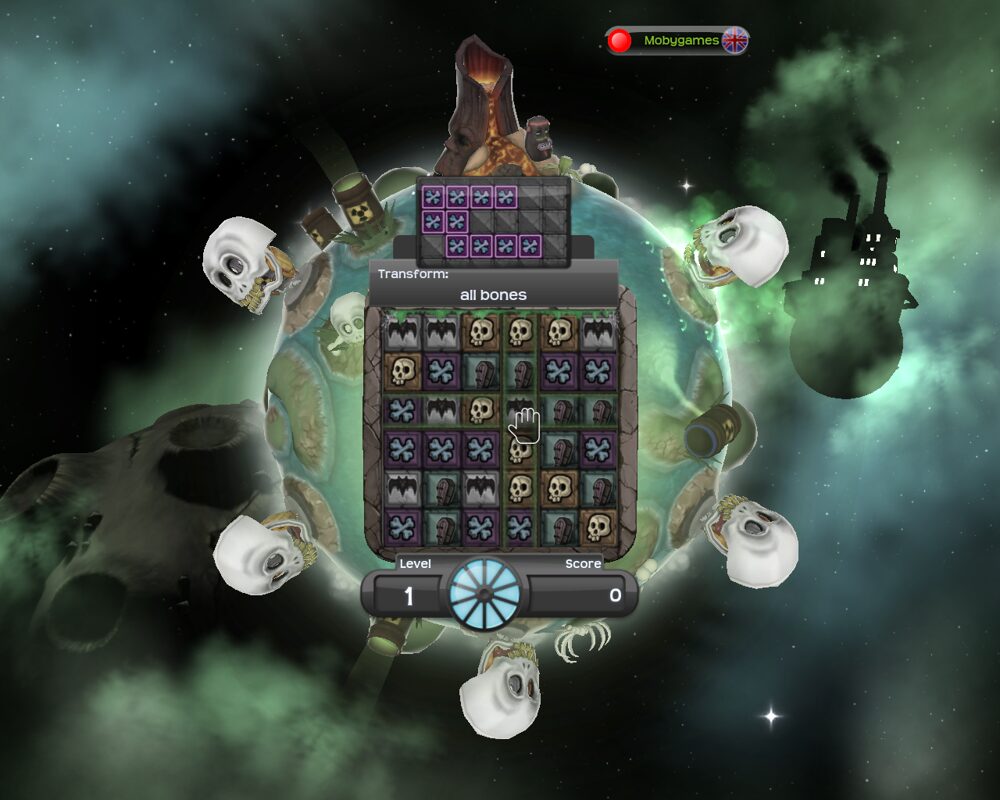
Puzzlegeddon’s core mechanic revolves around a deceptively simple tile-matching grid at the center of the screen. You slide entire rows and columns to line up clusters of five or more identical tiles, then remove them with a right-click. This straightforward interaction underpins a surprisingly deep strategic layer: every move not only clears tiles but also feeds into power gauges that you can unleash against opponents or use defensively.
(HEY YOU!! We hope you enjoy! We try not to run ads. So basically, this is a very expensive hobby running this site. Please consider joining us for updates, forums, and more. Network w/ us to make some cash or friends while retro gaming, and you can win some free retro games for posting. Okay, carry on 👍)
In its flagship multiplayer mode, Puzzlegeddon supports up to six players—human or AI—battling for planetary dominance. Each color of tile corresponds to a different offensive or defensive power. By filling a gauge through matching, you earn missiles, shields, drone strikes, or other special attacks. Timing is crucial: unleashing the right power at the right moment can turn the tide, whether you’re fending off an incoming salvos or zeroing in on a rival’s defenses.
Beyond the free-for-all, Puzzlegeddon offers varied rule sets like Team Battle and King of the Hill, each adding unique victory conditions and strategic twists. For solo puzzlers, Poison Peril mode challenges you to replicate specific tile patterns under a time limit, turning the same matching mechanics into an entirely different brain-teaser. Together, these modes ensure that whether you’re competing head-to-head or sharpening your skills alone, the gameplay remains fresh and endlessly replayable.
Graphics
Puzzlegeddon’s visual presentation is clean and functional, striking a balance between arcade flair and clear readability. The central planet backdrop provides a charming stage for six player avatars perched on their own islands. Each avatar is rendered with a touch of personality—military fatigues, exaggerated gear, cartoonish expressions—making it easy to identify foes and allies at a glance.
The tile grid itself is studiously uncluttered. Multicolored gems pop against a subdued background, and matching animations are smooth and satisfying: tiles explode outward in brief bursts of light before new pieces slide into place. Subtle shading and particle effects lend weight to power-up activations—missiles streak across space, shields flare around an avatar’s island—without ever overwhelming the core puzzle view.
Underneath the surface, Puzzlegeddon runs admirably well even on modest hardware. There’s no stutter when dragging rows or activating multiple powers in rapid succession. Whether you’re playing on a cramped laptop or a high-end gaming rig, the framerate stays locked, ensuring every click and drag feels instantaneous and precise.
Story
Puzzlegeddon doesn’t offer a conventional narrative campaign—instead it wraps its tile-matching warfare in a lighthearted, tongue-in-cheek premise. You’re a commander vying for control of a tiny planet, and your adversaries range from fellow human players to cheeky AI generals. The minimal storyline serves mainly as a framing device for the competitive thrills.
Despite the lack of deep character arcs, each avatar exudes enough attitude through its design and taunting sound bites to give players a sense of rivalry. Between matches, victory and defeat animations—complete with quips and celebratory gestures—help foster a playful, adversarial atmosphere that keeps the mood upbeat and entertaining.
For those seeking a structured plot or emotional beats, Puzzlegeddon may feel light on lore. However, the game’s focus is squarely on puzzle dynamics and multiplayer combat, and it delivers solidly on that promise. The Poison Peril solo puzzle challenges offer brief tutorials and scenario goals but stop short of weaving them into a larger storyline, reinforcing the game’s arcade-first identity.
Overall Experience
Puzzlegeddon excels as a multiplayer puzzle arena. Quick to learn yet hard to master, its blend of match-five mechanics with tactical power management creates thrilling back-and-forth exchanges. Sessions can be as short as five minutes or extend into strategic slogs, making it ideal for both casual drop-in play and more serious competitive showdowns.
The variety of modes—from chaotic six-player free-for-alls to solo Poison Peril brain-teasers—ensures broad appeal. AI opponents can fill seats in local multiplayer or provide solo practice, while online matchmaking keeps the action running after midnight. Though it lacks a traditional story campaign, the persistent drive to topple rival generals and top leaderboards provides its own motivational arc.
For puzzle enthusiasts seeking a social twist, or for groups looking to liven up game nights, Puzzlegeddon offers an addictive cocktail of strategy, speed, and spectacle. Its straightforward interface, stable performance, and high replay value make it a compelling addition to any gamer’s library. If you’ve ever wanted to wage war by lining up five gems, this is the game you’ve been waiting for.


Reviews
There are no reviews yet.