 Retro Replay Retro Replay gaming reviews, news, emulation, geek stuff and more!
Retro Replay Review
Gameplay
Breakout 2000 takes the tried-and-true paddle-and-ball formula of the original Breakout and spices it up with a suite of modern twists. At its core, you’re still directing a paddle to keep a ball in play and chip away at colorful blocks, but the addition of power-ups opens up a new strategic layer. From cannons that let you fire directly at walls to “catch” modes that let you pause the ball midair, each power-up alters your approach and keeps each round feeling fresh.
(HEY YOU!! We hope you enjoy! We try not to run ads. So basically, this is a very expensive hobby running this site. Please consider joining us for updates, forums, and more. Network w/ us to make some cash or friends while retro gaming, and you can win some free retro games for posting. Okay, carry on 👍)
One of the standout features is the two-player mode. Instead of taking turns, both players share the screen: one at the bottom and one at the top, each with their own set of blocks to demolish. You can choose to challenge a friend or let the CPU step in for either side, so you’ll never run out of opponents. Watching two AIs duke it out can even be entertaining in its own right, as you can see them trade power-ups and redirect balls to one another.
The level designs also deserve praise. While the original Breakout’s levels are simple rectangles, Breakout 2000 offers a variety of layouts that force you to think differently about ball angles and paddle placement. Some levels feature moving barriers or narrow gaps that demand precise timing, while others introduce tunnel sections where the ball wraps around the playfield. The increasing complexity ensures a smooth difficulty curve that both newcomers and veterans will appreciate.
Controls feel tight and responsive on the Atari Jaguar controller. The paddle slides smoothly across the screen, and power-up activations occur with a simple button press. Even when the action ramps up and multiple balls are in play, Breakout 2000 maintains a steady performance, so you won’t lose points to lag or awkward input.
Graphics
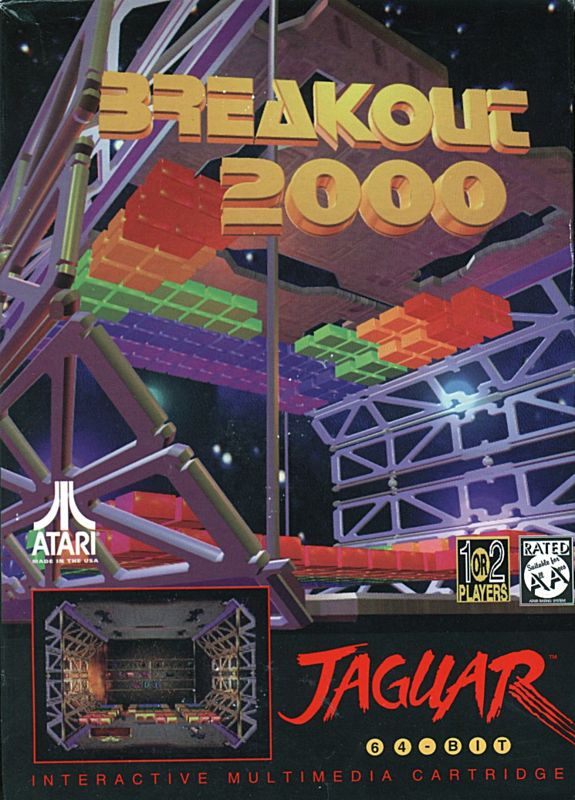
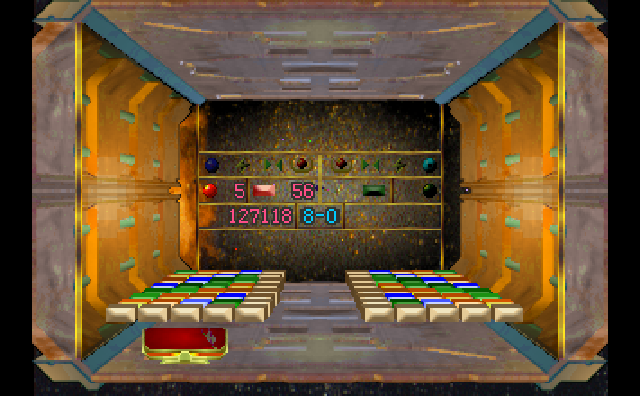
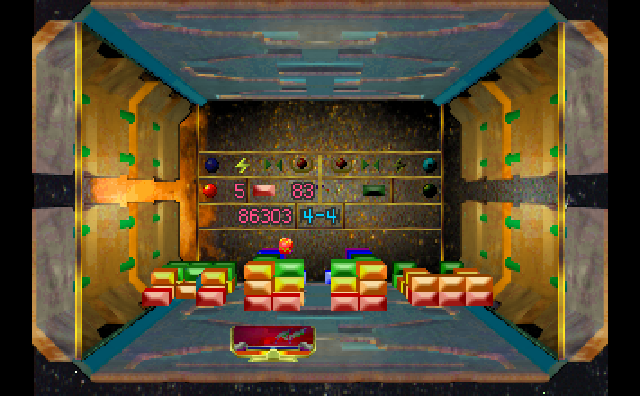
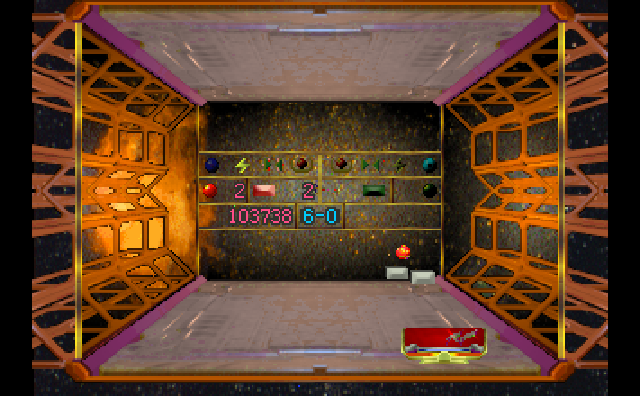
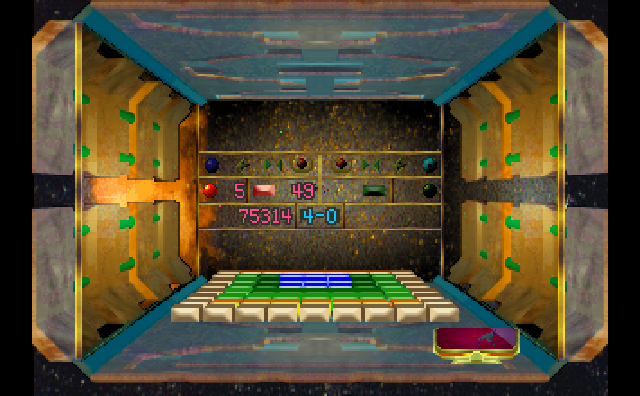
Graphically, Breakout 2000 is a stark upgrade over its 2D counterpart. The game boasts flashy pre-rendered 3D visuals that give each brick depth and shine. When you smash through a block, it crumbles with satisfying particle effects, and reflective surfaces catch the light in a way the original could never achieve. The visual polish makes the game feel like a futuristic arcade cabinet rather than a bare-bones home console port.
Backgrounds shift and rotate subtly as you progress, lending a sense of motion even before the ball is launched. Each level carries its own color palette, from neon blues and purples to fiery reds and oranges, and these schemes help you instantly recognize where you are in the campaign. Animations are smooth throughout, with no noticeable frame drops—even when multiple special effects hit at once.
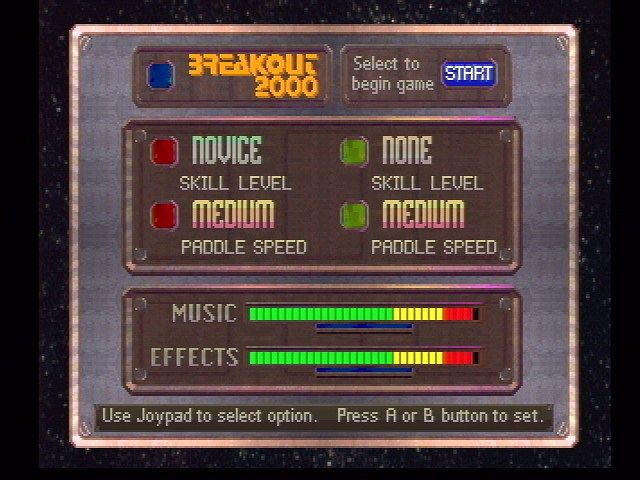
Breakout 2000 also features a slick user interface. Score tallies and power-up inventories occupy minimal screen real estate, so you’re free to focus on the main action. Menus are adorned with metallic textures and futuristic fonts, reinforcing the game’s high-tech makeover. Whether you’re a casual player or a competitive break-down enthusiast, the visuals make it clear that this is a modern reinterpretation of a classic.
Sound design complements the visuals nicely. While not overly complex, the electronic soundtrack drives the pace without becoming repetitive. SFX for paddle hits, block shatters, and power-up activations are crisp and punchy, adding to the arcade feel. Combined with the graphics, the audio work ensures Breakout 2000 feels like a premium Atari release.
Story
Breakout 2000 isn’t driven by a narrative in the traditional sense—it’s an arcade action experience that trades story for pure gameplay adrenaline. However, a loose sci-fi theme provides context: you’re piloting a gleaming paddle through an abstract digital landscape, blasting away rogue energy blocks. This futuristic framing helps tie together the various graphical styles and power-up concepts.
In lieu of cutscenes or character dialogue, the game relies on environmental storytelling. As you clear levels, the backgrounds shift to suggest deeper layers of a virtual network being purged of corruption. While there’s no named protagonist or villain, the steady progression through themed arenas gives you a satisfying sense of “advancement” from one digital frontier to the next.
For players who crave lore, the manual supplies a brief backstory about an interstellar data stream infected by malicious code, and your mission is to restore order by breaking through the obstructions. It’s minimal, but it’s enough to justify the neon grids and robotic sound effects. Ultimately, Breakout 2000’s story is simple by design, letting you focus on the core arcade action.
Overall Experience
Breakout 2000 delivers a compelling blend of nostalgia and innovation. Fans of the original will appreciate the faithful core mechanics, while the new graphical sheen and expanded features breathe fresh life into the formula. Even if you’ve played countless brick-busting games, the two-player mode and varied power-ups bring enough novelty to keep you hooked.
The game’s pacing is excellent: early levels ease you in, while later stages challenge your reflexes and strategic planning with tighter layouts and faster ball speeds. Replay value is bolstered by local multiplayer showdowns and a “watch the AI” mode that allows you to study tactics or simply enjoy the spectacle. High-score chasers will find plenty to grind for, especially when seeking to outperform friends or the CPU.
Breakout 2000 stands out as one of Atari Jaguar’s better arcade adaptations. While it may not reinvent the wheel, it refines it with better visuals, tighter controls, and more gameplay options. Whether you’re picking it up to relive childhood memories or as a fresh entry into the brick-breaker genre, this title makes a strong case for being more than just a retro curiosity.
In the end, Breakout 2000 proves that sometimes, simple premises are the most enduring—especially when dressed up in high-tech graphics and bolstered by thoughtful enhancements. It’s a must-try for anyone who loves pick-up-and-play arcade action with a modern twist.


Reviews
There are no reviews yet.