 Retro Replay Retro Replay gaming reviews, news, emulation, geek stuff and more!




Retro Replay Review
Gameplay
Tremulous offers a unique blend of first‐person shooter and real‐time strategy mechanics that set it apart from many other free online shooters. Players choose to fight either as humans, who rely on firearms and defensive constructions, or as aliens, who evolve into ever more formidable classes by earning frags in combat. This asymmetry encourages distinct playstyles: humans focus on teamwork and map control with turrets and barricades, while aliens emphasize speed, stealth and close‐quarters ambushes.
(HEY YOU!! We hope you enjoy! We try not to run ads. So basically, this is a very expensive hobby running this site. Please consider joining us for updates, forums, and more. Network w/ us to make some cash or friends while retro gaming, and you can win some free retro games for posting. Okay, carry on 👍)
Matches progress through three development stages, unlocked when a team accumulates enough frags or credits. In the early stage, both sides have only rudimentary equipment—basic rifles or melee claws—forcing players to scout, gather resources and defend their base. As the match evolves, humans can build stronger armoured suits, plasma rifles and advanced turrets, while aliens gain access to powerful mutations like the Guardian or the Dretch that can support or assault key structures.
The heart of Tremulous gameplay lies in its construction and resource systems. Humans spend credits in their Armoury to purchase everything from grenades to immovable turrets, while aliens channel team frags into evolutionary points that unlock new life-forms. Critical buildings—such as the human Reactor and the alien Overmind—serve both as staging grounds for upgrades and as soft timers; destroy the enemy’s central structure and their ability to produce reinforcements grinds to a halt. This dynamic tug-of-war fosters tense battles around choke points, lighting up corridors with gunfire, acid spit and strategic placement of defensive constructions.
Graphics
Built on the ioquake3 engine, Tremulous inherits the polished visual toolkit of Quake III Arena, including shader-based lighting, bump‐mapping on certain textures and hardware‐accelerated effects. Although it dates back to the early 2000s, the open‐source community has continued to refine the graphics, offering optional high‐resolution texture packs and modern widescreen support to keep the look crisp on today’s systems.
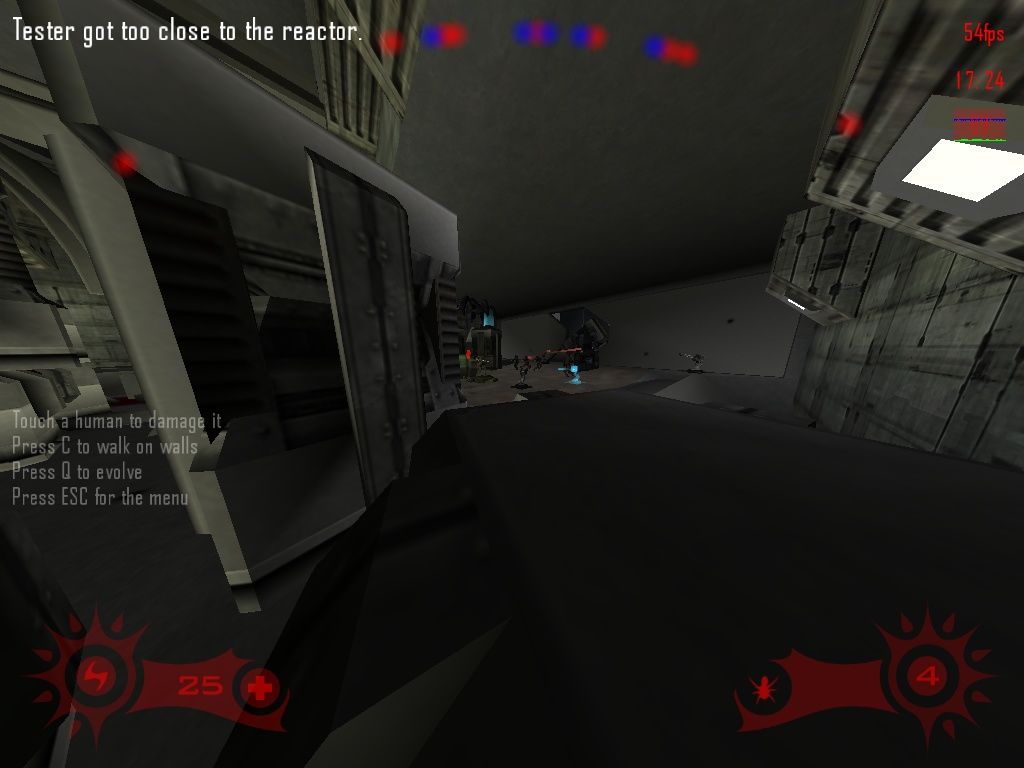
Environments range from metal corridors and concrete bunkers to alien hive chambers drenched in pulsating bioluminescent creep. Subtle use of colored lighting enhances the mood—cold blues and greys for human facilities, sickly greens and purples for alien lairs. Dynamic shadows and muzzle-flash glare add depth to firefights, while the occasional lens-flare and water reflection remind players that they’re running on a sophisticated 3D engine.
Character models are distinct and easy to identify in the heat of battle. Alien classes sport exaggerated claws, spines and tails, making silhouette recognition quick even at distance. Human models, while more utilitarian, come with clear armor pieces and helmets that differentiate engineers from assault troops. Thanks to ongoing community mods, you can even swap in new skins, voices and cosmetic effects, ensuring that server operators can keep visuals fresh long after the base game’s release.
Story
Unlike many modern shooters, Tremulous doesn’t present a sprawling single‐player campaign or elaborate cutscenes. Instead, the “story” unfolds through the match structure itself: an eternal conflict between resourceful colonist humans and a relentless alien horde. Light narrative hints—found in the game’s documentation and occasional server‐hosted intro messages—imply humanity has established mining operations on a hostile world, only to face an adaptive xenomorphic threat.
This minimal storytelling approach keeps the focus squarely on player‐driven drama. Every skirmish, base shutdown or daring raid becomes an emergent chapter in your personal Tremulous saga. Ghosted corridors and abandoned reactors whisper of past battles, but it’s the real-time decision to rush a flank or hold a chokepoint that truly defines each match’s narrative arc.
Community‐created maps occasionally weave in thematic elements—crashed transports, alien nurseries, underground labs—but the core lore remains a blank canvas. For players who thrive on cooperative tactics and dynamic encounters, the lack of a rigid storyline is an asset, inviting creativity, role-play and ever-shifting strategies instead of pre-scripted events.
Overall Experience
As a free, open‐source title, Tremulous delivers exceptional value. There’s no pay-to-win model, no DLC hooks—just pure team‐vs.‐team mayhem that you can enjoy indefinitely. The thriving community maintains active servers worldwide, while modders continually supply new maps, skins and balance tweaks. Installation is straightforward on Windows, Linux and macOS, and performance remains smooth even on modest hardware.
The learning curve can be steep for new players. Alien players must master map geometry and wall-climbing tactics, while humans need to balance investment in weapons versus base defenses. Communication is key: a well-timed turret placement or coordinated hive rush can swing a match in seconds. For those willing to squad up and learn the mechanics, Tremulous offers rich, rewarding gameplay that stays fresh even after hundreds of hours.
In a genre often dominated by high-budget live service shooters, Tremulous stands out as a labor of love powered by its community. Its blend of FPS and RTS elements is as compelling today as it was at release. If you’re looking for a free, skill-based team game that rewards strategy, adaptability and cooperation, Tremulous deserves a place in your library.



Reviews
There are no reviews yet.