 Retro Replay Retro Replay gaming reviews, news, emulation, geek stuff and more!




Retro Replay Review
Gameplay
Bricks of Camelot stays true to its Breakout roots, tasking players with clearing each level by bouncing a ball off a paddle to smash rows of medieval-themed bricks. As the successor to Bricks of Egypt, it refines the classic formula by introducing a host of new mechanics and power-ups that keep every session fresh. The core loop is instantly familiar—miss the ball and lose a life, clear all bricks to advance—but the depth comes from strategic power-up management and level design.
(HEY YOU!! We hope you enjoy! We try not to run ads. So basically, this is a very expensive hobby running this site. Please consider joining us for updates, forums, and more. Network w/ us to make some cash or friends while retro gaming, and you can win some free retro games for posting. Okay, carry on 👍)
The power-up system is where Bricks of Camelot really shines. Traditional bonuses like paddle expanders, multiball, and slow ball are joined by inventive additions such as arrow-shooting weapons and a “phantom” paddle that lets the ball phase through obstacles. A unique poison power-up injects risk into even your most confident moves, forcing split-second decisions: should you grab that cluster of bonuses, or risk triggering the deadly poison orb?
Adding another layer of unpredictability, the game features power-up generators that spawn random items whenever you hit them. Skilled players can target these generators with arrows to create massive power-up cascades—provided they’re careful to avoid unleashing a tide of poison bricks. With three difficulty settings and 15 distinct level packs (120 levels in total), Bricks of Camelot offers a steady progression curve that keeps both newcomers and Breakout veterans engaged for hours on end.
Graphics
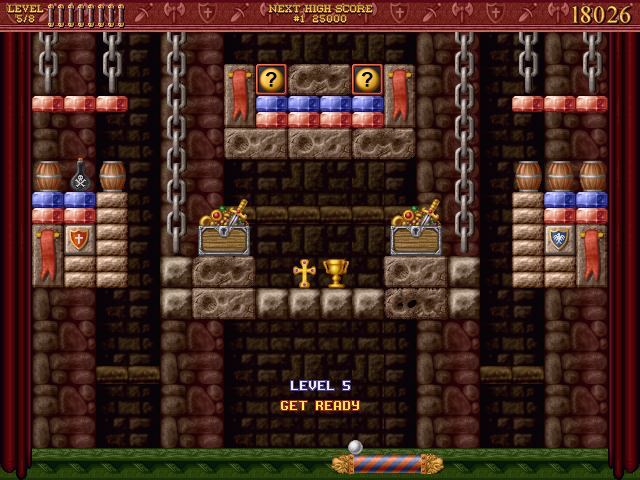
Visually, Bricks of Camelot adopts a rich medieval aesthetic, with each level pack representing a different environment—ancient castles, dimly lit dungeons, lush forests, and glittering treasure chambers. Brick designs are detailed, featuring carved runes, stone reliefs, and gold-inlaid motifs that break the monotony of standard rectangular blocks. Backgrounds are dynamic, with subtle animations like flickering torches or drifting mist to enhance immersion.
The paddle and ball are rendered with clear, responsive animations that never obscure your view of the playfield. When you fire arrows at generators or special bricks, the projectiles trace smooth arcs, and impact effects—sparks, shattering stone, or bursts of magical energy—are crisp and satisfying. On higher resolutions, the textures hold up well, avoiding the pixelation some older Breakout clones suffer from.
The UI is equally well executed, with sharp fonts for score and life counters, distinct icons for each power-up, and a clean heads-up display that won’t distract from the action. Small touches—like a glowing outline on your active power-up or a brief screen shake when you clear a large brick formation—add polish without overwhelming the player. Overall, the graphics strike an excellent balance between decorative flair and functional clarity.
Story
While Bricks of Camelot is primarily an arcade-style affair, it frames its levels within a light medieval narrative. You play as a heroic knight on a quest to reclaim lost relics hidden within the ramparts of Camelot’s fortress. Each level pack represents a new frontier in your journey, from the outer courtyard to the royal treasury, giving a sense of purpose to otherwise abstract brick formations.
The narrative is delivered through brief interludes between level packs—tiny scrolls that depict your knight receiving guidance from Merlin or narrowly escaping dragon-guarded vaults. These story snippets are concise but effective, offering context for the escalating challenge and a reason to look forward to each new set of 8 levels. Though not deeply plotted, the medieval framing adds charm and variety, keeping the progression more engaging than a simple “level 1, level 2” structure.
This light story approach means players aren’t burdened by lengthy cutscenes or complex lore. Instead, the focus remains on the gameplay, with the narrative acting as a thematic backdrop. For those who enjoy a bit of flavor text and world-building, the setting of Camelot and its legendary artifacts provides just enough context to make each round feel like part of a grander quest.
Overall Experience
Bricks of Camelot delivers an addictive Breakout experience that balances nostalgia with modern twists. The combination of classic ball-and-paddle mechanics, a wealth of power-ups, and varied medieval theming ensures that no two play sessions feel the same. Whether you’re aiming for a perfect clear or battling to maintain all your lives on the hardest difficulty, there’s always a new strategy to experiment with.
Replayability is high, thanks to the 120 levels across 15 packs and global high-score tables for each section. Players can revisit earlier levels to improve their point totals or challenge themselves with the hardest difficulty setting. The risk-and-reward nature of the power-up generator keeps even late-game action tense, as a single poisoned orb can upend a carefully planned combo.
In summary, Bricks of Camelot is a thoughtfully designed Breakout clone that caters to both casual players and hardcore brick-busting enthusiasts. Its polished graphics, engaging medieval flair, and robust gameplay mechanics make it an excellent pick for anyone seeking a fresh take on a timeless arcade genre. With its blend of strategic depth and pick-up-and-play fun, Bricks of Camelot makes a strong case for carving out a place among the top modern Breakout-style titles.


Reviews
There are no reviews yet.