 Retro Replay Retro Replay gaming reviews, news, emulation, geek stuff and more!



Retro Replay Review
Gameplay
Crusader Kings unfolds as a real-time, pause-able grand strategy sandbox where you assume the mantle of a medieval ruler and navigate the intricate web of feudal politics. Unlike its Europa Universalis predecessors, Crusader Kings removes merchants and mercenaries from the equation, placing familial bonds, vassal loyalty, and dynastic intrigue at center stage. You’ll juggle county management, levy recruitment, and realm stability while fielding armies to defend borders or press claims across Europe.
(HEY YOU!! We hope you enjoy! We try not to run ads. So basically, this is a very expensive hobby running this site. Please consider joining us for updates, forums, and more. Network w/ us to make some cash or friends while retro gaming, and you can win some free retro games for posting. Okay, carry on 👍)
The heart of the experience lies in diplomacy through bloodlines. Marriages are political tools, pacts are forged with ring exchanges, and inheritance laws can make or break dynasties. As you arrange unions for yourself, your children, or powerful vassals, each alliance reshapes the balance of power. Meanwhile, opportunistic courtiers, ambitious barons, and rival claimants challenge your grip on power, forcing you to decide between assassination, excommunication, or outright warfare.
Scenarios like the Battle of Hastings (1066), the Third Crusade (1187), and the Hundred Years’ War kick off major campaigns, but the true story emerges from emergent events: a sudden peasant revolt, a pope’s call for crusade, or a scheming brother plotting treason. The game’s pause functionality allows you to micromanage succession laws, negotiate with the Papacy, or issue feudal contracts—all while keeping a wary eye on the shifting tides of prestige and piety.
Graphics
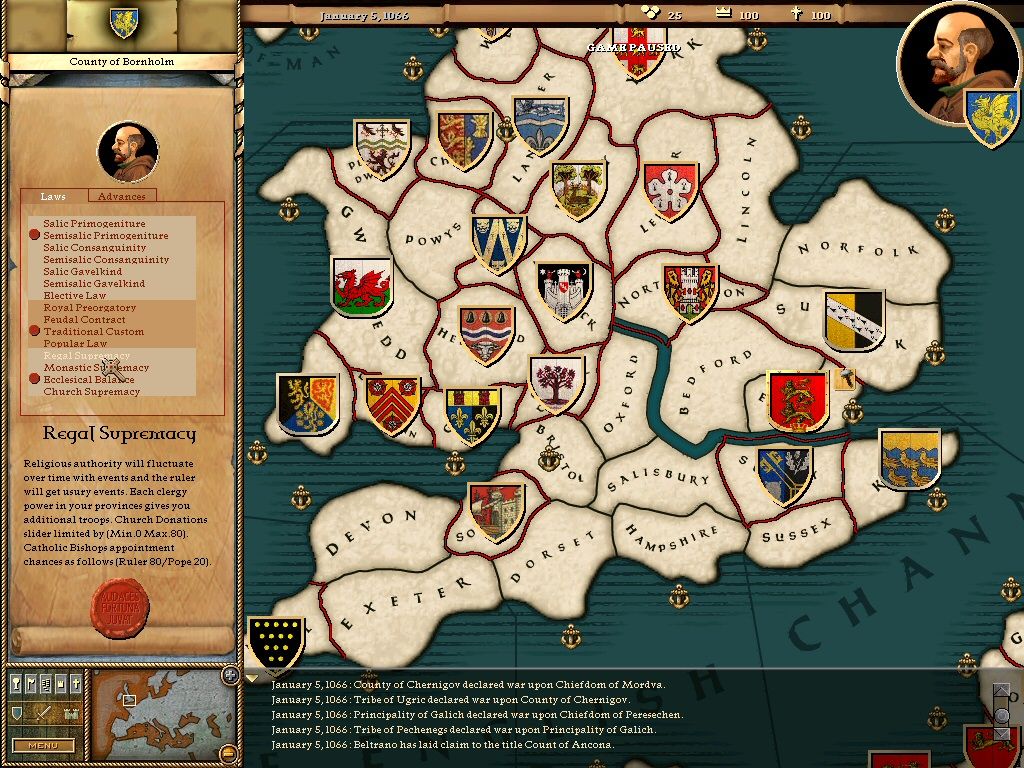
Built on the Europa Universalis engine, Crusader Kings presents a detailed 2D map of medieval Europe, North Africa, and the Near East. Province borders are clearly delineated, and each territory displays its coat of arms, terrain type, and supply limit at a glance. The color-coded realms lend instant readability to geopolitical alliances and ongoing conflicts.
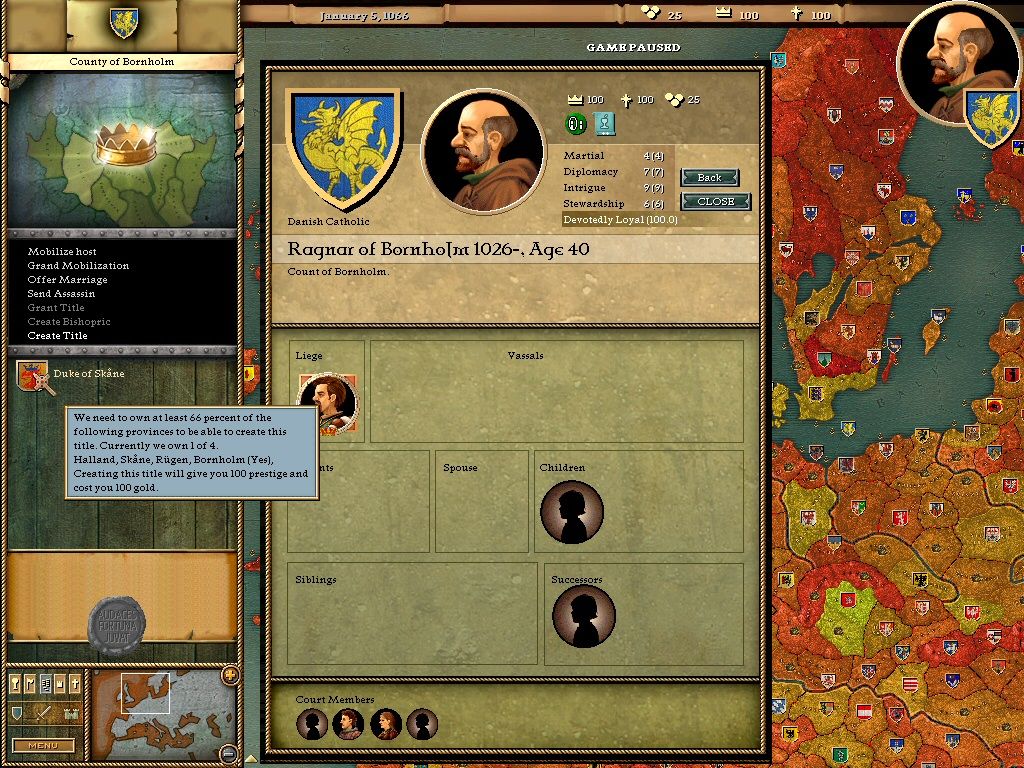
Unit sprites appear only when armies engage, showing stylized medieval banners rather than individual soldiers. While this abstraction may underwhelm those seeking battle-level detail, it keeps the focus on strategy. Menus and tooltips carry a parchment-inspired aesthetic, though modern players may find the interface feels dated compared to contemporary grand strategy titles.
Performance is generally smooth even on modest hardware, with minimal load times between pauses and real-time play. Map scrolling and zoom are responsive, and the UI—though cluttered at first—proves powerful once mastered. Mods and fan patches further refine the visual clarity, updating textures and sharpening icons without overhauling the game’s medieval charm.
Story
Unlike a linear campaign, Crusader Kings generates a unique saga each time you play. Your chosen ruler—be it a frail count in Iberia or a mighty king in Scandinavia—comes with traits, family ties, and ambitions that shape the unfolding narrative. Every marriage, assassination, and papal excommunication writes a new chapter in your family chronicle.
The three historical scenarios serve as entry points into major medieval conflicts, but the emergent stories often surprise. Perhaps your heir dies mysteriously in a hunting accident, leaving a six-year-old on the throne, or a zealous bishop calls a holy war that propels your dynasty into the Levant. These dynamic events encourage you to adapt your long-term strategy on the fly.
Even if history books remember only the Crusades and the Hundred Years’ War, your personal retelling will revolve around betrayals within your own court, alliances sealed by marriage, and the occasional miracle or scandal that reshapes your realm. This blend of historical backdrop and player-driven drama gives Crusader Kings its trademark narrative depth.
Overall Experience
Crusader Kings offers unparalleled depth for fans of medieval strategy and dynastic role-playing. Its emphasis on character relationships and emergent storytelling makes each campaign feel personal and unpredictable, ensuring high replay value. Whether you aim to forge a sprawling empire or simply secure your family’s legacy, the game delivers countless hours of engrossing play.
The learning curve can be steep, especially for newcomers to grand strategy. The interface requires patience to master, and the in-game encyclopedia doesn’t always explain every feudal nuance. However, once you overcome this initial hurdle, the satisfaction of outmaneuvering rival lords, reclaiming lost titles, and ascending to imperial heights is hard to match.
In sum, Crusader Kings remains a landmark title for strategy enthusiasts who crave political intrigue as much as battlefield tactics. Its dated visuals and occasionally clunky UI are minor trade-offs for a living medieval world where your choices echo through generations. For anyone intrigued by the fractured kingdoms of 1066–1419 A.D., this game is an essential conquest.


Reviews
There are no reviews yet.