 Retro Replay Retro Replay gaming reviews, news, emulation, geek stuff and more!
Retro Replay Review
Gameplay
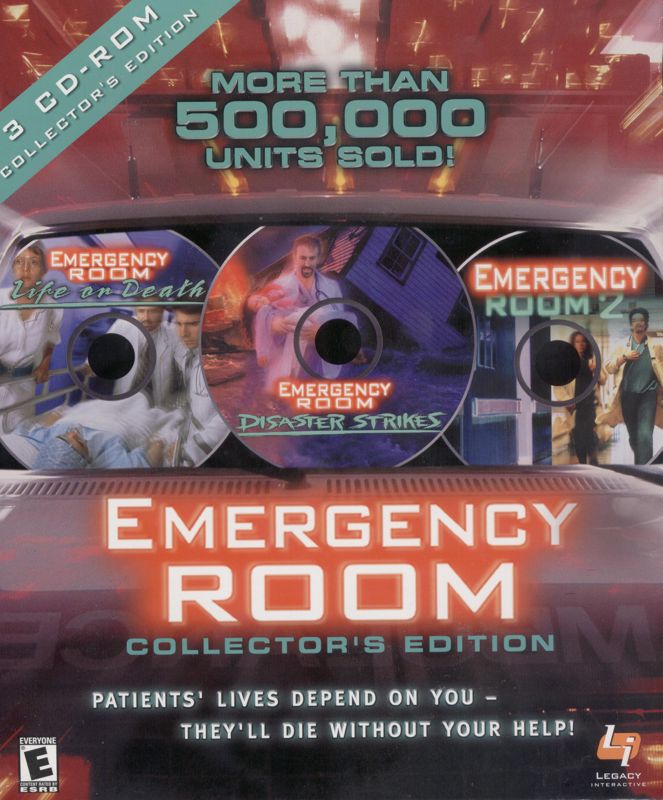
Emergency Room: Collector’s Edition invites players to step into the shoes of an ER physician, juggling multiple cases across three distinct scenarios. From triaging gunshot wounds in Emergency Room 2 to managing the aftermath of a catastrophic earthquake in Disaster Strikes, each title challenges you with time-sensitive decisions that affect patient outcomes. You’ll review charts, order diagnostic tests, and administer treatments in short bursts, making every second—and every choice—count.
(HEY YOU!! We hope you enjoy! We try not to run ads. So basically, this is a very expensive hobby running this site. Please consider joining us for updates, forums, and more. Network w/ us to make some cash or friends while retro gaming, and you can win some free retro games for posting. Okay, carry on 👍)
The gameplay loop across all three CDs is instantly recognizable yet continually engaging. Each case unfolds with a blend of point-and-click investigation and menu-driven decision making. You’ll pore over lab results, consult radiology scans, and elect surgical interventions, all while monitoring vital signs in real time. This balance of detective work and medical procedure gives players a sense of authentic urgency: delay too long, and you risk a patient’s health.
What stands out in this Collector’s Edition is the clear progression from novice to seasoned practitioner. As you advance, the complexity of cases ramps up, introducing multi-trauma victims, hazardous materials exposures, and pediatric emergencies. The series’ gradual learning curve makes it accessible to newcomers and rewarding to veterans, ensuring that every puzzle—whether a common fracture or a rare tropical infection—feels fresh and meaningful.
Graphics
Graphically, the Emergency Room series reflects its early-2000s origins, with pre-rendered backgrounds and full-motion video (FMV) sequences featuring live-action actors. While character animations can feel stiff by modern standards, they lend an authentic, documentary-style vibe that enhances immersion. The still images of X-rays and CT scans, although low-resolution by today’s benchmarks, are surprisingly clear in representing medical details.
Each CD presents a slightly different visual palette: Emergency Room 2 opts for a cooler, clinical aesthetic with stark white walls and blue surgical scrubs, while Disaster Strikes uses warmer, dust-tinted hues to convey the chaos of outdoor triage. Life Or Death strikes a balance, mixing fluorescent ER lighting with occasional outdoor scenes when you’re called to on-site emergencies. These variations keep the environment visually engaging across all three titles.
The user interface remains consistent throughout the series, featuring a toolbar for vital signs, patient history, imaging, and treatment options. Though dated, the interface is intuitive and responsive, with minimal load times when switching between diagnostic panels. For players seeking nostalgia or a retro medical sim, the graphics hit their mark—evoking classic PC gaming while still delivering essential visual clarity.
Story
Unlike narrative-driven RPGs or adventure games, Emergency Room’s story unfolds through procedural cases rather than predetermined plot arcs. Each patient presents a mini-story: the anxious hiker with an infected wound, the elderly gentleman suffering a stroke, or the construction worker trapped under rubble. Your role is to uncover the hidden details behind each ailment, piecing together clues to diagnose and treat effectively.
Between cases, brief FMV cutscenes introduce new scenarios and occasionally reveal the personal struggles of your on-screen colleagues. While these interludes are short, they offer context and emotional weight, reminding you that real lives hang in the balance. The episodic structure ensures players remain engaged, as the promise of a dramatic or unusual case always lurks just around the corner.
Moreover, each game’s setting contributes to its narrative tension. Emergency Room 2 feels like a high-stakes urban hospital, Disaster Strikes thrusts you into makeshift field clinics amid disaster zones, and Life Or Death combines both settings to underscore the unpredictability of emergency medicine. Together, the three titles craft a comprehensive portrait of the ER experience.
Overall Experience
Emergency Room: Collector’s Edition is a treasure trove for fans of simulation and medical drama. By bundling three complete games on separate CD-ROMs, Legacy Interactive delivers hours of content that span routine treatments to large-scale disasters. The compilation offers tremendous value, especially for players interested in the evolution of medical sims over the early 2000s.
Despite its age, the series’ core appeal remains intact: authentic medical procedures, compelling case scenarios, and that ever-present race against time. The compilation’s variety—ranging from desk-bound ER work to on-the-move crisis response—keeps the experience from growing stale. Whether you’re revisiting the series for nostalgia or discovering it for the first time, there’s a satisfying depth to each title’s mechanics.
While modern gamers may notice the dated graphics and FMV acting, these elements are part of the series’ charm. Emergency Room: Collector’s Edition is not a high-octane action game but rather a thoughtful, procedure-driven simulation that rewards attention to detail and clinical reasoning. For anyone curious about the fast-paced world of emergency medicine—or simply craving a unique, case-by-case puzzle adventure—this collection remains a compelling pick.


Reviews
There are no reviews yet.