 Retro Replay Retro Replay gaming reviews, news, emulation, geek stuff and more!


Retro Replay Review
Gameplay
Iron Helix delivers a tense exploration experience by placing you in control of an unarmed science robot tasked with infiltrating the rogue navy ship Jeremiah Obrian. Your objective is to navigate its abandoned corridors, access data ports, and ultimately disable the doomsday weapon, the Iron Helix. The core gameplay loop revolves around planning your route, collecting DNA samples for port access, and outsmarting the lethal security drone that relentlessly pursues you.
(HEY YOU!! We hope you enjoy! We try not to run ads. So basically, this is a very expensive hobby running this site. Please consider joining us for updates, forums, and more. Network w/ us to make some cash or friends while retro gaming, and you can win some free retro games for posting. Okay, carry on 👍)
One of the standout mechanics is the slight delay between issuing commands and seeing the robot act on them. This delay injects a real-time strategy element, forcing you to anticipate the drone’s movements and think several steps ahead. A single mistimed command can corner you in a dead end, leading to a quick robot “death” and sending you back to your last save point. This risk-reward balance creates a gratifying sense of achievement when you successfully dodge or trap the drone.
Interacting with data ports adds another layer of complexity. You must find DNA samples from specific crew members, each sample granting access to different sections of the ship. Hunting for these samples transforms each corridor into a puzzle, as you juggle pathfinding, resource management, and the constant threat of the drone. Every successful port hack or narrow escape feels earned, making the gameplay loop both challenging and deeply engaging.
While Iron Helix’s controls are simple—move, scan, hack—they are finely tuned to support the game’s strategic pacing. The motion commands, combined with the robot’s limited sensor range and occasional sensor glitches, keep your senses sharp. There’s a steady tension that builds as you venture deeper into the Jeremiah Obrian, ensuring that gameplay never becomes repetitive or predictable.
Graphics
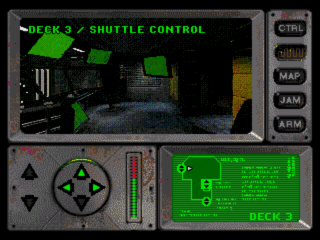
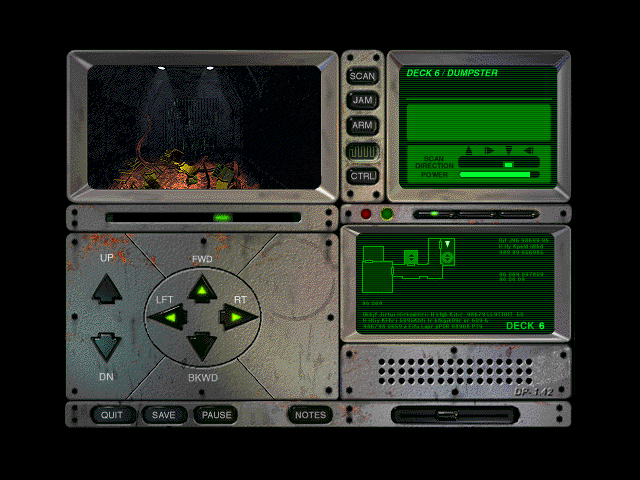
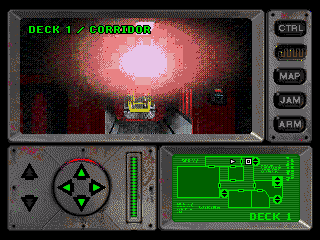
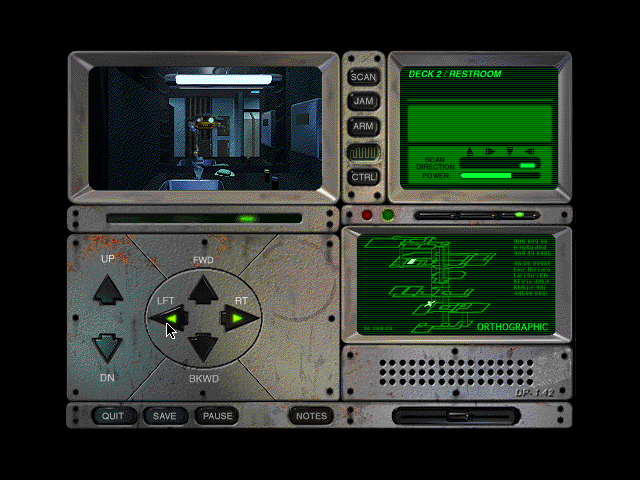
Iron Helix employs an innovative interactive quarter-screen footage technique to depict the ship’s interiors. Instead of full-motion 3D, the game uses pre-rendered live-action segments in each quadrant of the screen, updated dynamically based on your robot’s position. This hybrid approach gives the environments a realistic, gritty look that was cutting-edge at the time of release.
The footage showcases dimly lit hallways, flickering overhead lights, and ominous bulkheads—all captured in atmospheric detail. Every area feels lived-in, with signs of the crew’s sudden disappearance evident in overturned equipment and scattered papers. Despite the limitations of the medium, the visuals maintain a cohesive tone that reinforces the feeling of isolation and menace.
The automated security drone, rendered through a combination of live-action overlays and simple animations, stands out against the static backgrounds. Its distinct whirring sound and glowing sensor eye become instantly recognizable, heightening every encounter. Though the graphics may feel dated by modern standards, the artistry and ambition behind the quarter-screen footage remain impressive.
In addition to the main hallways, specialized rooms such as the biological lab, communications center, and the final weapons control chamber each have unique visual motifs. Subtle color grading and practical effects—steam venting from pipes, sparks from faulty wiring—add authenticity. The result is a graphical presentation that, while unconventional, serves the narrative and gameplay exceptionally well.
Story
The premise of Iron Helix is a classic sci-fi thriller: a once-proud navy vessel gone dark, its crew wiped out by a mysterious virus, leaving only the threat of its doomsday weapon. Early dialogue exchanges and briefing screens efficiently establish the high stakes—war hangs in the balance, and your remote intervention is humanity’s last hope. The story unfolds primarily through datapad logs, encrypted messages, and forensic audio snippets scattered throughout the ship.
Each piece of recovered data adds layers to the narrative, unveiling the ship’s tragic backstory and the chain of events that led to the virus outbreak. Crew journals hint at corporate cover-ups, moral conflicts, and scientific hubris. As you piece together these elements, the story evolves from a straightforward “save-the-world” mission into a darker meditation on ethical boundaries in military research.
Character is conveyed indirectly through the environments and data you uncover. The absence of living crew members heightens the suspense, turning every corner into a potential ambush site. When you finally learn the origin of the Iron Helix project and the true purpose behind the virus, the tension reaches its zenith. The narrative payoff, delivered in the final control room sequence, feels satisfying without relying on heavy cinematics.
Although the story is compact, it strikes an effective balance between exposition and player-driven discovery. By keeping you active in unearthing critical plot points, Iron Helix ensures that the narrative always feels earned. The game’s ambiguous ending also invites discussion and speculation, giving it a lasting impact beyond the final credits.
Overall Experience
Iron Helix stands out as a pioneering blend of live-action footage and interactive puzzle gameplay. Its deliberate pacing, combined with strategic command delays and relentless security drones, crafts a uniquely suspenseful experience. You’ll find yourself both strategizing and improvising as you delve deeper into the Jeremiah Obrian’s secrets.
The game’s audio-visual design—quarter-screen footage, ambient ship noises, and the drone’s mechanical hum—immerses you in a cold, clinical environment where danger lurks in every shadow. Even decades after its initial release, Iron Helix’s atmosphere remains engrossing, proving the lasting power of well-executed tension and practical effects.
While modern players accustomed to full 3D environments might need some adjustment, the core gameplay and story are compelling enough to overcome any initial unfamiliarity with the format. Iron Helix rewards patience, attention to detail, and a willingness to think ahead, offering a deeply satisfying puzzle-thriller that still feels innovative today.
For anyone seeking a cerebral sci-fi adventure that emphasizes strategy, exploration, and narrative discovery over combat, Iron Helix is an essential experience. Its fusion of interactive footage, thoughtful design, and high-stakes storytelling makes it a timeless classic for fans of atmospheric, intellectually engaging games.



Reviews
There are no reviews yet.