 Retro Replay Retro Replay gaming reviews, news, emulation, geek stuff and more!




Retro Replay Review
Gameplay
PeaceMaker delivers a turn-based simulation that challenges you to navigate the complex Israeli–Palestinian conflict through a clear, menu-driven interface. Each turn you review news events, assess the mood of different factions, and decide on a course of action in three broad categories: Security, Political, and Construction. These choices affect your popularity both at home and abroad, and help shape the path toward—or away from—lasting peace.
(HEY YOU!! We hope you enjoy! We try not to run ads. So basically, this is a very expensive hobby running this site. Please consider joining us for updates, forums, and more. Network w/ us to make some cash or friends while retro gaming, and you can win some free retro games for posting. Okay, carry on 👍)
Playing as either the Israeli Prime Minister or the Palestinian President, you must carefully balance the demands of hardliners, moderates, and international stakeholders. Security actions range from ordering missile strikes or demolishing buildings on the Israeli side to managing border control and internal militants on the Palestinian side. Political moves include delivering speeches, negotiating trade agreements, or lobbying world leaders for support. Construction efforts allow you to invest in health care, education, or infrastructure projects, reinforcing the belief that economic and social development can pave the way to reconciliation.
What sets PeaceMaker apart is the way each decision ripples across multiple constituencies. A single curfew order might placate one faction while enraging another; a successful meeting with the United Nations can unlock previously unavailable diplomatic options. The game provides you with real-time statistics on faction power, fears, goals, and likely reactions, turning every choice into a genuine strategic puzzle.
With three difficulty levels—Calm, Tense, and Violent—the game adjusts the frequency and severity of crises you must address. Beginners can focus on understanding the political landscape in a more forgiving environment, while veterans face a relentless barrage of bombings, protests, and international pressure. This scalability ensures that PeaceMaker remains engaging whether you’re new to geopolitical simulations or a seasoned strategist.
Graphics
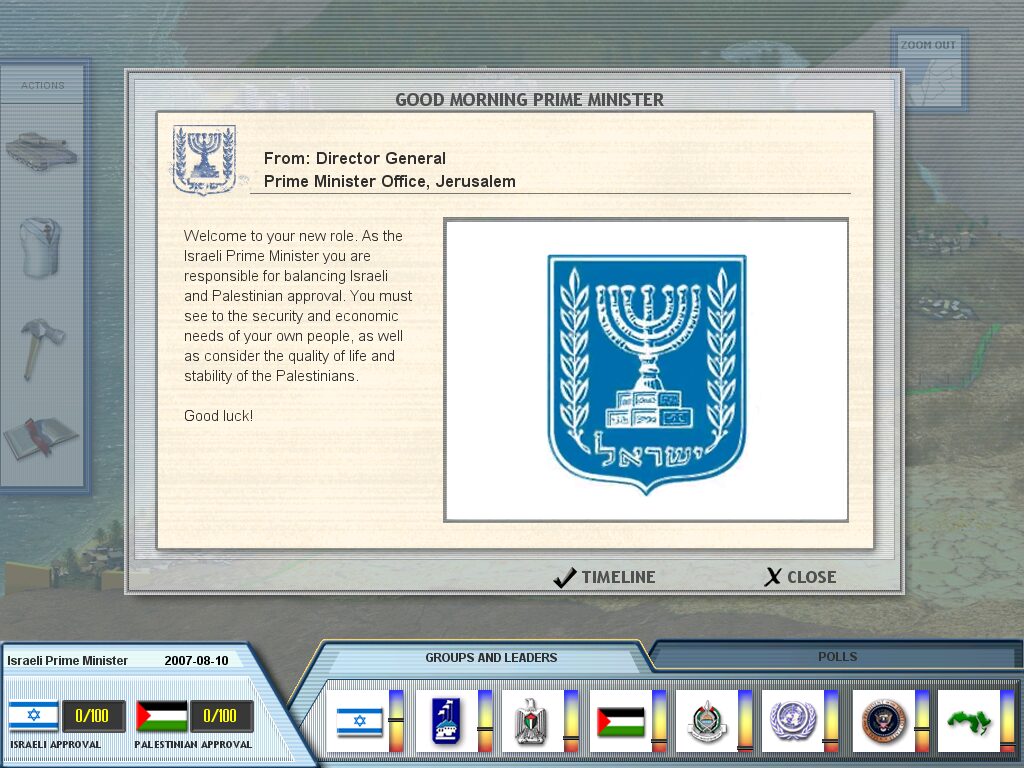
Although PeaceMaker is not a graphics-heavy title, its minimalist presentation serves its purpose perfectly. The game screen centers on a stylized map of Israel and the Palestinian territories, color-coded to reflect areas under your control or influence. Subtle animations highlight events such as demonstrations, settlement expansions, or military operations without overwhelming the player with distracting visuals.
The user interface is clean and functional. Action menus appear at the top of the screen, grouped by category, while the sidebar displays faction statistics, international opinion gauges, and current events. Icons are intuitive, and tooltips provide additional context, ensuring that even complex diplomatic options are easy to interpret.
Visual feedback is immediate and informative. When you announce a new policy or carry out a security operation, relevant regions on the map pulse or change color, and charts update to show shifts in public opinion. This direct correspondence between action and outcome reinforces the impact of each decision without resorting to cinematic cutscenes or elaborate 3D models.
In keeping with its serious subject matter, PeaceMaker forgoes flashy graphics in favor of clarity and focus. The restrained art style keeps the player’s attention squarely on the geopolitical challenges at hand, underscoring that this is a game of ideas and strategy rather than spectacle.
Story
At its core, PeaceMaker is driven by its real-world context. You step into the shoes of a national leader at a pivotal moment in history, tasked with steering your people away from violence and toward a peaceful resolution. Though the game does not follow a linear narrative, each turn unfolds like a chapter in an evolving diplomatic saga, with unpredictable twists and high-stakes consequences.
Events are drawn from actual historical patterns, and the game designers have striven for fairness in representing both sides of the conflict. Whether you’re dealing with a surge in settler activity, responding to a suicide bombing, or negotiating control over holy sites, every scenario is grounded in the complex realities of the region.
The branching possibilities create a sense of emergent storytelling. One poorly judged political speech can spark a wave of protests; a well-timed infrastructure grant can build goodwill and open doors for peace talks. The interplay of initiatives and reactions makes the story feel uniquely yours, and no two playthroughs are exactly alike.
By allowing you to experience the conflict from both Israeli and Palestinian perspectives, PeaceMaker fosters empathy and understanding. It doesn’t shy away from difficult questions or moral dilemmas, encouraging you to weigh the human cost of each decision and appreciate the monumental challenges involved in peacemaking.
Overall Experience
PeaceMaker stands out as an educational yet deeply engaging strategy game. It successfully transforms a decades-long geopolitical crisis into an interactive learning environment, where the rewards of diplomacy and the risks of escalation are both vividly illustrated. You come away with a clearer sense of how interwoven security, politics, and development truly are.
The replay value is high. Each side presents unique priorities and obstacles, and the three difficulty settings keep you testing new approaches and refining your judgment. Whether you aim for a cautious, incremental peace process or bold, sweeping reforms, the game accommodates a range of leadership styles and risk tolerances.
While its austere presentation may deter those seeking flashy graphics or fast-paced action, PeaceMaker offers a rich, thoughtful experience that resonates long after you’ve played. It challenges preconceived notions, fosters critical thinking, and rewards patience and empathy as much as strategic foresight.
For anyone interested in politics, history, or the art of negotiation, PeaceMaker is an essential play. It’s a rare example of a “serious game” that manages to be both enlightening and genuinely fun, making it a standout title for those looking to explore one of the world’s most intractable conflicts from the safety of their own desk.



Reviews
There are no reviews yet.