 Retro Replay Retro Replay gaming reviews, news, emulation, geek stuff and more!
Retro Replay Review
Gameplay
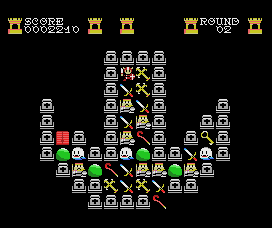
Griel’s Quest for the Sangraal builds its challenge on a deceptively simple foundation: you control a lone knight traversing a series of grid-based rooms, armed with exactly one magical item at a time. Unlike pure Sokoban clones, here you’re not shoving crates but strategically collecting and deploying objects to vanquish specific enemies. You’ll find the Magical Staff to dispatch slime creatures, the Holy Cross to banish ghosts, and the Sacred Sword to slay ogres. Deciding the correct pickup sequence is vital—once you grab an item, you can’t drop it until you use it on the appropriate foe.
(HEY YOU!! We hope you enjoy! We try not to run ads. So basically, this is a very expensive hobby running this site. Please consider joining us for updates, forums, and more. Network w/ us to make some cash or friends while retro gaming, and you can win some free retro games for posting. Okay, carry on 👍)
As levels progress, movement tiles appear that force you to glide in predetermined directions, raising the risk of getting irreversibly stuck. A misplaced step can leave you boxed in or cut off from the next magical tool. Coupled with the one-object limit, this restriction transforms each room into a miniature logic puzzle, where planning three or four moves ahead isn’t a luxury but a necessity. Fortunately, all monsters remain static, so the game centers entirely on spatial reasoning rather than reflexes.
Progression is punctuated by a password system: every five levels you’re rewarded with a code that allows you to return to that checkpoint later. This feature smartly balances the challenge, letting you tackle tricky rooms without losing weeks of effort. The difficulty curve is steady but steep, and while some levels border on fiendish, the consistency of the rules ensures that success always feels earned.
Overall, the gameplay loop in Griel’s Quest for the Sangraal is a triumphant nod to classic puzzle-adventure hybrids. It blends familiar mechanics from Lolo and Sokoban with its own medieval motif, creating a cerebral experience that rewards patience, observation, and a flair for strategic planning.
Graphics
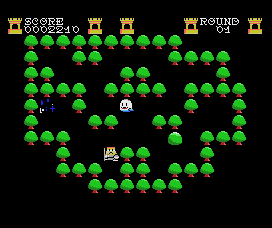
Visually, Griel’s Quest for the Sangraal embraces the MSX1’s modest palette and resolution to deliver crisp, nostalgic pixel art. Character sprites and enemies are small but distinct: the knight’s silvery armor gleams in contrast to the muted hues of dungeon walls, while ghosts appear as wispy white shapes that drift hauntingly across the screen. Despite hardware constraints, each object—Magical Staff, Holy Cross, Sacred Sword—boasts recognizable icons that never leave you guessing.
The level designs exploit tile-based repetition smartly, using subtle color shifts to delineate pathways, one-way tiles, and hazard zones. Backgrounds remain uncluttered, ensuring your focus stays on puzzle elements and item placements. Occasionally you’ll encounter thematic touches—torch sconces, stained-glass window motifs, ornate gate frames—that hint at the Sangraal’s mythic lore without overwhelming the functional layout.
Animation is minimal but purposeful. When you vanquish a slime or ghost, the screen briefly flashes or the sprite vanishes, giving an immediate sense of accomplishment. Movement transitions are smooth, with no perceptible slowdown even when the screen redraws after level completion. For fans of retro aesthetics, the visuals strike a satisfying balance between clarity and vintage charm.
In short, while Griel’s Quest for the Sangraal doesn’t push 8-bit hardware to its absolute graphical limits, it leverages the MSX1’s strengths to craft a coherent and pleasing visual identity. The artistry serves the gameplay first and foremost, but it also evokes a sense of medieval wonder that fits the quest theme perfectly.
Story
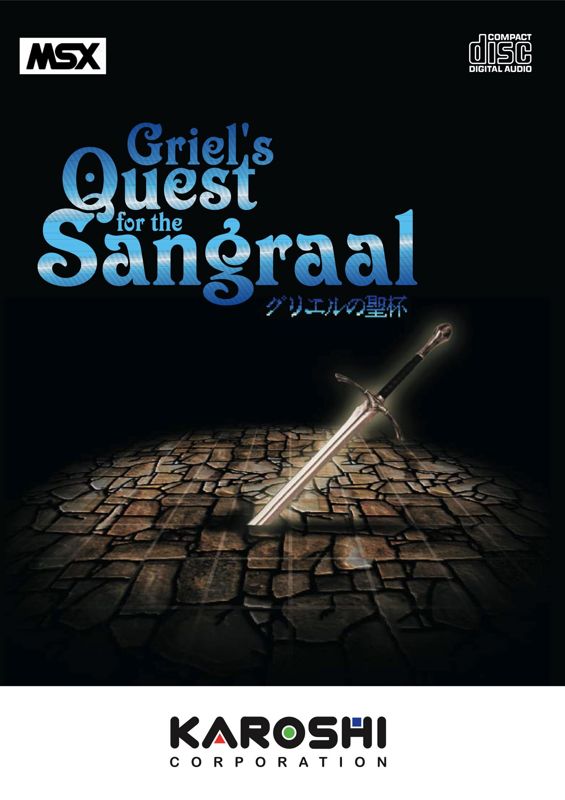
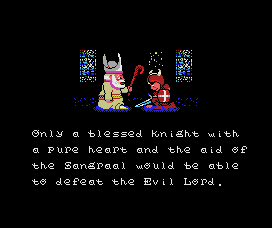
The narrative premise of Griel’s Quest for the Sangraal is elegantly straightforward: you are Griel, a valiant knight on a mission to retrieve the Holy Grail and restore peace to a realm besieged by dark creatures. Though the storyline is minimal by modern standards, it evokes classic fantasy tropes that immediately contextualize each dungeon’s purpose—rescue, recovery, deliverance.
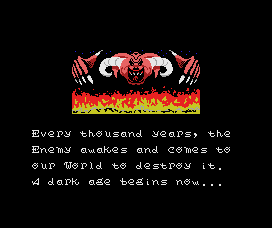
Hints of the original 1990 MSX2 title, Gurieru no Seihai, remain woven into the adaptation’s dialogue boxes and stage descriptions. Brief text interludes underscore the gravity of the quest, reminding you why each item matters and what fate awaits should you fail. The tone is earnest rather than self-aware, inviting you to lose yourself in a low-key but earnest heroic journey.
While there are no spoken cutscenes or branching narrative paths, the simplicity works in the game’s favor. Every level completed feels like a tangible step toward the Sangraal, driving you onward despite the mounting difficulty. The password system even carries a bit of story weight, as each code feels like a rune of empowerment bestowed by a grateful sect of monks.
Ultimately, the story in Griel’s Quest for the Sangraal functions as a guiding framework rather than a centerpiece. It sets the stage, fuels your motivation, and then steps aside to let the puzzles take center focus—an approach that suits this homage to early-’90s MSX puzzle-adventures.
Overall Experience
Griel’s Quest for the Sangraal offers a gratifying blend of nostalgia, mental challenge, and neatly crafted design. The one-item-at-a-time mechanic injects fresh tension into the familiar puzzle-adventure formula, forcing you to rethink strategies on every screen. Unlike modern titles that may distract with cutscenes or complex HUDs, this game keeps you immersed in the purity of its grid-based conundrums.
The learning curve is firm but fair. Early levels serve as an accessible tutorial, introducing each magical item and basic movement tiles. As you progress, the puzzles evolve into intricate mazes of logic that demand deep concentration—ideal for players who savor “aha” moments over fast reflexes. The password feature respects your time, letting you tackle bite-sized chunks without committing to an entire playthrough in one sitting.
For retro enthusiasts and newcomers alike, the game’s minimalist presentation is a strength rather than a shortcoming. There’s a certain magic in seeing problem-solving distilled to its essence: plan, collect, eliminate, and move on. The immobile monsters and static dungeons turn potential frustration into a test of wit, making each successful clearance feel like a genuine triumph.
In conclusion, Griel’s Quest for the Sangraal stands out as a thoughtful MSX1 remake that honors its MSX2 predecessor. It’s an engaging puzzle adventure with a noble quest at its heart, polished visuals, and an addictive gameplay loop. Whether you’re revisiting the golden era of 8-bit gaming or discovering these mechanics for the first time, Griel’s Quest promises a memorable journey toward the legendary Sangraal.


Reviews
There are no reviews yet.