 Retro Replay Retro Replay gaming reviews, news, emulation, geek stuff and more!
Retro Replay Review
Gameplay
Same or Different presents a straightforward yet engaging gameplay loop that’s perfectly suited for young children or anyone new to educational video games. Each round displays four EGA-style images of random items, and players must decide whether all four images are identical or if one image differs from the rest. The simple YES or NO prompt means that even the youngest users can easily understand and interact with the game without confusion.
(HEY YOU!! We hope you enjoy! We try not to run ads. So basically, this is a very expensive hobby running this site. Please consider joining us for updates, forums, and more. Network w/ us to make some cash or friends while retro gaming, and you can win some free retro games for posting. Okay, carry on 👍)
After each choice, the game immediately provides feedback on correctness. If the child correctly identifies that all images are the same or spots the odd one out, they receive positive reinforcement and proceed smoothly to the next round. Conversely, an incorrect answer triggers a helpful visual cue: the differing image flashes on the screen, guiding the player directly to the correct answer. This instant feedback loop encourages learning through trial and error and helps build pattern-recognition skills over time.
The game consists of ten sets of images, each presenting a fresh challenge. This fixed length prevents the experience from dragging on too long, making it ideal for short play sessions or educational breaks. At the conclusion of the tenth round, the child’s total score is displayed, offering a clear summary of their performance and providing motivation to play again and improve.
Graphics
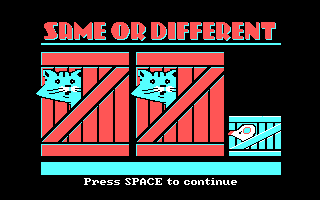
Same or Different uses classic EGA graphics, featuring a palette of 16 vibrant colors that evoke nostalgia while remaining clear and functional for its intended audience. The visuals prioritize clarity, ensuring that each item is easily distinguishable. Simple shapes and bold outlines prevent visual confusion, which is crucial when the primary task involves identifying subtle differences.
While the graphics are not cutting-edge, they are entirely appropriate for an educational title of this nature. The pixelated art style adds a retro charm, appealing to parents or educators who grew up with early PC games. These visuals also run flawlessly on low-end hardware, making the game accessible to a wide range of classrooms and home computers.
The flashing animation used to highlight incorrect answers is both effective and unobtrusive. It briefly attracts attention without becoming a distraction, striking a balance between corrective feedback and smooth pacing. Overall, the graphics serve the gameplay perfectly, focusing on function over flair.
Story
Same or Different does not feature a traditional narrative or characters, and this minimalist approach is intentional. By stripping away extraneous story elements, the game remains entirely focused on its core educational objective: improving pattern recognition and decision-making skills. For parents and teachers seeking a no-frills learning tool, this directness is a welcome design choice.
Although there’s no overarching plot, the game’s structure provides a small sense of progression. Each new screen of images feels like advancing to the next level, and the culminating score screen offers closure. This simple progression loop is enough to maintain engagement without the need for elaborate storytelling.
In lieu of narrative depth, Same or Different builds a learning journey through incremental challenges and positive reinforcement. This “narrative” of self-improvement and discovery can be more meaningful in an educational context than a traditional story, especially for younger audiences who are focused on mastering the task at hand.
Overall Experience
Same or Different is a concise, well-designed educational game that excels at its specific purpose. Its gameplay loop is easy to understand, offering immediate rewards and transparent progression. For parents, teachers, or guardians seeking an engaging tool to help children develop quick observation and decision-making skills, this title ticks all the right boxes.
The retro EGA graphics, while simplistic by modern standards, are clear and charming. They ensure that visual clarity remains paramount, reducing the risk of misinterpretation and keeping the game accessible even on older hardware. The flashing feedback mechanism is both helpful and motivating, ensuring that users learn from mistakes without feeling discouraged.
Overall, Same or Different offers a no-nonsense, highly approachable learning experience. It may not have bells and whistles or a sprawling narrative, but its focused design and instant feedback system make it a valuable addition to any early learning toolkit. For short bursts of educational entertainment, this game delivers exactly what it promises: a fun way to tell if images are the same or different.


Reviews
There are no reviews yet.