 Retro Replay Retro Replay gaming reviews, news, emulation, geek stuff and more!

Retro Replay Review
Gameplay
Martian Threat’s core gameplay revolves around piloting a nimble fighting probe inside the Martian spaceship’s zero-gravity environment. Using a simple joystick control scheme, players must carefully balance forward and reverse thrust—once the probe starts drifting, it won’t stop until you counter-thrust. This inertia-driven movement gives each engagement a satisfying sense of weightlessness, demanding precision and quick reflexes as you dodge incoming fire.
(HEY YOU!! We hope you enjoy! We try not to run ads. So basically, this is a very expensive hobby running this site. Please consider joining us for updates, forums, and more. Network w/ us to make some cash or friends while retro gaming, and you can win some free retro games for posting. Okay, carry on 👍)
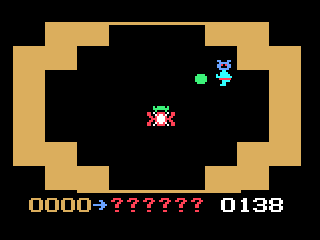
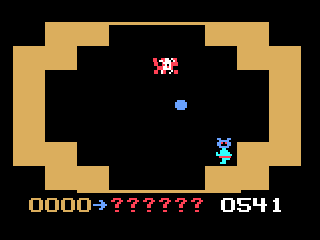
Enemy energy bombs spawn from four fixed points around the playfield, each color indicating increased power and speed. Early waves feature slow green bombs that deal minimal damage, but as the timer ticks toward 64 seconds, bombs shift to blue, purple, then lethal red. The diagonal-only firing arc adds another layer of strategy: you’ll be constantly adjusting your trajectory to line up clean shots while avoiding being pushed into the walls.
The probe can withstand up to ten hits from green bombs but only three from red, so situational awareness is crucial. Bomb impacts not only chip away at your health bar but also knock you off course, amplifying tension as you scramble to reorient. Additionally, colliding with the ship’s walls results in an immediate explosion, making the boundary lines as deadly as any Martian weapon.
Despite its straightforward premise—hold out until Earth’s laser cannon comes online—the game offers deep replay value. Mastering fuel-efficient maneuvers, predicting bomb spawn patterns, and finding safe zones near corners of the room all become essential skills. Each run feels like an escalating test of endurance, making “just one more try” a constant temptation.
Graphics
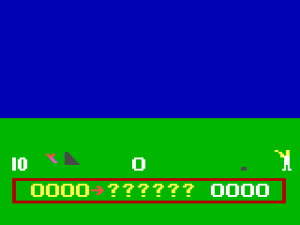
Visually, Martian Threat embraces a clean, retro-futuristic aesthetic. The spaceship interior is rendered in stark metallic grays and deep blacks, punctuated by glowing status panels and warning lights. Against this backdrop, the bright green, blue, purple, and red bombs stand out sharply, ensuring you never lose sight of incoming threats.
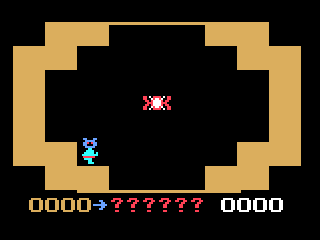
The probe itself is a crisp, angular sprite, its subtle animations conveying thruster flickers and minor hull damage. Enemy bombs pulse with an animated energy core, helping you gauge their threat level at a glance. The color transitions between bomb tiers are smooth and intuitive, providing both visual flair and instant gameplay feedback.
Frame rate remains rock-solid even when the screen is cluttered with multiple projectiles. This consistency is vital, as any slowdown would severely impact your ability to dodge or return fire. The heads-up display is minimal but effective, showing remaining shield hits and the mission timer without obscuring action.
While it may not push the boundaries of 3D rendering, Martian Threat’s graphics excel in functional clarity and retro charm. Everything you need to see is presented cleanly, helping maintain focus on the frantic dance of thrust and evasion at the heart of the game.
Story
The narrative premise of Martian Threat is classic sci-fi drama: a hostile Martian armada has orbited Earth, constructing a planet-scale laser cannon set to eradicate humanity. With no time for diplomacy, Earth’s governments form the Space Intruder Defense Organisation (SIDO) to plant a covert fighting probe aboard the dreadnought and stall the invasion.
You step into the role of this single-pilot probe, tasked with defending the ship’s interior against waves of Martian energy bombs until the ground-based laser defense completes its build. The stakes couldn’t be higher—survive 64 seconds (or 77 in PAL regions), and Earth’s fate flips from annihilation to triumph. Fail, and the Martians unleash their virus bomb, spelling total extinction.
Story beats are concise, delivered through a brief intro text and occasional status alerts on the HUD. While there are no in-game cutscenes, the ticking countdown and changing bomb colors effectively convey escalating tension. The minimalist approach keeps players laser-focused on the action, but the looming doomsday scenario remains ever-present.
For fans of streamlined, high-stakes storytelling, the setup provides just enough context to fuel adrenaline without bogging down gameplay. If you appreciate a narrative that serves the action—gone are lengthy exposition dumps—Martian Threat’s story hits the right notes in minimal time.
Overall Experience
Martian Threat delivers a tight, high-octane experience that challenges both your reflexes and strategic thinking. The zero-gravity controls are easy to pick up but hard to master, ensuring that every second of play feels fresh and demanding. The mission timer’s slow crawl toward completion ratchets up the tension, making each near-miss or collision resonate deeply.
Difficulty curves are well-balanced—the initial waves let you get comfortable with thruster management, while later stages force split-second decisions under pressure. Even if you fall to a red bomb or wall collision, the quick restart loop helps maintain momentum, encouraging you to refine your tactics run after run.
Audio design is equally effective: a subtle, throbbing soundtrack underscores the urgency, while explosive sound effects and HUD alerts punctuate key moments. The lack of voiceovers or lengthy dialogue keeps your focus squarely on the probe’s survival, heightening immersion in the do-or-die scenario.
Overall, Martian Threat excels as a focused survival shooter with a distinctive zero-gravity twist. Its clean visuals, escalating challenge, and succinct story make it a standout choice for players who crave fast-paced, high-stakes gameplay. If you’re looking for a compact yet demanding arcade experience that keeps you on the edge of your seat, this Martian incursion is well worth defending against.


Reviews
There are no reviews yet.