 Retro Replay Retro Replay gaming reviews, news, emulation, geek stuff and more!




Retro Replay Review
Gameplay
The core gameplay of Half-Life on PlayStation 2 stays true to the Windows original, delivering tense, corridor-to-corridor gunfights and physics-driven puzzles. The PS2 port overhauls many of the weapons, tweaking recoil patterns and rate of fire to suit the DualShock controller. Character hitboxes and enemy AI are faithfully recreated, but you’ll notice subtle differences in how grenades arc and how faster–paced battles unfold in tight spaces.
(HEY YOU!! We hope you enjoy! We try not to run ads. So basically, this is a very expensive hobby running this site. Please consider joining us for updates, forums, and more. Network w/ us to make some cash or friends while retro gaming, and you can win some free retro games for posting. Okay, carry on 👍)
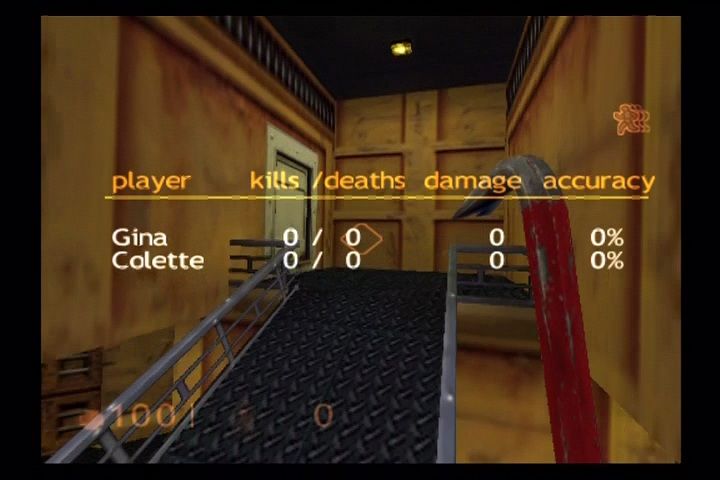
Beyond the base game, Half-Life: Decay adds an entirely new cooperative experience. Split-screen or via dual controllers, you and a partner assume the roles of scientists Gina Cross and Colette Green. Rather than blasting headcrabs nonstop, Decay leans into teamwork and puzzle solving: one player might need to reroute power while the other clears debris or presses switches in sync. If you go solo, you can still swap between the two protagonists, though the constant character switching does break the rhythm of the action at times.
PC purists will appreciate the USB mouse and keyboard support, which brings more precise aiming and smoother camera control compared to dual analog sticks. Whether you’re lining up headshots in Xen or guiding a barrel through a toxic waste pit, the added control options help bridge the gap between console and desktop FPS experiences. Combined with the extended levels and reworked geometry, Half-Life on PS2 manages to feel both familiar and fresh.
Graphics
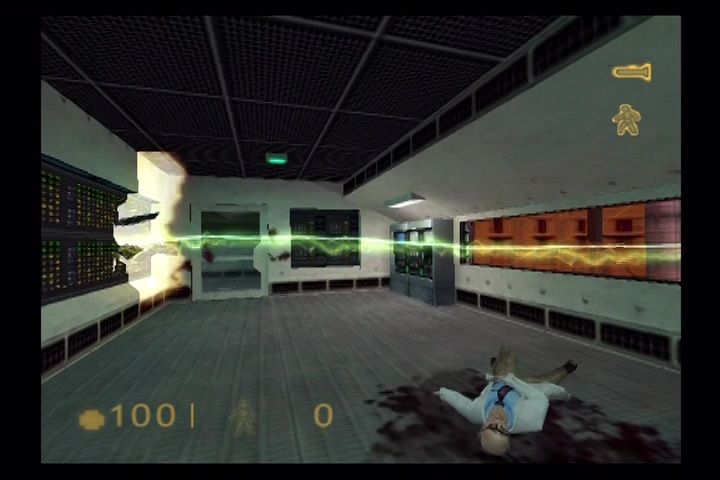
Graphically, this PS2 port receives significant upgrades from the Windows build. Character models are more detailed, with higher polygon counts and refined textures on protagonist Gordon Freeman, the HECU marines, and Xen creatures. Environmental assets have been rebuilt from the ground up—corridors are wider, rooms have more props and atmospheric details, and lighting effects are enhanced to better convey the hazardous Black Mesa labs.
Extended levels and the Decay expansion offer unique environments not found in the original release—wider industrial chambers, newly designed laboratory wings, and custom textures that give a slightly different color palette to familiar locales. The dynamic flickering lights, steam vents, and particle effects remain a highlight, especially during moments of high tension when power falters or explosions rock the facility.
Performance generally hovers around 30 FPS in single-player, dropping slightly in split-screen Decay when both players activate particle-heavy scenes like barnacle chases or large group skirmishes. Occasional pop-in or texture streaming quirks appear in the most elaborate rooms, but they’re minor when weighed against the improved draw distance and updated models. Overall, the graphics strike a solid balance between console limitations and faithful adaptation of Valve’s iconic art style.
Story
Half-Life’s narrative remains one of the most engaging in FPS history: you’re Gordon Freeman, a theoretical physicist thrust into a disastrous experiment at the Black Mesa Research Facility. Without cutscenes, the game uses environmental storytelling, radio chatter, and scripted events to propel you through military lockdowns, alien incursions, and a race against time to close dimensional rifts.
Decay’s campaign unfolds in parallel to Gordon’s journey, focusing on two female scientists who are typically background NPCs in the main game. Gina Cross and Colette Green find themselves solving power puzzles, escorting trapped personnel, and coordinating rescues during the same resonance cascade. Rather than a single linear narrative, Decay is structured as nine distinct missions, each concluding with a grade and statistics screen.
This mission-based approach gives Decay a uniquely replayable feel: strive for higher grades to unlock the bonus Xen mission featuring cooperative Vortigaunt play, or tackle the entire campaign again as the telepathic aliens. By shifting perspective from silent protagonist to dual-scientist duo, the expansion adds fresh context to the Black Mesa incident and highlights teamwork in a way the original campaign never attempted.
Overall Experience
Half-Life on PlayStation 2 succeeds in capturing the essence of Valve’s groundbreaking FPS, while offering new content and refinements that justify a console revisit. The weapons feel tight, the puzzles remain clever, and the Decay expansion transforms what was once a single-player thrill into a cooperative challenge that encourages communication and strategy.
Despite occasional framerate dips in split-screen or heavy-effect scenes, the game’s atmosphere never falters. The overhauled maps and character models breathe new life into the Black Mesa complex, and the option to plug in a USB mouse and keyboard ensures that target acquisition and navigation stay precise. For console players hungry for a true Half-Life experience, this port is the next best thing to the PC original.
Whether you’re revisiting a classic or experiencing it for the first time, Half-Life on PS2 delivers a memorable journey through sci-fi horror, military combat, and interdimensional intrigue. The added Decay episodes and bonus Vortigaunt missions extend the replay value and showcase how cooperative design can enrich a venerable franchise. In the end, you’ll find yourself fully immersed in the excitement that made Half-Life a genre-defining milestone.



Reviews
There are no reviews yet.