 Retro Replay Retro Replay gaming reviews, news, emulation, geek stuff and more!



Retro Replay Review
Gameplay
MX 2002 featuring Ricky Carmichael delivers a deep and engaging motocross experience, offering two distinct modes that cater to both racing purists and freestyle stunt enthusiasts. In the standard racing mode, players can dive into practice sessions, single races, or commit to a full season where points accumulate, new tracks unlock, and better bikes become available. The progression system feels rewarding, encouraging you to refine your racing lines and clutch technique to shave off precious seconds on the leaderboard.
(HEY YOU!! We hope you enjoy! We try not to run ads. So basically, this is a very expensive hobby running this site. Please consider joining us for updates, forums, and more. Network w/ us to make some cash or friends while retro gaming, and you can win some free retro games for posting. Okay, carry on 👍)
The stunt-based competition mode changes the pace entirely, dropping you into a packed arena where performing tricks is the name of the game. With a ticking clock and a cheering crowd urging you on, you’ll string together flips, whips, and aerial maneuvers, relying on precise timing of the “Prime Jump” button to get maximum hang time. Pull off well-timed combos and watch your score skyrocket, but be mindful: a mistimed stunt can send you crashing and cost you valuable points.
A unique highlight of MX 2002 is its fully controllable clutch system—yes, even in automatic gear settings—which becomes vital to master for top-tier performance. Managing the clutch when landing big jumps or powering through choppy terrain makes all the difference in maintaining momentum. This layer of mechanical authenticity adds a rewarding learning curve, pushing you to balance throttle control, clutch engagement, and bike stability under pressure.
The responsive controls and realistic physics model demand attention to detail. Braking into corners, feathering the throttle over tabletop jumps, and timing the clutch release all feed into an immersive ride. While the initial learning curve can be steep, once you’ve internalized the timing and flow, each lap feels like a finely tuned dance with your bike. Whether you’re gunning for first place in a muddy Grand Prix or launching into gravity-defying stunts, the gameplay systems here shine with depth and replay value.
Graphics
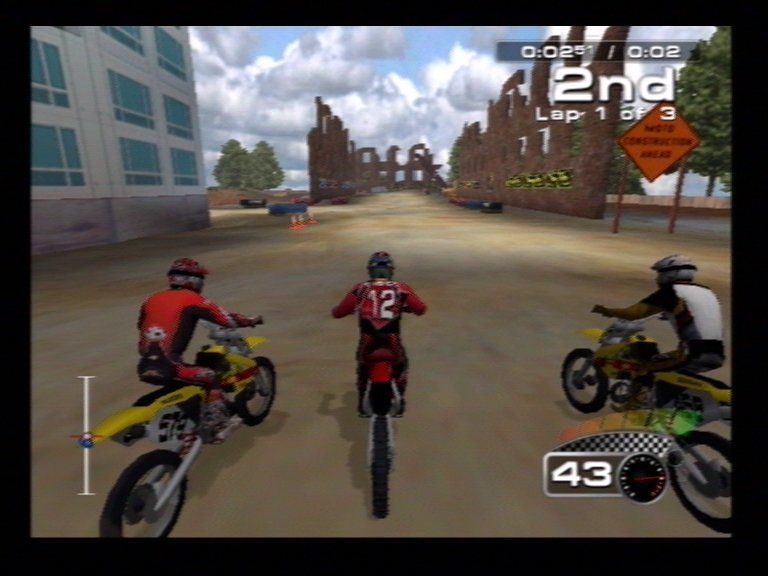
For a title released in 2002, MX 2002 featuring Ricky Carmichael still holds up impressively in its portrayal of rugged off-road environments. Tracks boast varied textures—from sandy washes and rocky hillsides to wet, mud-splattered loops—that dynamically respond to tire treads. Watching your rear wheel carve deep ruts into a soft corner surface creates a satisfying level of visual feedback, reinforcing the sense that you’re tackling unpredictable terrain.
Rider and bike models are well-detailed, capturing the iconic look of Ricky Carmichael’s signature gear and colors. Animations flow smoothly, be it the subtle lean through bermed turns or the exaggerated flair of a high-flying backflip. When you hit a bump or misjudge a jump, the bike reacts with realistic suspension compressions and occasional tumbles, heightening the stakes of every landing.
The game’s lighting and environmental effects, though dated by today’s standards, still contribute to the immersive atmosphere. Sun-drenched midday races present dazzling glare across the track, while evening stunts under artificial arena lights bring a palpable energy to the crowd sequences. Occasional frame rate dips can occur in split-screen multiplayer, but the single-player experience remains stable and visually coherent.
Overall, MX 2002’s graphical presentation strikes a fine balance between arcade excitement and off-road authenticity. Textures are crisp enough to identify hazards at a glance, and environmental details—such as crowd barriers, pit areas, and sponsor banners—add context and vibrancy. While modern titles may outshine it in resolution and polygon count, this game’s aesthetic still conveys the adrenaline-fueled world of professional motocross.
Story
As a sports-based title, MX 2002 doesn’t feature a traditional narrative with cutscenes or branching dialogue—rather, it tells its story through progression and achievement. You assume the role of an aspiring motocross rider under the tutelage (or mere endorsement) of champion Ricky Carmichael, aiming to climb the ranks from local qualifiers to championship events. Your tale unfolds in the form of unlocked circuits, upgraded gear, and post-race podium celebrations.
Season mode serves as the backbone of the game’s informal storyline. Each race weekend poses a series of challenges—qualification, main event, and points accumulation—that push you to refine your skill set. With each victory, you earn not only bragging rights but also in-game currency to purchase better bikes and components, charting your rise from rookie to contender. This sense of growth and progression crafts a satisfying “underdog-to-champion” arc without a single voiceover line.
The stunt arena mode introduces a different narrative flavor: the pursuit of crowd acclaim. Here, you’re not just racing; you’re performing for an audience, feeding off the cheers and jeers of an energetic stadium. Building a highlight reel of tricks fosters a story of personal showmanship, challenging you to constantly elevate your repertoire. Although the game stops short of scripted cutscenes, the evolving environment—crowd reactions, scoreboard updates, and leaderboard rivalries—provides a subtle but engaging storyline of its own.
While players seeking a cinematic storyline might find the plot minimal, MX 2002’s approach feels appropriate for a pure sports simulation. The game’s narrative emerges organically through your on-track exploits and trick performances. If you relish the idea of crafting your own motocross journey—rising through the ranks, mastering techniques, and claiming glory—this title delivers a compelling framework to tell that player-driven story.
Overall Experience
MX 2002 featuring Ricky Carmichael excels as both a realistic motocross simulator and an arcade-style stunt platform. Its dual-mode structure ensures that casual hobbyists and dedicated racers alike will find something to enjoy. The racing component offers depth through clutch management and realistic physics, while the stunt arenas deliver high-octane spectacle perfect for short bursts of adrenaline-fueled fun.
The learning curve can be demanding, especially for newcomers unaccustomed to manual clutch control. However, mastering the interplay between throttle, clutch, and “Prime Jump” timing becomes deeply rewarding. Once you’ve internalized these mechanics, the game’s true potential shines through: fluid, lightning-fast laps punctuated by jaw-dropping aerial maneuvers.
Graphically and technically, MX 2002 may show its age compared to modern motocross titles, yet its core gameplay remains robust. Track designs are varied and well-balanced, rider animations are convincing, and the audio mix of revving engines and roaring crowds adds to the immersive feel. Any minor frame rate hiccups in split-screen are easily forgiven given the sheer replay value on offer.
In sum, MX 2002 featuring Ricky Carmichael stands as a landmark motocross title that still resonates with off-road racing fans. Its combination of skill-based racing, high-flying stunt challenges, and a gratifying progression system make it a worthy addition to any sports gamer’s collection. Whether you’re vying for first place in a muddy championship race or amassing trick combos in a packed arena, this game promises hours of dirt-slinging excitement.


Reviews
There are no reviews yet.