 Retro Replay Retro Replay gaming reviews, news, emulation, geek stuff and more!



Retro Replay Review
Gameplay
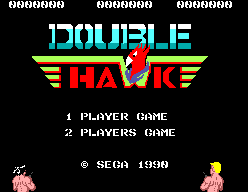
Double Hawk drops you straight into the action with two selectable difficulty settings: Easy and Difficult. From the moment you pick your challenge, you’re immersed in a fast-paced shooting experience reminiscent of classic arcade titles like Cabal. You control one of two hardened veterans, John Jackson or Jack Thomas, each armed with a standard rifle that can be upgraded through power-ups scattered across the battlefield. The core loop is simple yet addictive: eliminate all enemies before the countdown meter runs dry, then move on to the next wave.
(HEY YOU!! We hope you enjoy! We try not to run ads. So basically, this is a very expensive hobby running this site. Please consider joining us for updates, forums, and more. Network w/ us to make some cash or friends while retro gaming, and you can win some free retro games for posting. Okay, carry on 👍)
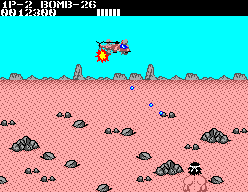
Each level is a gauntlet of enemy soldiers, armored tanks, buzzing choppers, and even underwater snorkelers lurking just off-screen. The variety keeps your reflexes sharp as you dodge incoming fire, sprint behind cover, and blast foes with everything from rapid-fire rifles to devastating bombs. The pacing never slows. You’ll find yourself juggling offense and defense, timing evasive rolls to avoid explosions, and hunting down the next upgrade drop before your ammo runs low.
The five missions, each containing four distinct levels plus a boss encounter, showcase how Double Hawk balances thematic variety with escalating challenge. You’ll start in dense jungles, advance through scorched wastelands, weave past village outposts, clear a seaside fortification, and finally assault a snow-capped mountain stronghold. At every turn, meter timers and enemy spawn patterns force you to make split-second decisions: press forward aggressively to rack up points or hang back and preserve your health bar. This tension is the heart of Double Hawk’s enduring allure.
Graphics
For an early 1990s arcade-style shooter, Double Hawk’s visuals hold up remarkably well. The sprite work is crisply defined, with detailed soldier animations and realistically shaded tanks that convey a sense of weight on screen. Environments are rich in color—lush greens in the jungle, rusty browns in the wasteland, and crisp blues along the seashore—each palette evoking the mood of the mission setting.
Background layers scroll at varying speeds to create a pseudo-3D effect, making you feel like you’re truly advancing deeper into enemy territory. Explosions bloom in bright oranges and yellows, and screen-shaking effects punctuate each boss defeat, heightening the drama of these climactic battles. The power-up icons themselves are designed with clear silhouettes—bombs, machine guns, and rapid-fire modules stand out so you never miss a chance to boost your arsenal.
Though not as graphically ambitious as later generation shooters, Double Hawk delivers consistent performance with little slowdown even when the screen is flooded with bullets and debris. The game’s art style leans into its military theme without veering into cartoonish territory, striking a balance that feels suitably gritty while remaining accessible and unambiguous.
Story
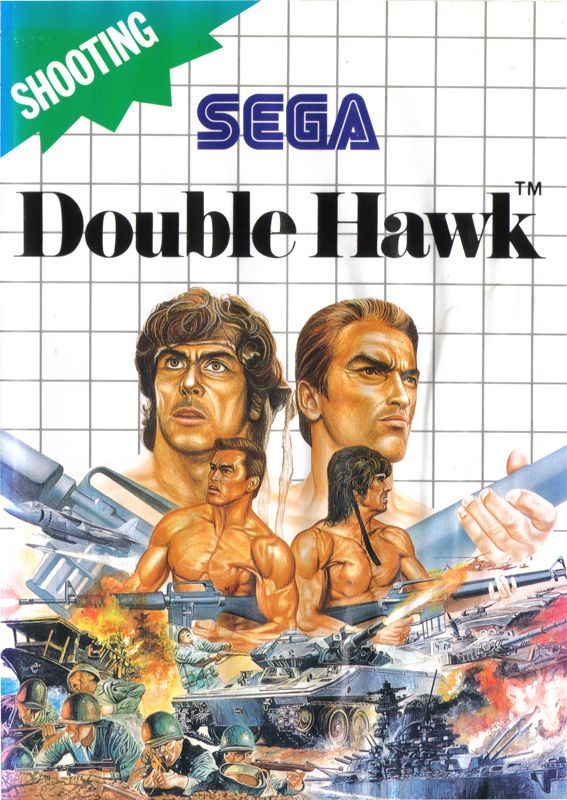
At its core, Double Hawk presents a straightforward narrative: an international terrorist syndicate is wreaking havoc worldwide, and the United Nations has dispatched John Jackson and Jack Thomas to put an end to the carnage. The story unfolds primarily through brief mission intros and stage names, echoing the streamlined storytelling of classic arcade titles. It’s nothing groundbreaking, but it supplies enough context to keep players invested in the fight.
Character backstories are minimal, but that’s part of the charm—these are taciturn heroes who let their weapons do the talking. Mission briefings paint vivid mental pictures: dense jungle ambushes, desert ruins held by fanatical soldiers, and a final stronghold perched atop a remote mountain. Each locale feels like a chapter in a globe-trotting manhunt against an elusive enemy organization built on fear and violence.
Double Hawk’s narrative strength lies in its immediacy. You don’t spend time listening to lengthy cutscenes or reading walls of text—every moment is action-packed, and you’re propelled forward by a sense of urgency. While the plot may be conventional, it serves as a solid framework that supports the blistering arcade gameplay without unnecessary distractions.
Overall Experience
Double Hawk offers a distilled, high-octane shooting experience that appeals to both nostalgia hunters and newcomers seeking old-school arcade thrills. Its straightforward premise, tight controls, and relentless pacing combine to create an instantly engaging title that’s easy to pick up yet hard to master. The dual difficulty modes ensure that casual players can enjoy the spectacle while hardcore fans chase a perfect run on Difficult mode.
The level design strikes a satisfying balance between repetition and variety. Though the objective—wipe out foes before the meter expires—never changes, the shifting environments and evolving enemy types keep each mission feeling fresh. Boss encounters provide welcome spikes in intensity, demanding pattern memorization and precision shooting to overcome.
While it may lack the narrative depth or graphical polish of modern shooters, Double Hawk’s strengths lie in its purity of design and uncompromising focus on action. If you’re drawn to arcade-style combat, crave responsive controls, and appreciate a challenge that scales from casual enjoyment to hardcore domination, Double Hawk remains a worthy addition to your collection.



Reviews
There are no reviews yet.